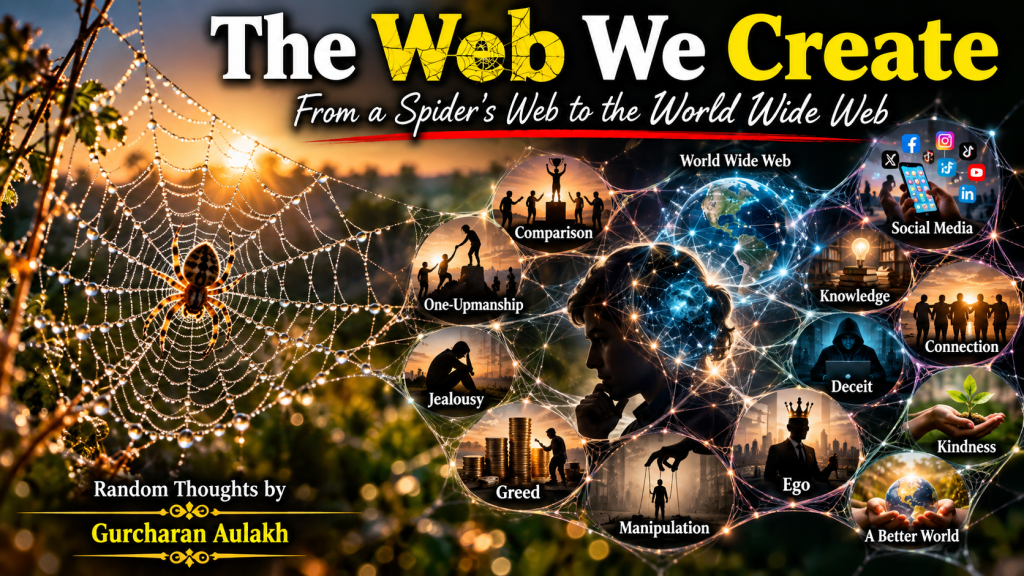
The Web We Weave
From a Spider’s Web to the World Wide Web — What Kind of Connections Are We Creating?
In a green field, a cobweb can be an extraordinary sight.
At first, it is almost invisible. But when the early morning sunlight falls upon it, thousands of tiny silken threads suddenly appear—delicate, symmetrical and beautifully woven. It looks less like a trap and more like a work of art.
Yet the beautiful web has a purpose.
It is a trap.
The spider waits patiently. An unsuspecting insect touches one of the threads, becomes entangled, struggles—and the beautiful creation becomes an instrument of survival.
Looking at such a web recently, I began wondering:
Are we, human beings, also weaving cobwebs around ourselves and others?
Our threads are not made of silk.
They are made of ambition, comparison, jealousy, greed, ego, manipulation, insecurity and deceit.
And unlike the spider, we have a choice about what kind of web we create.
⸻
The Web of Comparison
Perhaps one of the first webs we learn to weave is comparison.
Who is more successful?
Who earns more?
Whose house is bigger?
Whose children are more accomplished?
Who drives the better car?
Who travels more?
Who looks younger?
Who has more followers?
Comparison can be useful when it inspires us to improve ourselves. But when it becomes a measure of our worth, it becomes dangerous.
If we think we are ahead, we develop pride.
If we think someone else is ahead, we develop jealousy.
And the race continues.
Sometimes we don’t merely want to be successful.
We want to be more successful than somebody else.
That is another thread in the cobweb.
⸻
The Web of One-Upmanship
Comparison can easily become one-upmanship.
Someone tells us about a wonderful holiday.
We immediately mention an even better one.
Someone buys a new car.
We talk about the car we are planning to buy.
Someone tells us about a child’s achievement.
We mention what our child has achieved.
Someone says they walked five kilometres.
We have walked ten.
The conversation slowly stops being a conversation.
It becomes a competition.
We are no longer listening.
We are preparing our next response.
Every achievement becomes a measuring scale.
And without realising it, we can turn friendship into competition.
⸻
The Web of Jealousy
Jealousy is a much finer and more invisible thread.
A colleague receives recognition.
A friend becomes successful.
Someone younger achieves something we could not.
Someone else’s relationship appears happier.
Someone else’s life seems easier.
Instead of simply appreciating their happiness, a little voice inside us may whisper:
“Why them and not me?”
We begin looking for an explanation.
“They were lucky.”
“They had connections.”
“It won’t last.”
Why does another person’s success sometimes disturb our peace?
Because their success can unintentionally remind us of what we believe is missing in our own lives.
But jealousy does not diminish another person’s achievement.
It diminishes our own peace.
⸻
The Web of Greed
Ambition is not necessarily bad.
The desire to improve, create, achieve and provide for ourselves and our families can be a powerful force for good.
The problem begins when enough disappears from our vocabulary.
More money.
More possessions.
More recognition.
More influence.
More power.
More attention.
And after every achievement comes another target.
The finish line keeps moving.
We can spend our lives collecting things without ever stopping to ask:
“What is it that I actually need?”
The spider creates its web to survive.
We sometimes create enormous webs long after survival has ceased to be the issue.
⸻
The Web of Manipulation
Another thread is manipulation.
We praise someone because we need something from them.
We maintain a relationship because it is useful.
We offer help expecting something in return.
We tell someone what they want to hear rather than what they need to hear.
We carefully calculate our words.
From outside, the relationship may look perfectly normal.
But underneath it lies a network of invisible threads.
Trust slowly disappears when every interaction carries an ulterior motive.
And eventually, the person who created the web may become trapped inside it.
Because manipulation requires more manipulation.
One deception needs another explanation.
One lie needs another lie to protect it.
The web keeps growing.
⸻
The Web of Ego
Perhaps the strongest thread of all is ego.
“I am right.”
“I know better.”
“I deserve more.”
“Why should I apologise?”
“Why should I take the first step?”
Ego can turn a small disagreement into a battle.
A misunderstanding becomes an argument.
The argument becomes a contest.
And eventually both people may remember the victory they wanted—but forget the relationship they were trying to protect.
Sometimes the most difficult sentence to say is also the most liberating:
“Perhaps I was wrong.”
Ego does not like those words.
Wisdom does.
⸻
And Then We Created the World Wide Web
There is another web that deserves our attention.
The World Wide Web — WWW.
Perhaps it is the greatest web humanity has ever woven.
What began as a remarkable way of connecting information has transformed the world.
Today, a message can travel across continents in seconds.
Knowledge that once required a library can be accessed almost instantly.
A teacher can reach students thousands of kilometres away.
A small business can find customers across the world.
An artist can share a song without a record company.
A writer can publish an idea without a printing press.
A person sitting alone can communicate with another person on the other side of the planet.
The reach of this web is extraordinary.
And, like the spider’s web, it can be both beautiful and dangerous.
⸻
The Social Web
Social media has added another layer to the digital web.
We reconnect with old friends.
We discover ideas.
We share photographs, music, knowledge and experiences.
We form communities around interests that may have nothing to do with geography.
A person with a meaningful message can reach thousands—or millions.
That is a remarkable achievement of human connectivity.
But the same web has its nuisances.
We compare our ordinary lives with carefully selected versions of other people’s lives.
We chase likes and followers.
We become dependent on attention.
We sometimes confuse popularity with importance.
And we may forward information without asking a simple question:
“Is this true?”
A web designed to connect us can sometimes leave us more divided than connected.
⸻
The Digital Spider
There are spiders on this web too.
Not eight-legged spiders.
They are algorithms, advertisers, scammers, manipulators and people who understand how to capture our attention.
A sensational headline catches us.
A provocative photograph catches us.
A false promise catches us.
A scam message catches us.
A carefully constructed piece of misinformation catches us.
We click.
We react.
We share.
And another thread catches us.
Sometimes we do not even realise that we are the prey.
⸻
The Web of Truth and Deceit
The digital world has given humanity something extraordinary:
An abundance of information.
But an abundance of information does not automatically mean an abundance of truth.
False information can travel extremely fast.
Manipulated photographs and videos can make fiction appear real.
Artificial intelligence can create remarkably convincing images, voices and videos.
Fake identities can appear authentic.
And a confident presentation can sometimes make an untruth sound like a fact.
The answer is not to reject the digital world.
That would be like rejecting the printing press because books can contain lies.
The answer is discernment.
Pause.
Question.
Verify.
Think.
Then decide.
Perhaps one of the most important skills in the digital age is not simply knowing how to connect—
but knowing what to trust.
⸻
The Web Can Also Be Beautiful
It would be unfair to see the web only as a trap.
The same technology that spreads misinformation can spread knowledge.
The same social media that creates envy can create friendship.
The same internet that enables scams can help expose them.
The same digital platform that promotes superficiality can give a voice to someone who would otherwise never be heard.
A doctor can educate.
A teacher can teach.
An artist can create.
A student can learn.
A volunteer can mobilise help.
A family separated by continents can remain connected.
The web itself is not the villain.
It is a tool.
Its value depends largely upon how we use it.
⸻
From Spider Web to Human Web
There is an interesting parallel.
The spider’s web catches insects.
The digital web catches information, attention, money and influence.
The spider waits patiently for its prey.
The digital world competes patiently for our attention.
The spider’s web is made of silk.
Our human webs are made of relationships, information, ambition, influence and connection.
But there is one crucial difference.
The spider has no choice about the nature of its web.
We do.
We can use our personal relationships to manipulate—or support.
We can use technology to deceive—or educate.
We can use influence to exploit—or inspire.
We can use social media to divide—or connect.
We can use our success to make others feel small—or to help them rise.
⸻
The Web of Kindness
There is another kind of web we can weave.
A harsh word replaced with patience.
A criticism replaced with encouragement.
Jealousy replaced with appreciation.
Self-interest replaced with generosity.
Suspicion replaced with trust.
Indifference replaced with empathy.
These may appear to be small acts.
But relationships are built from small acts.
A marriage becomes strong through countless little gestures.
A friendship survives through understanding and forgiveness.
A community becomes humane when people notice one another.
A society becomes stronger when people help without constantly asking:
“What’s in it for me?”
One thread touches another.
Another touches another.
And gradually, a beautiful network emerges.
⸻
The Web of Human Connection
Think about the people who have helped us during difficult moments.
Sometimes it was family.
Sometimes a friend.
Sometimes a colleague.
And sometimes, unexpectedly, a complete stranger.
A small act of kindness can travel much farther than we realise.
Someone helps us.
We remember it.
Years later, we help someone else.
That person helps another.
The original act may eventually be forgotten, but its thread continues.
This is perhaps the most beautiful cobweb human beings can weave.
A network where kindness travels from one person to another.
⸻
What Kind of Web Are We Weaving?
This is perhaps the real question raised by my little observation of a spider’s web.
Every day, knowingly or unknowingly, we weave.
Around our ambitions.
Around our relationships.
Around our careers.
Around our possessions.
Around our identities.
Around our digital lives.
And sometimes, around our own minds.
The question is not whether we will have a web.
We will.
The question is:
What will our threads be made of?
Comparison?
Jealousy?
Greed?
One-upmanship?
Manipulation?
Ego?
Deceit?
Or—
Love.
Kindness.
Empathy.
Trust.
Compassion.
Contentment.
⸻
The Beautiful Web of Life
Imagine if each of us consciously added one good thread every day.
One act of kindness.
One word of encouragement.
One moment of patience.
One act of forgiveness.
One relationship repaired.
One person helped.
One genuine compliment given without jealousy.
One success celebrated without feeling the need to compete.
One piece of information verified before forwarding it.
One person treated with dignity simply because they are human.
The individual acts may seem tiny.
But, like the spider’s delicate threads, they gradually connect.
And perhaps one morning, when the sunlight of time falls upon our lives, we will suddenly see what we have created.
Not a trap.
Not a prison.
Not a network of manipulation.
But a beautiful, intricate web of human connection.
A web strong enough to hold us when life becomes difficult.
⸻
The Thought Behind the Web
The spider weaves a web to trap.
We weave webs to live.
The World Wide Web connects us.
Our social webs influence us.
Our personal webs define many of our relationships.
But in every case, there is a choice.
We can weave threads of jealousy and competition—
or threads of love and compassion.
We can create webs that trap others—
or connections that hold one another.
Perhaps the real beauty of life is not in escaping the web.
It is in weaving a better one.
And when the light finally falls upon the web we have created, may it reveal something beautiful.
Not how much we possessed.
Not how many people we defeated.
Not how many people admired us.
But how many lives were made a little better because our thread touched theirs.
— Gurcharan Aulakh

