For the Sake of It — When a Ritual Becomes a Way of Life
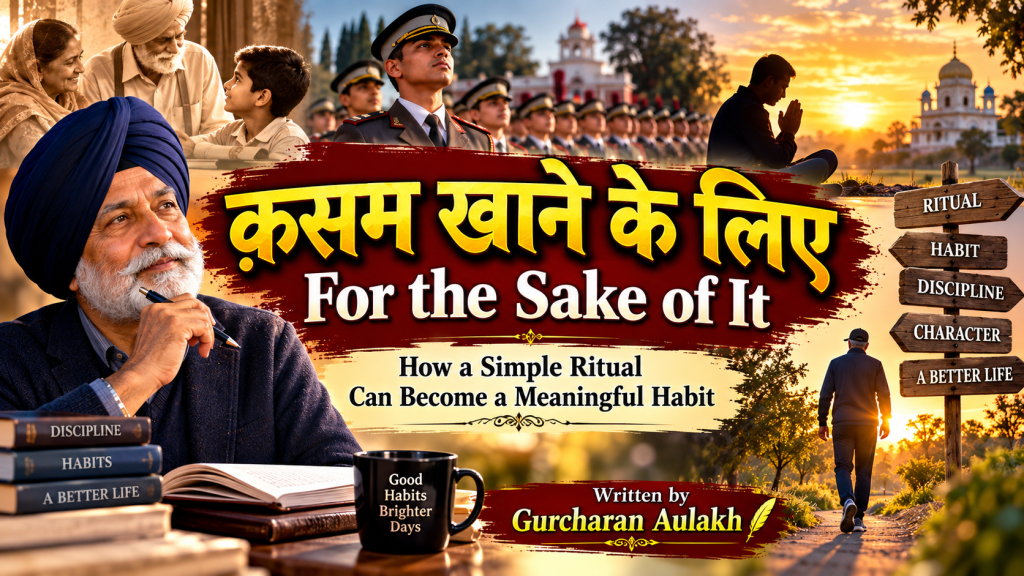
There are many things in life that we do not because we particularly want to do them, but because someone we respect has asked us to do them.
Sometimes it is our parents.
Sometimes our teachers.
Sometimes our elders.
Sometimes an institution.
Sometimes tradition.
And sometimes, quite simply, we do something “क़सम खाने के लिए” — just for the sake of doing it, just to fulfil an expectation, or just because that is how we have been taught.
At first, there may be no great conviction behind the action.
But repetition has a strange power.
What begins as an instruction can become a routine.
A routine can become a habit.
A habit can become discipline.
And discipline, over time, can become character.
I have experienced this transformation personally.
At Five in the Morning — Because My Parents Said So
I have never considered myself a natural early riser.
If I were completely free to choose, I might still enjoy a little extra sleep in the morning.
But my parents—God bless them, they are no longer with us—believed strongly in getting up early.
Their message was simple:
“Get up early. Start your day early.”
There was no elaborate philosophy attached to it.
They were my parents, and I respected them.
So I got up.
Perhaps initially I did it “क़सम खाने के लिए”—because they wanted me to.
Today, many years later, waking early has become almost automatic.
The external authority is gone.
My parents are no longer there to tell me what time to get up.
Yet I still get up early.
The instruction has disappeared.
The habit has remained.
Prayer — From Obedience to Meaning
I am not an intensely religious person.
Yet my parents advised me to pray in the morning and again in the evening.
So I did.
Perhaps, in the beginning, I prayed more out of deference to them than from a deeply developed personal conviction.
They believed in prayer.
They wanted their children to remember God.
I respected their wishes.
And so the practice continued.
But somewhere along the way, something changed.
Prayer became more than something I was expected to do.
It became a pause in the day.
A moment to become quiet.
A moment to reflect.
A moment to acknowledge that there are things beyond my control and perhaps something larger than myself.
The ritual had acquired meaning.
The reason for doing it had changed, although the practice remained.
Then Came the Army
My understanding of discipline, however, was shaped most profoundly by my military life.
I was 16 years old when I entered the life of an officer cadet.
At that age, discipline is not something you necessarily understand intellectually.
You experience it.
You live it.
You are told when to wake up.
When to fall in.
How to dress.
How to march.
How to speak.
How to maintain your surroundings.
How to be punctual.
How to perform a task correctly even when you don’t feel like doing it.
There are inspections.
There are timings.
There are standards.
And there are consequences for not meeting them.
At sixteen, you don’t necessarily wake up before dawn because you have discovered the philosophy of discipline.
You wake up because you are required to.
Perhaps that is the beginning.
The Officer Cadet Learns to Obey
An officer cadet gradually learns something very important:
You cannot always wait for motivation.
There will be days when you are tired.
There will be days when the weather is unpleasant.
There will be days when you don’t feel like doing what is required.
But the task still has to be done.
Punctuality cannot depend upon your mood.
Dress cannot depend upon your mood.
Responsibility cannot depend upon your mood.
Discipline begins when “I don’t feel like it” stops being an acceptable reason.
And repeated often enough, this becomes internalised.
The person begins to regulate himself.
That was one of the greatest lessons of my military life.
Thirty-Eight Years of Reinforcement
From those early days as an officer cadet, discipline continued to be reinforced throughout my 38 years of service.
Military life provided an external framework.
There were appointments to keep.
Orders to execute.
People depending upon you.
Responsibilities that could not simply be postponed because you were not in the mood.
Over the years, punctuality, personal discipline, orderliness, physical activity, responsibility and adherence to routine stopped feeling like imposed rules.
They became normal behaviour.
The external structure was doing its job.
But something much more important was happening inside me.
The external discipline was becoming internal discipline.
And Then I Retired
Here is the interesting part.
I have now been living a retired life for about 17 years.
There is no commanding officer standing over me.
Nobody is going to inspect my room.
Nobody is going to ask me why I woke up late.
Nobody is going to punish me for being five minutes late.
There is no parade.
There is no military appointment book.
There is no external authority enforcing my daily routine.
And yet—
my discipline today is perhaps even more ingrained than it was during my service.
Why?
Because the external factor disappeared.
But the habit remained.
In fact, without the external pressure, the habit became even more clearly my own.
I don’t get up early because somebody orders me to.
I do it because that is how I have trained myself to live.
I don’t maintain routines because somebody is watching.
I do it because somewhere along the way, the routine became part of me.
That, to me, is the real success of discipline.
When nobody is watching, and you still do what you have trained yourself to do.
The Arranged Marriage Example
Consider another area of life—marriage.
Suppose yours is an arranged marriage.
You enter the relationship because your families have brought two people together.
Your elders advise:
Respect your wife.
Take care of her.
Be patient.
Don’t argue over every little thing.
Stand beside her in difficult times.
At the beginning, these may sound like instructions.
You follow them because your parents taught you.
Because tradition expects it.
Because your elders believe it is the right way to conduct a marriage.
Perhaps initially, you are doing it “क़सम खाने के लिए.”
But years pass.
You begin to know each other.
You learn each other’s habits.
You understand the silences.
You share successes and failures.
You look after each other when one falls ill.
You celebrate together.
You disagree and then reconcile.
You grow older together.
And one day you realise:
You are no longer taking care of her because somebody told you to.
You are doing it because you genuinely care.
The instruction has disappeared.
The affection has remained.
What began as duty has developed into companionship.
Perhaps even love.
Breaking a Bad Habit Can Begin With a Small Step
The same principle can work in the opposite direction.
Suppose someone has developed a drinking habit.
Someone advises:
“Reduce it.”
The person may think:
“What difference will reducing it slightly make?”
But suppose he reduces his consumption even by one-tenth.
It may appear insignificant.
Yet that one small reduction is no longer zero.
Then another small reduction.
Then another.
Over time, the person may discover that what initially seemed impossible has become achievable.
The important lesson is not about one particular substance.
It is about behavioural change.
We often imagine that change must begin with a dramatic declaration:
“From tomorrow, everything will change!”
It doesn’t always happen that way.
Sometimes change begins with:
“Let me do just a little less today.”
And then repeat it tomorrow.
Tradition and the Power of Appearance
Indian traditions contain many examples of behaviour that begins as social discipline.
A young person might smoke or drink, but traditionally would avoid doing so in front of his parents.
Why?
Respect.
Family values.
Social expectations.
Perhaps even the desire to maintain an image.
Initially, the thought might simply be:
“I should not do this in front of my parents.”
But repeated restraint can sometimes influence behaviour beyond that particular setting.
What began as:
“I don’t do this in front of them”
can gradually become:
“I don’t do this.”
Of course, not every tradition deserves to be followed merely because it is old.
Tradition should be examined with reason.
But some traditions carry practical wisdom that becomes apparent only through repeated practice.
Yoga, Exercise and Meditation
Look at yoga.
Look at exercise.
Look at meditation.
Look at reading.
Look at writing.
None of these necessarily feels attractive every single day.
There are mornings when the bed looks far more inviting than a walking path.
There are evenings when meditation seems less interesting than television.
There are days when exercise feels like an unnecessary effort.
Yet if we continue—
something happens.
The body begins expecting movement.
The mind begins appreciating silence.
The routine begins creating its own reward.
Eventually, you don’t ask:
“Do I feel like doing it today?”
You simply do it.
The practice has become part of your life.
“I Don’t Feel Like It” Is Not Always a Good Guide
This is perhaps one of the most important lessons I have learned.
Our feelings change constantly.
Today we feel energetic.
Tomorrow we don’t.
Today we are motivated.
Tomorrow we are not.
Today we want to exercise.
Tomorrow we want to sleep.
If our actions are completely controlled by our momentary feelings, our lives can become inconsistent.
Discipline provides continuity.
It says:
Do what needs to be done—even when the mood isn’t there.
That doesn’t mean becoming rigid or joyless.
It means understanding that motivation is temporary, while habit can be dependable.
But Repetition Works Both Ways
There is also a warning here.
Repetition doesn’t automatically make something good.
It can strengthen bad habits too.
If we repeatedly postpone things, procrastination becomes easy.
If we repeatedly lose our temper, anger becomes familiar.
If we repeatedly complain, complaining becomes a way of thinking.
If we repeatedly make excuses, excuses become part of our behaviour.
So perhaps we should occasionally ask ourselves:
What am I practising every day?
Because every repeated action is teaching us something.
We may not realise it.
But we are training ourselves.
From External Discipline to Self-Discipline
Looking back at my own journey, I find the progression fascinating.
At sixteen, discipline was largely external.
Someone told me what to do.
During my military service, discipline became professional.
Responsibility demanded it.
After retirement, discipline became personal.
Nobody demands it.
Nobody monitors it.
Nobody rewards me for it.
Yet I continue.
That is perhaps the ultimate transformation:
External discipline → Internal discipline → Self-discipline
And perhaps this is what good training is supposed to accomplish.
The teacher eventually leaves.
The instructor eventually retires.
The parent eventually passes away.
The commanding officer is no longer there.
But the lesson remains.
“क़सम खाने के लिए” May Not Be Such a Bad Beginning
We sometimes dismiss actions performed merely as a routine.
“Why are you doing this?”
“Just because my parents told me.”
“Just because that’s how we have always done it.”
“Just because it is expected.”
“क़सम खाने के लिए.”
But perhaps we shouldn’t dismiss it too quickly.
Sometimes the body learns before the mind understands.
Sometimes behaviour comes before conviction.
Sometimes discipline comes before appreciation.
Sometimes duty comes before affection.
Sometimes ritual comes before meaning.
And sometimes, after enough time has passed, we discover that the thing we were initially doing for someone else has quietly become something we do for ourselves.
The Journey
Perhaps the journey can be expressed in seven simple steps:
Someone tells us.
↓
We do it reluctantly.
↓
We repeat it.
↓
It becomes routine.
↓
Routine becomes habit.
↓
Habit becomes discipline.
↓
Discipline becomes character.
And then something beautiful happens.
We no longer need anyone to tell us.
What My Parents Started, Life Reinforced
When I wake up early, I sometimes think of my parents.
They are no longer here to see it.
They cannot tell me anymore:
“Get up. It is morning.”
But perhaps, in a way, their voices remain.
The same is true of many things I learned during my military life.
The commands are gone.
The parade ground is gone.
The inspections are gone.
The external pressures are gone.
But the habits remain.
And after 17 years of retirement, they seem to have become even more deeply ingrained.
That tells me something.
Perhaps the greatest achievement of discipline is not that someone can make you do something.
It is that, eventually, you don’t need anyone to make you do it.
In the End…
Maybe we should not always wait to feel inspired before beginning something worthwhile.
Begin.
Even if it feels artificial.
Begin.
Even if someone else has encouraged you.
Begin.
Even if, initially, you are doing it merely out of respect.
Because you never know what repetition will do to you.
The morning prayer may eventually become contemplation.
The exercise may become a way of life.
The meditation may become inner quiet.
Punctuality may become respect for other people’s time.
Discipline may become self-respect.
Duty may become love.
And a simple instruction from a parent may remain with you for the rest of your life.
So, “क़सम खाने के लिए” may not necessarily mean meaningless.
Sometimes it simply means:
“I don’t understand its value yet—but I am willing to practise it.”
And perhaps that is enough.
Because sometimes…
we practise first,
we understand later,
and eventually,
we become what we practised.
Gurcharan Aulakh.

