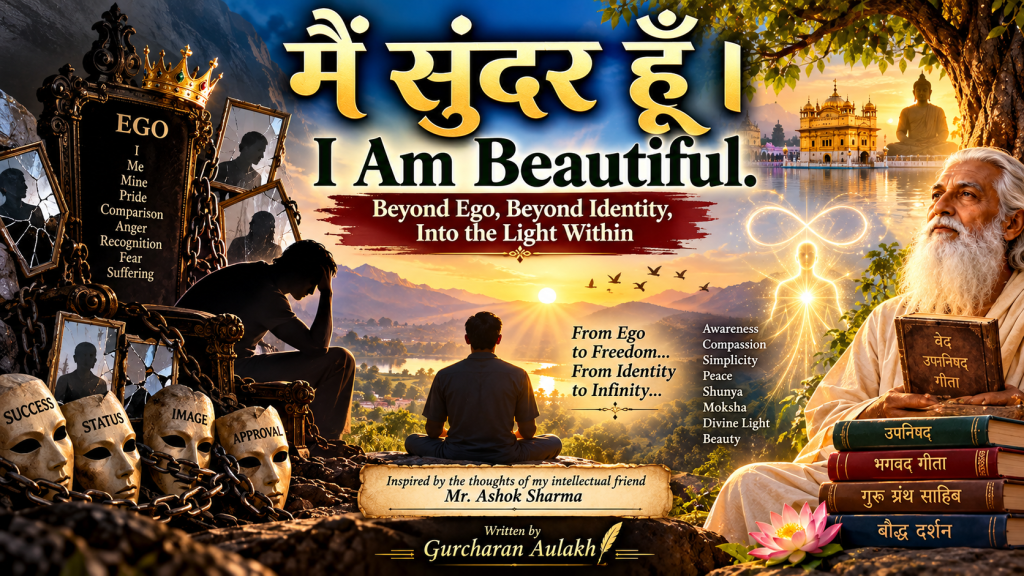
मैं सुंदर हूँ । I Am Beautiful
Beyond Ego, Beyond Identity, Into the Light Within
An article inspired by the thoughts of my intellectual friend Mr. Ashok Sharma, and further developed through my own reflections — Gurcharan Aulakh
⸻
There are some conversations that end when the words end.
And then there are conversations that continue inside us.
Some time ago, my intellectual friend Mr. Ashok Sharma shared his thoughts on ego. His reflections set me thinking: What exactly is this “I” that we protect, defend, glorify and sometimes suffer for?
His thoughts became the seed.
What follows is my own journey of reflection on that seed.
And it leads me to a rather unusual declaration:
मैं सुंदर हूँ ।
I Am Beautiful.
But please do not mistake these words for vanity.
The “मैं” in this sentence is not the ego that says, I am better than you.
It is something altogether different.
⸻
The Invisible Throne of Ego
We all carry an invisible throne within us.
Upon it sits the person we believe ourselves to be:
I am intelligent.
I am successful.
I am important.
I deserve respect.
I am right.
And once this image of “I” is constructed, we begin spending much of our lives protecting it.
Someone praises us—and the throne becomes higher.
Someone criticises us—and the throne begins to shake.
Someone ignores us—and we wonder why.
Someone takes credit for our work—and we feel betrayed.
Someone insults us—and the wound can remain for years.
But what exactly has been injured?
The body?
No.
The body may not even have been touched.
What has been wounded is an image of ourselves.
That is ego.
The child demonstrates this beautifully.
A child falls while playing, gets up, dusts himself and runs again.
An adult may fall in front of twenty people and remember the incident for twenty years.
The difference is not the fall.
It is the observer called “I.”
⸻
What Is Ego?
Ego is not simply confidence.
Confidence can say:
“I can do this.”
Ego says:
“I must prove that I can do this.”
Confidence can accept correction.
Ego feels attacked by correction.
Confidence performs.
Ego performs for an audience.
Confidence knows its worth.
Ego needs others to confirm its worth.
The ego therefore becomes a subtle prison.
We begin living not according to what we are, but according to what we think others think we are.
⸻
The Indian Question: Who Am I?
Indian philosophy has been asking this question for thousands of years:
Who am I?
Not:
What is my name?
What is my profession?
What is my social status?
What is my nationality?
But:
Who is the “I” behind all these identities?
The Upanishadic traditions explored the relationship between Ātman and Brahman, with some teachings identifying the deepest self with ultimate reality. The famous formulations associated with this tradition point beyond the ordinary personality toward a deeper dimension of being.
This is a radically different “I” from the ego.
The ego says:
“I possess.”
The deeper inquiry asks:
“Who is the possessor?”
The ego says:
“I am this body, this name, this position, this history.”
Spiritual inquiry asks:
“Who is the one witnessing all these changing identities?”
⸻
Krishna’s Beautiful Definition of Inner Freedom
The Bhagavad Gita offers a profound description of the person who has moved beyond the restless demands of the mind.
In Chapter 2, verse 55, Krishna describes the sthita-prajña—the person of steady wisdom—as one who relinquishes the desires occupying the mind and finds satisfaction in the Self.
The movement is therefore inward.
Not:
“Give me more, so that I can become complete.”
But:
“Let me discover the completeness that does not depend upon more.”
That is a very different way of living.
⸻
Sikhism Calls It Haumai
The Sikh tradition gives this problem a particularly beautiful name:
ਹਉਮੈ — Haumai
It is often translated as ego, egotism or self-centredness, though scholars have noted that these English words do not completely capture its meaning. One useful rendering is “I-am-ness.”
The problem is not merely saying “I.”
The problem is becoming imprisoned by “I am me”—the belief that the world revolves around this separate, permanent identity.
Gurbani repeatedly connects haumai with bondage and spiritual darkness.
Thus the spiritual journey is not necessarily the destruction of the individual personality.
It is the loosening of its claim:
“Everything is about me.”
⸻
And Then Comes Buddhism
Here we encounter an interesting philosophical contrast.
Buddhist thought develops the doctrine of anattā, commonly translated as “not-self.” It questions the idea that there is a permanent, independent and unchanging self behind our changing physical and psychological processes.
This is important because Buddhism and Vedantic traditions do not say exactly the same thing.
Some Upanishadic traditions speak of Ātman as ultimate reality.
Buddhism challenges the very notion of an enduring substantive self.
Yet, despite their philosophical differences, both traditions offer a powerful challenge to our ordinary attachment to the egoic “I.”
And that is where my reflection begins to become personal.
⸻
Shunya — The Beautiful Emptiness
I have often wondered:
What happens when the ego disappears?
Perhaps what remains is Shunya.
But here I must make an important distinction.
Mathematically, division by zero is undefined; it does not produce infinity.
My use of “zero” is therefore metaphorical, not mathematical.
Spiritually, I use Shunya to suggest the emptying of the false centre—the emptying of the ego’s claim to ownership, superiority and separateness.
Mahāyāna Buddhist philosophy uses śūnyatā in a more precise sense: things are empty of independent, inherent self-nature and arise through interdependence. It is not simply “nothingness.”
And this distinction is beautiful.
When the false centre becomes empty, life does not necessarily become empty.
It becomes fuller.
⸻
The Paradox
This is where my own thought takes another step.
Perhaps the purpose of shedding ego is not to become nothing.
Perhaps it is to become transparent.
When the ego becomes quiet, something else becomes visible.
Compassion.
Love.
Humility.
Awareness.
Wonder.
Beauty.
The need to prove oneself diminishes.
The need to possess diminishes.
The need to be applauded diminishes.
And gradually, one begins to experience life without constantly placing oneself at its centre.
⸻
Then Who Says: “मैं सुंदर हूँ”?
Here comes my proposition.
When I say:
मैं सुंदर हूँ ।
I Am Beautiful.
I am not saying:
I, Gurcharan, am more beautiful than somebody else.
That would simply be another form of ego.
Nor am I referring merely to physical beauty.
The “मैं” in this sentence is the deeper inner presence—the soul, consciousness, or divine light, depending upon the philosophical language one chooses.
It is the part of us that does not need comparison.
It does not ask:
“Am I more beautiful than you?”
It simply experiences:
“I am.”
And perhaps that existence itself is beautiful.
⸻
Beauty After Ego
Imagine a mirror covered with dust.
The mirror has not lost its capacity to reflect.
It has merely become obscured.
The dust is our accumulated:
I, me, mine.
My achievement.
My reputation.
My insult.
My possession.
My status.
My opinion.
My victory.
My defeat.
When the dust is removed, the mirror does not become beautiful because someone painted beauty upon it.
Its ability to reflect was already there.
Perhaps spiritual awakening is something similar.
We do not manufacture the divine.
We remove what prevents us from seeing.
⸻
From “I” to “We” to “One”
The journey may therefore look something like this:
I am important.
↓
I am one among many.
↓
I am connected with many.
↓
The boundary between myself and others becomes less rigid.
↓
The ego loses its throne.
↓
Awareness remains.
↓
Love remains.
↓
Beauty remains.
And then perhaps the ancient question—
“Who am I?”
—no longer demands a verbal answer.
⸻
My Friend’s Thought Became My Inquiry
This is why I wish to acknowledge Mr. Ashok Sharma at the heart of this article.
The initial spark came from his reflections on ego.
I have taken that spark into my own philosophical and spiritual journey, placing it alongside ideas from the Upanishadic tradition, the Bhagavad Gita, Sikh thought and Buddhist philosophy.
I do not claim that these traditions are saying identical things.
They are not.
Their concepts of self, soul, consciousness, emptiness and liberation differ significantly.
But they can all become companions in a human inquiry:
What happens when we stop making the ego the centre of existence?
⸻
The Final Thought
Perhaps Moksha is not merely going somewhere after death.
Perhaps, at one level, it begins here.
In this moment.
When the burden of proving “I am somebody” becomes unnecessary.
When praise does not inflate us.
When criticism does not destroy us.
When possession does not define us.
When comparison loses its grip.
When the little “I” becomes quiet enough for the larger mystery of existence to be heard.
And then—
perhaps—
we discover something astonishing.
We thought that by losing the ego, we would lose ourselves.
Instead, we may discover the self we had never truly seen.
And that is why I dare to say:
मैं सुंदर हूँ।
I Am Beautiful.
Not because I am better than anyone else.
Not because my ego has won.
But because, when ego becomes silent, the light within does not need to boast.
It simply shines.
Perhaps beauty is what remains when the one who wanted to possess it disappears.
⸻
With gratitude
Initial thought on Ego:
Mr. Ashok Sharma — my intellectual friend
Further reflection and articulation:
Gurcharan Aulakh
(This article is a personal philosophical reflection, bringing together ideas from different traditions. It is not intended to present them as one identical doctrine.
Stanford Encyclopedia of Philosophy — Mind in Indian Buddhist Philosophy
Internet Encyclopedia of Philosophy — Upanisads
Gita Supersite — Bhagavad Gita 2.55)

