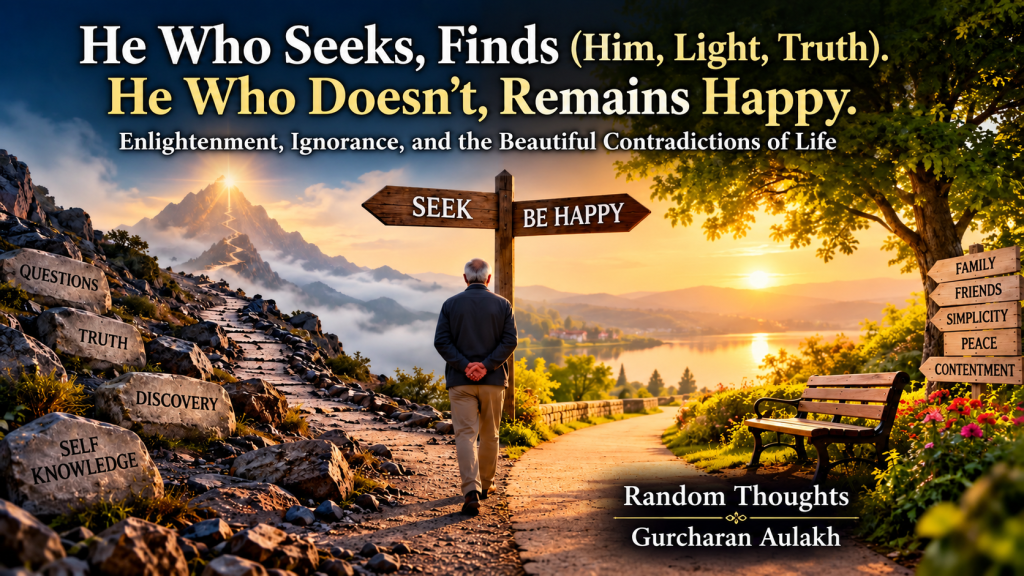
He Who Seeks, Finds (Him, Light, Truth). He Who Doesn’t, Remains Happy.
(Enlightenment, Ignorance, and the Beautiful Contradictions of Life)
1. A Thought on a Morning Walk
During my morning walk, a random thought struck me. It arrived without invitation, as thoughts often do, and then refused to leave me alone.
He who seeks, finds (Him, Light, Truth). He who doesn’t, remains happy. What would you choose?
At first glance, the proposition appears simple. One person embarks upon a journey in search of something beyond the ordinary—the ultimate truth, the meaning of existence, the mystery of God, or perhaps the understanding of one’s own self.
The other person carries on with life as it comes. He fulfils his responsibilities, enjoys his relationships, celebrates his successes, accepts his failures, and sleeps peacefully without feeling compelled to solve the mysteries of the universe.
One seeks answers. The other enjoys the questions he never asks.
One risks disturbing his peace in pursuit of enlightenment. The other may preserve his happiness by remaining comfortably unaware of what lies beyond his immediate experience.
But is the seeker necessarily wiser? Is the non-seeker necessarily ignorant? And is the happiness of the latter worth more, or less, than the truth sought by the former?
I confess that I am equally lost between these alternatives.
Perhaps that is precisely what makes this thought so intriguing.
2. The Restlessness of the Seeker
Human beings are curious creatures. We do not merely live; we want to know why we live. We do not merely experience happiness and sorrow; we want to understand their causes. We do not merely witness the universe; we wonder who created it, whether it has a purpose, and what our place in it might be.
Some seek God. Others seek scientific truth. Some turn to sacred scriptures, philosophy, meditation, or the teachings of spiritual masters. Others look inward, hoping to discover the person hidden beneath layers of identity, ambition, fear, and ego.
The search can be exhilarating. It can broaden our understanding, deepen our compassion, and free us from superficial assumptions.
But it can also be exhausting.
Every answer seems to open another door. Every discovery reveals another mystery. The more we learn, the more clearly we recognise the limits of our knowledge.
A person who once accepted the world as straightforward may discover its bewildering complexity. Someone who once lived comfortably within inherited beliefs may begin questioning them. Familiar certainties may crumble before new questions, while the answers remain elusive.
Is this progress or punishment?
Perhaps both.
The search for truth does not always bring immediate peace. Sometimes, it first destroys the peace that unquestioning belief or comfortable ignorance had provided.
But then arises another question: is a comfortable illusion preferable to an uncomfortable truth?
Our dilemma has begun.
3. The Happiness of Not Seeking
Imagine two people watching the same sunset.
The first admires the changing colours of the sky, feels the evening breeze, and experiences a quiet sense of gratitude. He is not contemplating the origin of the universe, the impermanence of existence, or the mystery of consciousness. He is simply enjoying the moment.
The second watches the same sunset and begins thinking about the vastness of the cosmos, the insignificance of human existence, the passage of time, and the inevitability of death.
Both witness the same beauty. Yet their minds travel in different directions.
Who is happier?
Perhaps the first. Perhaps the second. We cannot know merely by observing their thoughts.
The first may possess the gift of living fully in the present. The second may experience a deeper wonder at the immensity of existence.
And what if the first person is a compassionate, thoughtful human being who has never felt the need to investigate metaphysical questions? Would we call him ignorant merely because he does not seek enlightenment?
Certainly not.
A person may possess practical wisdom, emotional maturity, kindness, and a profound understanding of human relationships without ever attempting to unravel the mysteries of existence.
Conversely, a person may read volumes of philosophy, quote sacred texts, and discuss enlightenment endlessly, yet remain impatient, arrogant, or unkind.
The distinction, therefore, is not simply between the seeker and the non-seeker.
It is between understanding and mere accumulation of knowledge, between genuine contentment and the avoidance of uncomfortable truths.
Perhaps the person who does not seek is not missing happiness at all. Perhaps he has discovered a form of contentment that the seeker is still struggling to attain.
4. Is Ignorance Bliss?
The expression “Ignorance is bliss” captures one side of our paradox.
There are truths that can disturb us. Awareness of injustice can rob us of complacency. Recognition of our own shortcomings can bruise our pride. Understanding the impermanence of everything we love can awaken fears we had never previously confronted.
Sometimes, not knowing protects us from pain.
But ignorance has another side.
A person who ignores a problem does not necessarily eliminate it. Someone who refuses to acknowledge his mistakes may preserve his self-image while damaging his relationships. A society that avoids difficult questions may remain superficially peaceful while injustice continues beneath the surface.
Ignorance can protect our comfort, but it can also make us vulnerable.
We must distinguish between two kinds of not knowing.
The first is the freedom to live without needing an explanation for everything.
The second is the refusal to face a truth because it threatens our comfort, pride, or interests.
The first can be liberating. The second can become a prison.
Similarly, knowledge can liberate us, but it can also burden us when the desire to know becomes an obsession.
The real challenge is not to know everything or to remain ignorant of everything. It is to recognise which truths deserve our attention, which uncertainties we must learn to live with, and which questions may remain unanswered without diminishing the quality of our lives.
5. What Exactly Are We Seeking?
When we say that the seeker finds (Him, Light, Truth), what do we mean?
The beauty of the statement lies in its ambiguity.
For one reader, Him may mean God—the Creator, the Supreme Being, or the Divine Presence that sustains existence.
For another, Light may represent enlightenment, the awakening of consciousness, or the illumination that dispels the darkness of ignorance.
For yet another, Truth may mean the ultimate reality, the courage to confront facts, or the discovery of one’s authentic self.
And perhaps all three meanings coexist.
But can the seeker ever be certain that the object of his search has finally been found?
A spiritual experience may transform one person’s life, while another person interprets a similar experience differently. A philosophical argument may convince one mind and leave another unconvinced. A scientific discovery may resolve an old question while opening several new ones.
The journey towards understanding is rarely as simple as finding a lost object.
Sometimes, we discover something real. Sometimes, we discover that our earlier understanding was mistaken. And sometimes, we merely replace one uncertainty with another.
Perhaps seeking is less about arriving at a final destination and more about continually refining our understanding.
But even this proposition deserves questioning.
Must every human being undertake such a journey? Is a life incomplete merely because its owner never asks what lies beyond the visible world?
I do not think we can make that claim.
A life of love, service, integrity, and contentment may be meaningful without any explicit search for enlightenment.
The seeker has no automatic monopoly on wisdom.
6. The Paradox of Enlightenment
Consider another contradiction.
We often seek enlightenment because we want peace. We hope that understanding the nature of existence will free us from fear, anxiety, attachment, and suffering.
Yet the search itself may create restlessness.
We compare ourselves with others. We wonder whether our spiritual practice is progressing. We become impatient for revelations. We worry that we have not understood what others claim to have understood.
We may even become dissatisfied with ordinary pleasures because we have begun imagining that an enlightened person must exist on a higher plane of consciousness.
In trying to escape the ordinary human condition, we risk becoming dissatisfied with the very life we are trying to understand.
How ironic!
The search for peace becomes a source of agitation. The desire to transcend the ego creates a new ego—the ego of the seeker. The pursuit of freedom becomes another form of bondage.
The person who begins by asking, “How can I become free?” may eventually become trapped by the idea that he has not yet become free.
Perhaps this is why humility matters so much.
We must be willing to question not only our assumptions about the world but also our assumptions about our own spiritual progress.
Are we becoming wiser, or merely more knowledgeable?
Are we becoming more compassionate, or merely more convinced of our superiority?
Are we learning to accept uncertainty, or are we desperately searching for a certainty that will never be available to us in the form we desire?
These questions may be more important than the number of books we read or the number of spiritual experiences we collect.
7. Can Ignorance and Enlightenment Coexist with Happiness?
Let us consider the possibility that our original statement presents a false choice.
Why must we choose between enlightenment and happiness?
A person can seek truth without being consumed by the search. He can question his beliefs without becoming cynical. He can acknowledge the limits of his knowledge without feeling diminished.
He can contemplate death while appreciating life. He can recognise impermanence without ceasing to love. He can become aware of suffering without surrendering to despair.
Similarly, a person can remain content without closing his mind to new ideas.
He can enjoy the simplicity of his life while remaining willing to learn. He can accept what he does not know without pretending that there is nothing more to understand.
Perhaps happiness does not require ignorance, and enlightenment does not require perpetual dissatisfaction.
The important distinction may lie in our relationship with knowledge.
Do we seek truth with an open mind, or do we demand answers that will eliminate every uncertainty?
Do we enjoy life as it unfolds, or do we postpone happiness until we have solved its mysteries?
Do we accept that some questions may remain unanswered, or do we allow those questions to consume us?
The seeker need not be miserable. The non-seeker need not be ignorant.
Both may possess a form of wisdom. Both may have something to learn.
8. The Ego of the Seeker
There is a subtle danger in the pursuit of enlightenment: the seeker may develop a new and more sophisticated ego.
The ordinary ego says, “I am successful. I am powerful. I know more than others.”
The spiritual ego says, “I am awakened. I understand truths that ordinary people cannot comprehend. I have transcended the illusions in which others remain trapped.”
The language changes, but the desire for superiority may remain.
We may abandon material possessions and become attached to our image as renunciates. We may speak of humility while secretly expecting admiration for our wisdom. We may claim to have surrendered our ego while taking immense pride in having done so.
The contradiction is almost amusing.
The very search intended to free us from ego can become another means through which ego survives.
This does not make the spiritual journey worthless. It simply reminds us that self-deception is remarkably resourceful.
Perhaps genuine wisdom begins when we become willing to examine our own motives.
Am I seeking truth because I genuinely wish to understand, or because I want certainty?
Am I seeking the Divine because I feel devotion, or because I hope to secure protection and reward?
Am I seeking enlightenment to become freer, or to feel superior?
And can I accept that someone who has never undertaken my particular search may nevertheless be a better human being than I am?
These questions are uncomfortable. But discomfort, when approached honestly, can sometimes be a valuable teacher.
9. The Wisdom of Not Knowing
The ancient Greek philosopher Socrates is associated with the idea that recognising the limits of one’s knowledge is an important beginning of wisdom.
This insight has relevance far beyond philosophy.
We often divide the world into those who know and those who do not. Yet the more seriously we investigate complex questions, the more carefully we must distinguish between what we know, what we believe, what we hope, and what remains uncertain.
The same humility is valuable in spiritual life.
I may believe in God, but can I claim to comprehend the entirety of the Divine?
I may study sacred texts, but does reading them guarantee that I have absorbed their wisdom?
I may meditate, pray, or contemplate, but can I be certain that every experience I interpret as spiritual revelation represents ultimate truth?
There is nothing wrong with faith. Nor is there anything wrong with sincere doubt.
Faith without humility can become dogmatism. Doubt without humility can become arrogance.
The mature mind must make room for conviction and uncertainty alike.
Perhaps we do not always need to resolve the mystery. Sometimes, we need only learn to stand before it without fear.
And perhaps this is where the seeker and the non-seeker can meet.
The seeker acknowledges that he has not found every answer. The non-seeker acknowledges that he may not have asked every question.
Neither needs to be ashamed.
10. What Would I Choose?
Now comes the difficult question.
What would I choose: the restless pursuit of (Him, Light, Truth), or the happiness of the person who does not seek?
My inclination is to continue seeking. Curiosity is part of what makes life intellectually alive. I would not want to close the doors of inquiry merely because the answers might disturb me.
But I would not want the search to become a punishment, either.
I would like to understand more without becoming arrogant about what I understand.
I would like to question my beliefs without losing the capacity for faith.
I would like to see through illusions without becoming cynical about life.
I would like to recognise impermanence without treating love as meaningless.
And above all, I would like whatever wisdom I acquire to make me a better human being.
If the search makes me kinder, more patient, less judgmental, and more accepting of others, then perhaps the journey is worthwhile.
If it merely makes me argumentative, restless, and dissatisfied with the ordinary blessings of life, I must ask whether I have confused the pursuit of wisdom with the pursuit of intellectual gratification.
Yet I cannot dismiss the non-seeker.
A person who lives honestly, loves generously, serves others, and remains content may have discovered something precious. He may not possess answers to the great metaphysical questions, but neither may he need those answers to live a meaningful life.
Who am I to declare his happiness inferior to mine?
Perhaps the seeker must learn contentment, while the contented person must remain open to discovery.
Perhaps each has something the other needs.
11. Beyond the Choice
As I reflect on this thought, I begin to wonder whether the real question is not which path we should choose, but how we should walk whichever path we choose.
Can we seek without becoming obsessed?
Can we remain content without becoming complacent?
Can we question without losing our capacity to appreciate?
Can we believe without becoming intolerant of those who believe differently?
Can we acknowledge uncertainty without allowing it to rob us of the joys of living?
Perhaps the wisest life is not one in which every mystery has been solved, but one in which curiosity and contentment have learnt to coexist.
The seeker need not abandon happiness to pursue truth. The non-seeker need not abandon truth to preserve happiness.
There may be no final formula that applies to everyone.
Some people may find meaning through spiritual inquiry. Others may discover it through science, art, service, family, friendship, or the quiet performance of everyday duties.
The routes differ. Human experience is too varied for us to assume that everyone must travel the same road.
And yet, whatever path we follow, we may benefit from two qualities: the courage to examine what we believe and the humility to accept what we cannot know.
Perhaps enlightenment is not the possession of every answer. Perhaps it is a growing freedom from the need to pretend that we possess them.
And perhaps happiness is not the absence of questions. Perhaps it is the ability to live fully even while some questions remain unanswered.
Epilogue: Still Walking, Still Wondering
My morning walk continued, but the thought stayed with me.
He who seeks, finds (Him, Light, Truth). He who doesn’t, remains happy. What would you choose?
I began with a simple proposition and ended with more questions than answers.
I am not certain whether that represents progress. But perhaps intellectual honesty sometimes requires us to resist the temptation of a neat conclusion.
I remain a seeker, though not necessarily a successful one. I claim no enlightenment and have no prescription for others.
The seeker is searching for something he does not yet possess. The non-seeker may be enjoying something he has never felt the need to name.
One hopes that knowledge will bring freedom. The other may already possess a measure of freedom through contentment.
And somewhere between them stands the ordinary human being, trying to understand life while living it.
Perhaps that is where I stand, too.
I wish to seek the Truth without losing the happiness of living, and to enjoy the happiness of living without turning away from the Truth.
Is that possible?
I do not know.
But tomorrow morning, when I resume my walk, I shall probably continue to wonder.
And perhaps, for today, that is enough.
May we all have the courage to seek, the humility to learn, the wisdom to question ourselves, and the grace to remain happy even when the answers elude us.
Over to You, Dear Reader
Would you choose the uncertain journey of the seeker, hoping to discover (Him, Light, Truth), or the contentment of the person who does not seek?
Is ignorance sometimes bliss? Is enlightenment necessarily liberating? Or can we find a way to remain happy while continuing to question the mysteries of existence?
I have shared my dilemma. I would love to hear yours.
Gurcharan Aulakh

