Introduction
We live in an age of instant gratification.
Food arrives in minutes. Messages travel in seconds. Information is available at a touch. Yet, despite unprecedented speed, anxiety, frustration, and stress have become common companions.
Why?
Because technology has accelerated everything except the human process of growth.
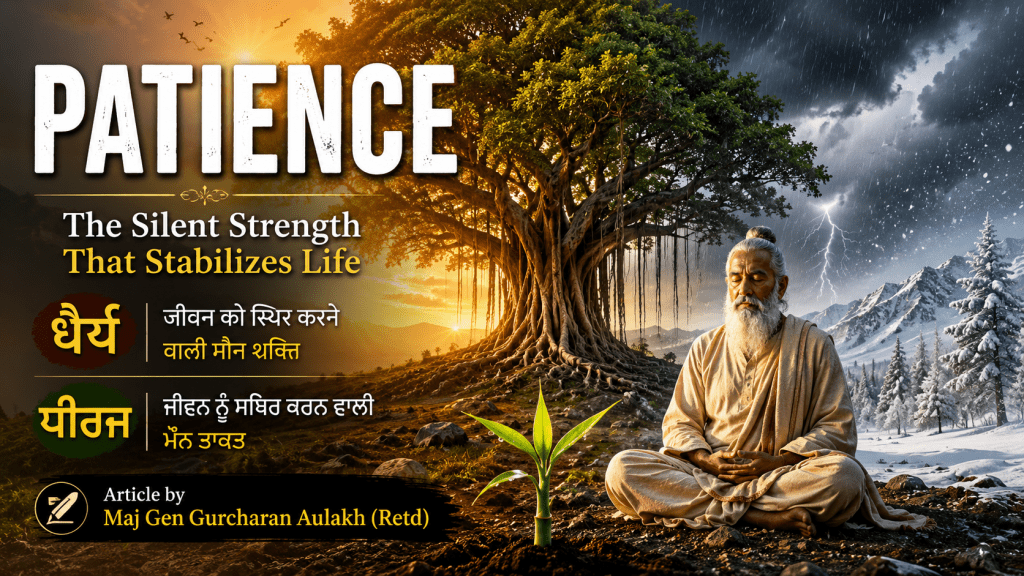
A seed still takes time to become a tree.
A child still takes years to mature.
A wound still requires time to heal.
A career still demands effort and perseverance.
Patience is not merely waiting. It is the ability to remain peaceful while waiting.
The Sanskrit word “Dhairya” combines courage, steadiness, endurance, and patience. It is a virtue that separates the wise from the impulsive.
Ancient Indian scriptures, modern psychology, and life experiences all point toward the same truth:
Patience is not weakness. Patience is strength under control.
What Exactly Is Patience?
Patience is the ability to:
- Endure difficulties without bitterness.
- Wait without anxiety.
- Face delays without frustration.
- Continue efforts without immediate rewards.
- Remain balanced during uncertainty.
Patience is emotional maturity in action.
A patient person does not stop working.
He simply stops panicking.
Why Is Patience Becoming Rare?
Modern society rewards speed.
We have become conditioned to expect:
- Instant results
- Immediate success
- Quick responses
- Fast promotions
- Overnight fame
Social media worsens the illusion.
People see only the success of others, not their years of struggle.
A young entrepreneur sees a billionaire.
He does not see the twenty years behind that success.
An aspiring singer sees a celebrity.
She does not see thousands of hours of practice.
Impatience is born when expectations move faster than reality.
The Bamboo Story
A Chinese bamboo tree remains invisible for nearly five years after planting.
The gardener waters it daily.
Nothing appears.
No shoots.
No branches.
No signs of growth.
Then suddenly, within a few weeks, it grows nearly ninety feet tall.
Did it grow in six weeks?
No.
It was developing roots for five years.
Human success often follows the same pattern.
Many people quit during the root-building phase.
Patient people continue watering.
Patience During Adverse Circumstances
Anyone can be patient when life is comfortable.
True patience is tested when:
- Health deteriorates
- Finances become strained
- Relationships suffer
- Careers stagnate
- Dreams appear distant
Adversity is patience’s laboratory.
The storm reveals the strength of the tree.
Story of Patience: The Pandavas in Exile
In the Mahabharata, the Pandavas lost everything.
They were exiled for thirteen years.
Imagine their situation:
- Kingdom lost
- Honour challenged
- Future uncertain
Yet they did not abandon discipline.
They prepared.
They learned.
They waited.
Their patience was not passive resignation.
It was active preparation.
When the right moment arrived, they were ready.
Patience does not mean doing nothing.
Patience means preparing while waiting.
Lord Rama and Patience
The life of Lord Rama is a masterclass in patience.
Instead of rebelling against exile, he accepted fourteen years in the forest.
He never allowed anger to dominate judgment.
His patience preserved dignity, relationships, and ultimately victory.
The lesson is profound:
When patience guides action, wisdom guides decisions.
Patience and Peace of Mind
Impatience creates mental turbulence.
Observe your own mind when:
- Traffic is slow.
- Internet stops working.
- Someone delays responding.
- Plans change unexpectedly.
Notice the irritation.
The external event is often small.
The suffering comes from resistance.
Patience reduces resistance.
Acceptance creates peace.
The patient person understands:
“Things are unfolding according to their own pace.”
The Psychology of Patience
Modern research suggests patient individuals generally experience:
- Lower stress levels
- Better relationships
- Improved decision-making
- Greater emotional resilience
- Greater long-term success
Why?
Because impatience narrows vision.
Patience expands perspective.
An impatient mind asks:
“Why isn’t this happening now?”
A patient mind asks:
“What can I do while I wait?”
The second question leads to growth.
The Hidden Nuances of Patience
Patience is Not Laziness
Laziness avoids effort.
Patience continues effort.
Patience is Not Weakness
Weakness surrenders.
Patience perseveres.
Patience is Not Inaction
Patience acts consistently.
It simply avoids panic.
Patience is Not Endless Tolerance
Patience does not mean accepting injustice.
A patient person can still take firm action when necessary.
How Impetuous People Can Develop Patience
Some individuals are naturally impulsive.
They want immediate answers, immediate results, immediate movement.
The good news:
Patience can be cultivated.
Like a muscle, it grows through practice.
1. Pause Before Reacting
When emotional:
- Wait ten seconds.
- Take three deep breaths.
Many regrets disappear during those ten seconds.
2. Delay Small Gratifications
Practice waiting intentionally.
Examples:
- Wait five minutes before checking messages.
- Wait before responding to criticism.
- Wait before making purchases.
Small acts strengthen patience.
3. Focus on Process
Impatient people obsess over outcomes.
Patient people focus on daily actions.
A farmer controls sowing.
Not rainfall.
Not harvest timing.
Focus on what you can control.
4. Reduce Multitasking
Constant stimulation weakens attention.
Slow down.
Do one thing fully.
Patience grows where attention grows.
5. Practice Long-Term Projects
Gardening.
Learning music.
Writing.
Walking programs.
Meditation.
These activities naturally teach patience.
Patience During Job Search
Perhaps nowhere is patience tested more severely than during unemployment.
Applications disappear into silence.
Interviews lead nowhere.
Weeks become months.
Confidence suffers.
Many people begin doubting themselves.
This is precisely where patience becomes essential.
What Patience Does Not Mean
Patience does not mean sitting idle.
Continue:
- Learning new skills
- Networking
- Improving resumes
- Applying consistently
- Practicing interviews
Patience means trusting the process while continuing effort.
The Farmer’s Principle
A farmer does not dig up seeds every morning to check growth.
He waters.
He waits.
He trusts.
Job seekers must do the same.
Apply.
Improve.
Follow up.
Then let time work.
Patience and Life Stabilization
Most instability arises from emotional reactions.
We react too quickly:
- To criticism
- To setbacks
- To temporary failures
Patience introduces a gap between stimulus and response.
Inside that gap lives wisdom.
Many crises disappear if we wait before reacting.
A delayed response is often a superior response.
Patience in Indian Scriptures
Bhagavad Gita
Krishna teaches equanimity.
Perform your duty.
Do not become attached to immediate results.
This is patience in spiritual form.
Action without anxiety.
Effort without agitation.
Guru Granth Sahib
The teachings of Guru Granth Sahib repeatedly encourage acceptance of Divine Will (Hukam).
When one aligns with Hukam, impatience diminishes.
The individual understands:
Life unfolds according to a larger wisdom.
Yoga Sutras
Patanjali teaches persistent practice over a long period.
Transformation comes through steady effort.
Not sudden breakthroughs.
Practical Daily Exercises to Build Patience
Morning Exercise
Ask:
“What is one thing today that may test my patience?”
Prepare mentally.
Waiting Exercise
Whenever waiting:
- Observe breathing.
- Observe surroundings.
- Avoid reaching for the phone.
Turn waiting into awareness.
Reflection Exercise
Every night ask:
“When did I become impatient today?”
“What would a wiser response have been?”
Gratitude Practice
Impatience focuses on what is missing.
Gratitude focuses on what is present.
The two cannot coexist for long.
The Greatest Example of Patience
Nature itself.
The sun rises every morning.
The seasons arrive in order.
The river reaches the ocean without haste.
Nature never hurries.
Yet everything gets accomplished.
Human beings suffer because they demand that life follow their timetable.
Life follows its own.
Final Thoughts
Patience is not a passive virtue.
It is active strength.
It is courage without noise.
It is confidence without hurry.
It is faith combined with effort.
The patient person does not escape difficulties.
He navigates them with composure.
He understands a profound truth:
Some things can be achieved by force.
The most valuable things can only be achieved by patience.
Success needs patience.
Relationships need patience.
Healing needs patience.
Wisdom needs patience.
And peace of mind perhaps needs patience more than anything else.
As the old saying goes:
“The river cuts through rock not because of power, but because of persistence.”
Patience is persistence made peaceful.
‘And in a restless world, it may be one of the greatest virtues we can cultivate.
Guchi.

