I was recently reminded of a memorable scene from the classic film The Good, the Bad and the Ugly. Tuco, the notorious outlaw, is standing on the gallows. The crowd watches with sympathy as the noose is tightened around his neck. Someone whispers, “Don’t worry, he will be saved. Someone is watching over him.”
Moments later, as the horse beneath him is kicked away and the rope begins to tighten, a rifle shot rings out from a distant hill. The rope snaps. Tuco falls free. The mysterious marksman is Blondie—“The Good.” Amid the confusion that follows, Tuco escapes once again.
The scene is dramatic, but it conveys a profound truth about life: very few people travel through life entirely alone. Most of us are guided, supported, encouraged, protected, or inspired by someone—or something.
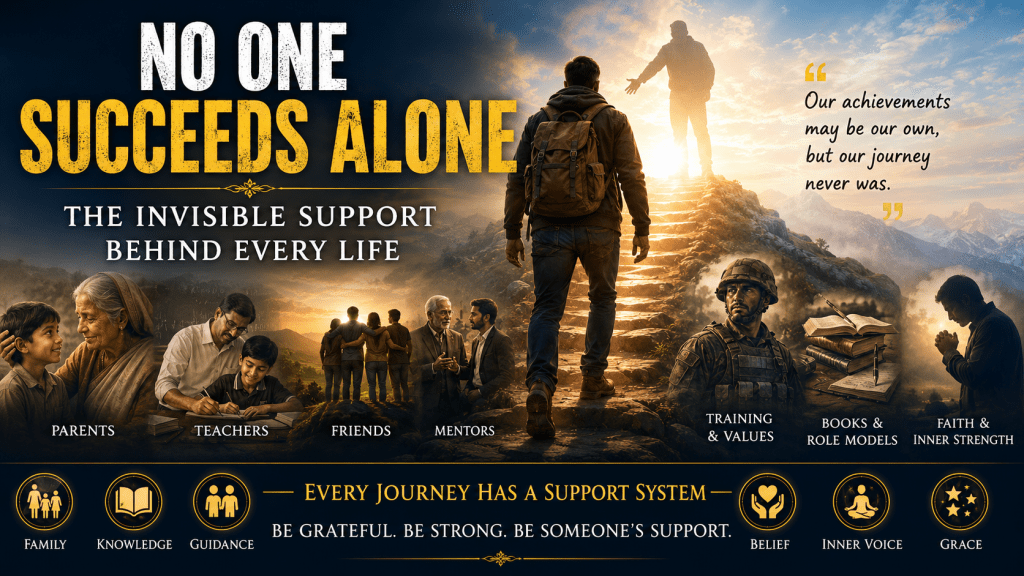
The older I grow, the more convinced I become that there is no such thing as a completely self-made person. We may earn our achievements through hard work and perseverance, but the journey is never entirely ours. Somewhere along the way, parents sacrificed, teachers guided, friends encouraged, mentors advised, books inspired, values shaped us, and faith sustained us.
Even those who appear to stand alone are often leaning on beliefs, principles, role models, or an inner voice that refuses to surrender.
Our achievements may be our own, but our journey never was.
The Myth of the Self-Made Person
We often admire “self-made” individuals. Business tycoons, military leaders, artists, athletes, scientists, and political leaders are frequently described as having achieved success entirely on their own.
Yet, if we look closely, the phrase self-made is somewhat misleading.
Behind every successful person stands an invisible network of support.
A child may have been encouraged by loving parents.
A student may have been inspired by a dedicated teacher.
An entrepreneur may have been trusted by a mentor.
An officer may have been shaped by a commanding officer.
A writer may have been motivated by a favorite author.
Even the most independent individuals carry within them the influence of countless people who helped shape their character.
No tree grows in isolation. It requires soil, sunlight, water, and favorable weather. Human beings are no different.
The Many Forms of Support
Support does not always come in obvious forms.
Sometimes it is financial.
Sometimes emotional.
Sometimes intellectual.
Sometimes spiritual.
And sometimes it is simply the reassuring presence of someone who believes in us when we struggle to believe in ourselves.
Parents
For many people, the first and strongest support system is their parents.
A child learning to walk repeatedly falls. Yet he continues trying because loving hands are always nearby.
Years later, the child may become a doctor, engineer, soldier, artist, or entrepreneur. Society applauds the achievement, but behind the applause lie countless sacrifices made by parents.
Siblings and Friends
Many people derive strength from siblings and friends.
A brother who stands beside you during difficult times.
A sister who offers encouragement when confidence fades.
A friend who says, “You can do it,” when the world says otherwise.
These relationships often provide the emotional resilience needed to face life’s battles.
Teachers and Mentors
History is full of examples.
Chanakya stood behind Chandragupta.
Aristotle guided Alexander.
Ramakrishna inspired Vivekananda.
Every great achiever has benefited from the wisdom of those who walked ahead.
A mentor often sees potential long before the individual sees it himself.
The Invisible Supporters
Not all support is visible.
Many people carry within them the influence of role models whom they have never met.
A young cricketer may draw inspiration from Sachin Tendulkar.
A soldier may be motivated by Field Marshal Sam Manekshaw.
An entrepreneur may look up to J.R.D. Tata.
A musician may be inspired by Ravi Shankar.
These individuals may never know the people they inspire, yet their influence shapes countless lives.
Books, too, become silent companions.
A sentence read at the right moment can alter the direction of a life.
An idea encountered in youth can become a guiding principle decades later.
The authors may be gone, but their influence remains alive.
The Support of Belief
Some people seem to stand alone.
They may have lost parents.
They may lack influential connections.
They may have few friends.
Yet even they are rarely unsupported.
Often their support comes from deeply held beliefs.
Their faith.
Their values.
Their principles.
Their commitment to a cause.
History provides many examples.
Mahatma Gandhi possessed no army, no wealth, and no political office when he began his struggle. Yet he possessed an unwavering belief in truth and non-violence.
That belief became his support system.
Nelson Mandela spent twenty-seven years in prison. What sustained him was not external assistance but an unshakeable conviction in justice and equality.
Sometimes a belief can support a person more powerfully than an entire organization.
The Support of One’s Own Soul
Perhaps the most fascinating support system is the human soul itself.
There are moments in life when no one is available to help.
No friend.
No mentor.
No family member.
No guide.
Yet something within whispers:
Keep going.
Do not give up.
This too shall pass.
Call it conscience.
Call it inner strength.
Call it self-belief.
Call it soul.
That quiet inner voice has rescued countless individuals from despair.
Many of life’s greatest victories begin with a conversation between a person and his own conscience.
A Soldier’s Example
During military service, there are occasions when an officer finds himself in difficult circumstances—far away from family, facing uncertainty, responsibility, and danger.
In such moments, it is not always rank or authority that sustains him.
Often it is training.
Discipline.
Faith in his men.
Belief in the mission.
And an inner voice that says:
Stand firm.
That invisible support becomes his strength.
The Ultimate Support
There is yet another category.
Many people believe that behind all visible support systems lies an invisible one.
Some call it God.
Some call it destiny.
Some call it providence.
Some call it grace.
Whatever name we choose, many of us have experienced moments when events unfolded in ways that seem beyond explanation.
A chance meeting.
An unexpected opportunity.
A narrow escape.
Help arriving at precisely the right moment.
A door opening when all others were closed.
Looking back, people often say:
“Something was looking after me.”
Whether one attributes such moments to divine intervention, destiny, or sheer coincidence is a matter of personal belief. Yet few can deny having experienced them.
Gratitude: The Mark of Wisdom
As we grow older, we begin to recognize how many people contributed to our journey.
The successful businessman remembers his first customer.
The officer remembers his instructor.
The writer remembers his teacher.
The athlete remembers his coach.
The parent remembers his own parents.
The patient remembers the doctor.
The student remembers the mentor.
And the wise person remembers to express gratitude.
Because success is rarely a solo performance.
It is usually an orchestra in which many unseen musicians play their part.
Conclusion
The next time you hear someone described as self-made, pause for a moment.
Look deeper.
You may discover parents, teachers, mentors, friends, role models, books, values, faith, beliefs, and inner strength standing quietly behind that person.
And if you ever feel alone, remember this:
You may not always see your support system.
But that does not mean it does not exist.
It may be a parent.
A spouse.
A friend.
A mentor.
A role model.
A belief.
A cherished memory.
Your own conscience.
Or perhaps a higher power.
Whatever its form, each one of us draws strength from a source beyond ourselves.
The secret of a meaningful life is not merely to receive support from others, but eventually to become a source of strength for someone else.
Because in the end, the greatest achievement in life is not how high we rise, but how many people we help rise with us.
Final Thought
No one succeeds alone.
Our achievements may be our own, but our journey never was.
—
Maj Gen Gurcharan Aulakh (Retd)
LifeSublime

