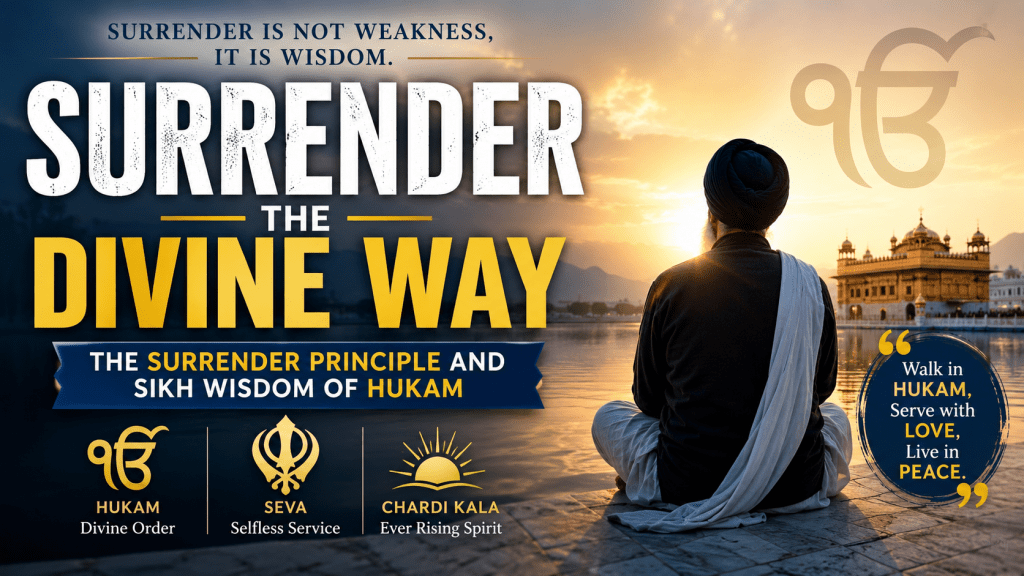
The Surrender Principle and Sikh Wisdom: The Strength to Flow with Hukam
By Maj Gen Gurcharan Aulakh (Retd.)
Introduction: Is Surrender a Sign of Weakness?
The very word surrender often creates discomfort.
To a soldier, surrender may signify defeat. To an ambitious professional, it may sound like abandoning goals. To a modern mind conditioned to believe that success comes from controlling every aspect of life, surrender can appear almost irresponsible.
Yet the world’s great spiritual traditions have consistently taught the opposite.
They tell us that the deepest peace, the greatest resilience, and the highest wisdom emerge not from controlling life but from aligning ourselves with it.
In recent years, Michael A. Singer’s acclaimed book The Surrender Experiment introduced millions of readers to this idea. Singer describes how he stopped forcing life to conform to his personal preferences and instead accepted opportunities and challenges as they arrived. To his surprise, life unfolded in ways far richer than anything he could have planned.
For Sikhs, however, this is not a new discovery.
More than five centuries ago, Guru Nanak Dev Ji revealed a profound truth:
“ਹੁਕਮਿ ਰਜਾਈ ਚਲਣਾ ਨਾਨਕ ਲਿਖਿਆ ਨਾਲਿ।”
“Walk in harmony with the Divine Will; this is written along with our existence.”
This principle of living in Hukam—the Divine Order—is one of the cornerstones of Sikh philosophy.
The surrender principle and the Sikh understanding of Hukam meet at a beautiful intersection: both teach us to act wholeheartedly while accepting that the universe is larger than our personal desires.
Understanding the Human Struggle
Most human suffering begins with resistance.
We resist change.
We resist aging.
We resist criticism.
We resist uncertainty.
We resist loss.
At the root of this resistance lies a simple belief:
“Life should unfold according to my expectations.”
When reality disagrees, frustration arises.
A promotion goes to someone else.
A trusted friend disappoints us.
A business venture fails.
An illness appears unexpectedly.
The mind immediately protests:
“This should not be happening.”
“Why me?”
“This is unfair.”
The event itself may be painful, but much of our suffering comes from our refusal to accept what has already occurred.
Guru Nanak recognized this tendency centuries ago. Human beings become trapped when they insist on placing their personal will above the Divine Order.
The result is inner conflict.
Michael Singer’s Experiment
Michael Singer’s life changed when he began observing the constant stream of thoughts in his mind.
He realized that there was always a voice commenting on everything:
“I like this.”
“I dislike that.”
“This must happen.”
“That must not happen.”
He began asking a simple but profound question:
If I can hear this voice, who is listening?
This inquiry led him to an unusual decision.
Rather than organizing life around personal preferences, he would accept whatever opportunities life presented and give them his full commitment.
This became his “Surrender Experiment.”
Remarkably, opportunities appeared that he never imagined.
He became a meditation teacher.
He founded a spiritual community.
He eventually led a successful software company.
Again and again, life presented circumstances he had not planned, and by saying “yes” to them, he discovered unexpected growth.
The lesson was simple:
Life often knows more than the limited perspective of the ego.
Hukam: The Sikh Understanding of Divine Order
The Sikh concept of Hukam is often translated as Divine Will, but it means far more.
Hukam is the universal law governing existence.
The planets move in Hukam.
The seasons change in Hukam.
Birth and death occur within Hukam.
Human beings, whether aware of it or not, live within Hukam.
Guru Nanak asks:
“ਹੁਕਮੀ ਹੋਵਨਿ ਆਕਾਰ ਹੁਕਮੁ ਨ ਕਹਿਆ ਜਾਈ।”
“By Hukam forms come into existence, yet Hukam cannot be fully described.”
The Gurus teach that suffering arises when we forget this truth and attempt to place our ego at the center of existence.
Living in Hukam does not require understanding every event.
It requires trusting that there is a larger intelligence operating beyond our limited vision.
Haumai: The Obstacle to Surrender
If Hukam is the path, then Haumai is the obstacle.
Haumai means ego-consciousness.
It is the persistent feeling of “I,” “me,” and “mine.”
The ego constantly demands:
“I must be appreciated.”
“My plans must succeed.”
“My opinions must prevail.”
“My expectations must be fulfilled.”
The Gurus repeatedly identify Haumai as the root of spiritual ignorance.
This does not mean abandoning individuality.
It means releasing the illusion that we are the ultimate controllers of life.
The ego wishes to dominate reality.
Wisdom learns to cooperate with reality.
That cooperation is surrender.
Surrender Is Not Passivity
One of the greatest misunderstandings about surrender is the belief that it encourages passivity.
Nothing could be further from the truth.
The Sikh Gurus never taught passivity.
Guru Arjan Dev Ji accepted martyrdom with serenity.
Guru Hargobind Sahib carried two swords symbolizing Miri and Piri—temporal responsibility and spiritual authority.
Guru Tegh Bahadur Ji sacrificed his life defending religious freedom.
Guru Gobind Singh Ji created the Khalsa to confront oppression and injustice.
These examples demonstrate a profound truth:
Acceptance of Divine Will does not eliminate courageous action.
A Sikh accepts outcomes but never abandons duty.
The Bhagavad Gita and Detached Action
The surrender principle also finds powerful expression in the Bhagavad Gita.
Standing on the battlefield of Kurukshetra, Arjuna is overwhelmed by confusion and grief.
Lord Krishna does not tell him to withdraw.
Nor does He encourage despair.
Instead, Krishna teaches:
Perform your duty.
Act with excellence.
But do not become attached to the fruits of action.
This teaching closely parallels Sikh philosophy.
The Sikh is encouraged to work diligently, serve selflessly, and remain detached from ego-driven expectations.
Action remains essential.
Attachment becomes optional.
Chardi Kala: The Spirit of Positive Acceptance
Perhaps no Sikh concept illustrates surrender more beautifully than Chardi Kala.
Often translated as “ever-rising spirits,” Chardi Kala is not blind optimism.
It is resilient optimism.
It is the ability to maintain hope and courage despite adversity.
Consider Sikh history.
Persecution.
Exile.
Martyrdom.
Battles.
Immense hardships.
Yet the Sikh spirit remained unbroken.
Why?
Because faith was placed not in circumstances but in the Divine.
When acceptance is rooted in faith, circumstances lose their power to define us.
The Farmer’s Wisdom
Imagine a farmer.
He prepares the soil.
He selects quality seeds.
He irrigates the field.
He protects the crop.
Yet he cannot command the rain.
He cannot control the sun.
He cannot dictate the seasons.
The wise farmer does everything within his power and accepts everything beyond it.
This is the essence of surrender.
Effort without anxiety.
Action without attachment.
Responsibility without obsession.
Lessons from Military Life
My years in uniform reinforced this principle repeatedly.
A commander can prepare meticulously.
He can train his troops.
He can study terrain.
He can formulate plans.
Yet no commander controls every variable on the battlefield.
Weather changes.
Unexpected challenges emerge.
New realities appear.
Successful leaders accept reality quickly and adapt accordingly.
Unsuccessful leaders waste energy complaining about circumstances.
In many ways, military leadership teaches practical surrender.
Not surrender to the enemy.
Surrender to facts.
Once reality is accepted, effective action becomes possible.
Surrender in Daily Life
When Health Declines
Aging is inevitable.
Illness may arrive unexpectedly.
Resistance increases suffering.
Acceptance allows us to focus on treatment, adaptation, and gratitude.
When Relationships Change
People grow.
Circumstances evolve.
Holding rigid expectations creates disappointment.
Acceptance creates understanding.
When Retirement Arrives
Many people struggle after retirement because their identity was tied entirely to their profession.
Yet retirement can become a doorway to service, creativity, spirituality, and learning.
Life does not end.
It changes form.
When Success Comes
Surrender also protects us from arrogance.
Success often involves countless factors beyond personal effort.
Recognizing this truth cultivates humility and gratitude.
Seva: Surrender Through Service
The highest expression of surrender in Sikhism may be Seva.
Selfless service dissolves the ego.
When serving others, we stop asking:
“What will I gain?”
Instead, we ask:
“How can I contribute?”
Whether serving in a langar, helping a neighbour, mentoring a student, or comforting a stranger, Seva transforms surrender from a philosophical concept into a living reality.
The ego shrinks.
Compassion expands.
Nanak Naam Chardi Kala
The closing line of the Sikh Ardas captures the essence of surrender:
“ਨਾਨਕ ਨਾਮ ਚੜ੍ਹਦੀ ਕਲਾ, ਤੇਰੇ ਭਾਣੇ ਸਰਬੱਤ ਦਾ ਭਲਾ।”
“Through the Divine Name may we remain in ever-rising spirits, and by Your Will may there be welfare for all.”
Notice the extraordinary balance.
Faith without passivity.
Acceptance without weakness.
Optimism without denial.
Service without selfishness.
This is surrender at its highest level.
The Ultimate Freedom
Many people spend their lives trying to control everything.
They seek certainty where certainty does not exist.
They demand guarantees from a world that offers none.
The result is anxiety.
The surrender principle offers another path.
Do your duty.
Serve sincerely.
Accept reality.
Trust the larger order.
Release attachment to outcomes.
This does not make life easier.
It makes us stronger.
The river reaches the ocean not by fighting every obstacle but by flowing with unwavering persistence.
Likewise, the surrendered individual moves through life with courage, humility, and peace.
Conclusion
The surrender principle is not about giving up.
It is about letting go of the illusion of control.
Michael Singer’s The Surrender Experiment presents this wisdom in modern language.
The Bhagavad Gita teaches it through detached action.
Sikhism teaches it through Hukam, Seva, Chardi Kala, and freedom from Haumai.
The message remains timeless.
Act with full commitment.
Serve with humility.
Accept what comes.
Trust the Divine Order.
For when the ego stops demanding that life obey its wishes, a remarkable transformation occurs.
We discover that surrender is not defeat.
It is freedom.
And perhaps that freedom is the greatest victory a human being can achieve.
Guchi.

