“A nation’s greatest wealth is not its natural resources. It is the character of its people.”
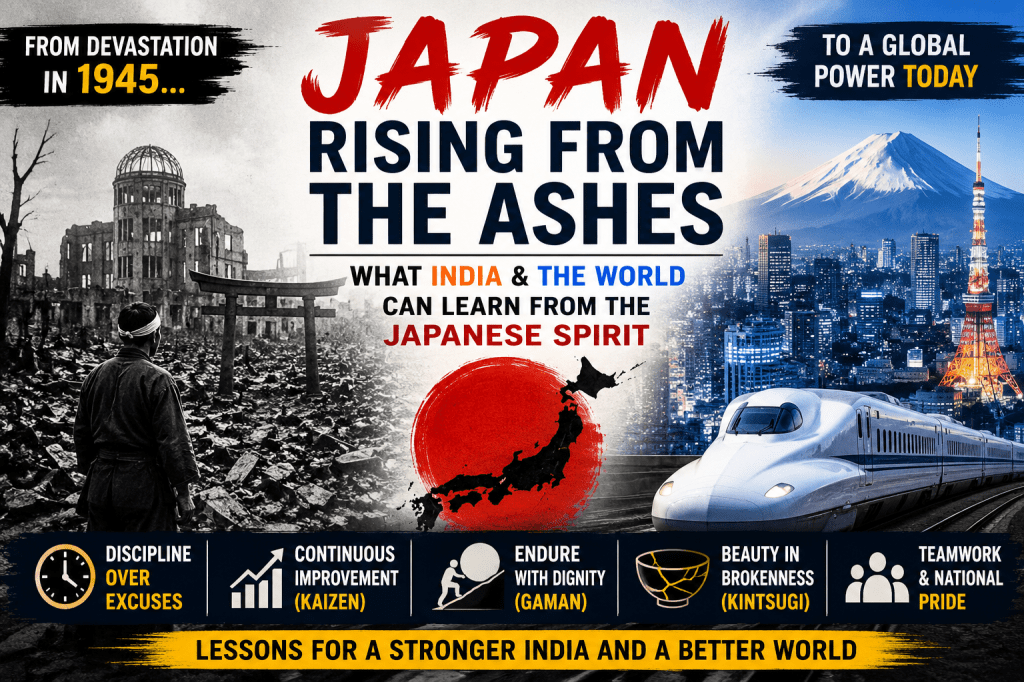
When the Second World War ended in August 1945, Japan lay shattered.
Its cities were in ruins. Millions had lost their lives. Industries had collapsed. The economy was broken. Hiroshima and Nagasaki had suffered the unimaginable horror of atomic bombings. Hunger, uncertainty, and despair stalked the land.
To many observers, Japan appeared finished.
Yet within a generation, the same nation astonished the world. Japanese cars became symbols of reliability. Japanese electronics entered homes across the globe. Japanese trains became models of punctuality. Japanese factories became benchmarks of quality and efficiency. By the 1970s and 1980s, Japan had emerged as one of the world’s most powerful economies.
How did a defeated nation rise so quickly from devastation to greatness?
The answer lies not merely in economic policies or foreign aid. It lies in the spirit of the Japanese people.
The Foundation Was Laid Long Before the War
Japan’s recovery did not begin in 1945.
The values that powered its reconstruction had been cultivated for centuries.
The Samurai code, known as Bushidō, emphasized honour, loyalty, courage, self-discipline, responsibility, and unwavering commitment to duty. While certain aspects of pre-war militarism led Japan down a dangerous path, many of the underlying virtues survived the war and were redirected toward peaceful nation-building.
Modern Japan retained discipline while rejecting militarism.
It retained honour while embracing democracy.
It retained sacrifice while focusing on economic progress.
This transformation became one of the most remarkable stories in human history.
The Power of Collective Responsibility
One of the most striking features of Japanese society is the sense of collective responsibility.
In many societies, people first ask, “Who is responsible?”
In Japan, people often ask, “What can I do?”
Whether it is a natural disaster, an economic setback, or a community problem, citizens tend to view themselves as participants in the solution rather than spectators waiting for someone else to act.
National progress begins when individuals stop asking what others should do and start asking what they themselves can contribute.
Work as a Matter of Honour
In Japan, work is more than a source of income.
It is a reflection of character.
A craftsman takes pride in perfection.
A railway employee takes pride in punctuality.
A factory worker takes pride in quality.
A shopkeeper takes pride in service.
Every task, however small, is treated with seriousness and dignity.
The Japanese concept of Shokunin Kishitsu—the spirit of the craftsman—teaches that mastery is a lifelong pursuit. Excellence is not an event. It is a habit.
Kaizen: The Art of Continuous Improvement
One of Japan’s greatest contributions to modern management is the philosophy of Kaizen.
Kaizen means continuous improvement.
The principle is simple:
Improve a little every day.
A small improvement today.
Another tomorrow.
A hundred tiny improvements over a year.
Thousands over a lifetime.
This philosophy transformed Japanese industries and can transform individual lives as well.
Most people overestimate what they can achieve in a day and underestimate what they can achieve in ten years.
Kaizen teaches patience, persistence, and progress.
Gaman: Endure with Dignity
Another uniquely Japanese concept is Gaman.
It means enduring hardship with patience and dignity.
The world witnessed this spirit after earthquakes, tsunamis, economic crises, and wartime devastation.
Instead of panic, there was calm.
Instead of disorder, there was discipline.
Instead of blaming others, there was determination to rebuild.
Gaman does not mean accepting defeat.
It means refusing to surrender to circumstances.
Life inevitably brings setbacks. Gaman teaches us to remain steady until better days arrive.
Mourning Without Stopping the Nation
One characteristic often noticed by foreign observers is the Japanese approach to public mourning.
When respected leaders or public figures pass away, the nation pays tribute with dignity and respect. Memorial services are held. Black ribbons may be worn. Moments of silence are observed.
Yet schools remain open.
Factories continue operating.
Trains continue running.
Offices continue working.
The underlying belief is that the greatest tribute to those who have served the nation is not inactivity but continued dedication to duty.
This approach may differ from practices in many other countries where public holidays and closures accompany periods of mourning. Neither approach is inherently right or wrong; both emerge from cultural traditions.
However, the Japanese example reminds us that grief and responsibility can coexist.
One can honour the departed while continuing to serve the living.
Kintsugi: Beauty in Brokenness
Perhaps no Japanese philosophy better symbolizes national recovery than Kintsugi.
When a cherished ceramic bowl breaks, it is repaired using lacquer mixed with gold.
The cracks are not hidden.
They are highlighted.
The object becomes more valuable because it has survived damage.
The lesson is profound.
Our failures, scars, disappointments, and setbacks do not diminish us.
They can strengthen us.
Japan itself became a living example of Kintsugi.
The nation was broken.
The scars remained visible.
Yet those very scars became the source of wisdom, resilience, and strength.
Education as a National Priority
Japan understood that rebuilding required more than reconstructing buildings.
It required rebuilding minds.
Education became a national mission.
Schools taught not only academics but also discipline, teamwork, respect, cleanliness, and responsibility.
In many Japanese schools, students help clean classrooms and common areas. The objective is not to save money but to build character.
Children learn that maintaining their environment is their responsibility.
The lesson extends far beyond the classroom.
The Japanese Economic Miracle
Between the 1950s and 1980s, Japan experienced what economists call the Japanese Economic Miracle.
Government planning, industrial cooperation, technological innovation, export-oriented manufacturing, quality management, and a highly educated workforce all played important roles.
But behind every economic statistic stood ordinary men and women committed to excellence.
The miracle was not created by a few leaders.
It was created by millions of disciplined citizens.
The Ant Philosophy
Watching Japanese society often reminds one of an ant colony.
Not because people are robotic.
But because they are relentless.
An ant does not seek applause.
It simply keeps moving.
One journey.
One grain.
One effort.
Repeated thousands of times.
Japan’s success was built through countless ordinary acts performed extraordinarily well.
Great achievements rarely result from sudden bursts of effort.
They emerge from consistency.
What India Can Learn
India and Japan are very different civilizations.
India possesses immense strengths of its own—family values, spirituality, adaptability, creativity, entrepreneurship, and cultural richness.
The objective is not imitation.
The objective is learning.
From Japan, we can learn:
• Respect for time
• Respect for public property
• Respect for honest work
• Commitment to quality
• Civic discipline
• National responsibility
• Continuous improvement
• Long-term thinking
Imagine the transformation if every citizen resolved to improve just one aspect of daily behaviour.
A cleaner street.
A punctual meeting.
A better product.
A more disciplined queue.
A stronger work ethic.
Small actions multiplied by millions create national change.
What We Should Not Copy
A balanced view also requires acknowledging Japan’s challenges.
The same dedication that contributed to economic success has sometimes produced excessive work pressure, stress, loneliness, and demographic decline.
The lesson is not to work ourselves into exhaustion.
The lesson is to perform our duties with excellence while maintaining balance, family life, health, and humanity.
Wisdom lies in adopting strengths without inheriting weaknesses.
Lessons for Everyday Life
The Japanese story is not merely about nations.
It is about individuals.
If you lose a job, rebuild.
If you suffer a setback, rebuild.
If a business fails, rebuild.
If circumstances knock you down, rebuild.
Do not waste precious energy asking, “Why did this happen to me?”
Ask instead:
“What is my next step?”
Practice Kaizen.
Endure with Gaman.
Repair yourself with Kintsugi.
Work with the dedication of a Shokunin.
Move forward with the persistence of an ant.
That is the Japanese formula for resilience.
The Greatest Lesson of All
The most important lesson from Japan is not about economics.
It is about attitude.
The atomic bombs destroyed cities.
They did not destroy the Japanese spirit.
Factories were destroyed.
Character was not.
Buildings collapsed.
Determination did not.
Japan teaches us that circumstances, however tragic, do not have the final word.
Human resolve does.
Every individual experiences setbacks.
Every family faces difficulties.
Every organization encounters crises.
Every nation suffers reverses.
The difference between decline and renewal lies in the response.
Do we complain, blame, and surrender?
Or do we rebuild?
Japan chose to rebuild.
Brick by brick.
Day by day.
Year by year.
And in doing so, it became one of history’s greatest examples of national resilience.
Conclusion
The story of Japan is the story of a Phoenix rising from the ashes.
It reminds us that greatness is not measured by how high we stand during times of prosperity.
It is measured by how courageously we rise after falling.
The Japanese people transformed devastation into opportunity, defeat into determination, and tragedy into triumph.
Their journey offers a timeless message to nations, organizations, families, and individuals alike:
You may not control what happens to you, but you always control how you respond.
And often, that response determines your destiny.
Guchi
— Maj Gen Gurcharan Aulakh (Retd.)
Gurcharan’s Motivation
“Learning from the World, Growing from Within”


An inspiring and thought-provoking piece! You have beautifully highlighted how discipline, resilience, collective responsibility, and continuous improvement shaped Japan’s remarkable recovery. The lessons of Kaizen, Gaman, and the spirit of craftsmanship offer timeless wisdom that extends far beyond one nation. Thank you for sharing such a meaningful reflection—it is both educational and deeply motivating. 👏🇯🇵📖
LikeLike
Thank you so much Sir, for your enlightened comments.
LikeLike