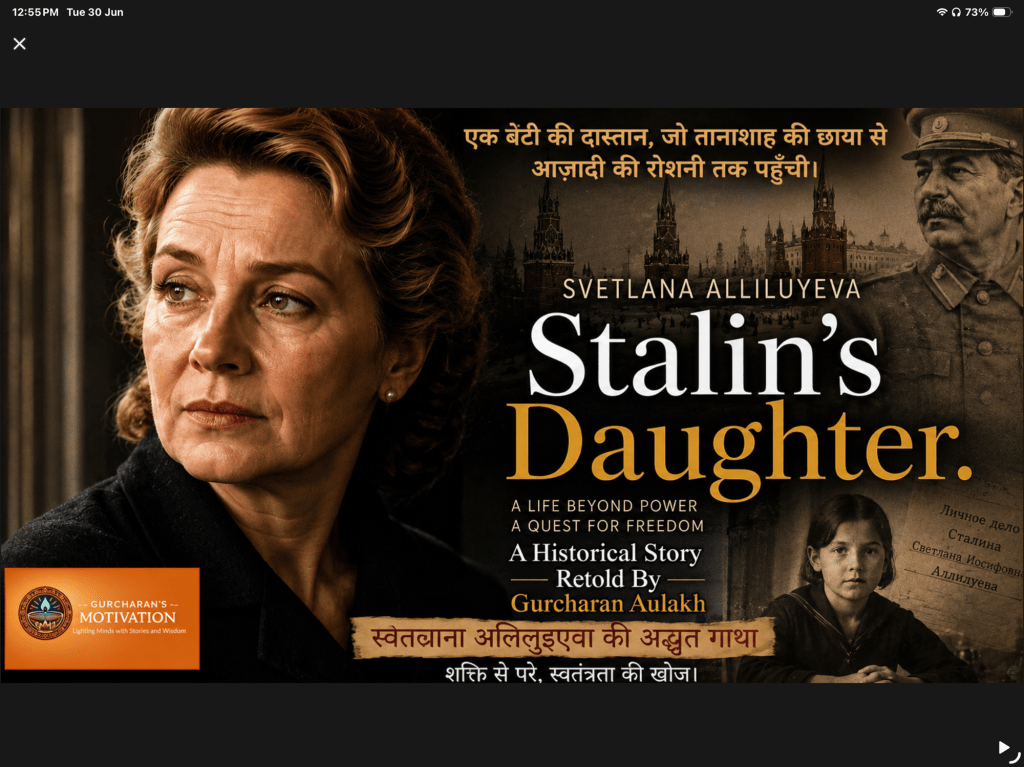
The Dictator’s Daughter Who Chose Freedom: The Extraordinary Journey of Svetlana Alliluyeva
In March 1967, a woman carrying little more than a small suitcase entered the American Embassy in New Delhi and quietly requested political asylum. The embassy staff immediately recognized her and were stunned.
She was Svetlana Alliluyeva, the only daughter of Joseph Stalin, one of the most feared and powerful rulers of the twentieth century. By seeking asylum, she was not merely changing countries; she was attempting to escape a legacy that had shaped—and haunted—her entire life.
A Childhood Behind Kremlin Walls
Svetlana was born into extraordinary privilege. Raised within the Kremlin, she enjoyed comforts few could imagine: private tutors, luxurious residences, servants, and access to the highest circles of Soviet power.
Yet behind the grandeur lay a different reality.
Her father exercised strict control over every aspect of her life. Decisions about her friendships, movements, and even her romantic relationships were often subject to his approval.
At sixteen, she fell in love with filmmaker Alexei Kapler. Intelligent, charismatic, and considerably older than her, Kapler quickly attracted Stalin’s disapproval. Within days, he was arrested and sent to a labor camp for a decade. Svetlana was denied even the chance to bid him farewell.
The experience left a lasting mark, teaching her that personal happiness could be sacrificed at the altar of political power.
Living in Her Father’s Shadow
Although Stalin died in 1953, his influence over Svetlana’s life did not end with him.
Being Stalin’s daughter brought neither freedom nor privilege. Instead, it made her a permanent symbol of the Soviet system. Every move she made was scrutinized, and every choice carried political significance.
She married, had children, and tried to build a life of her own, but the shadow of her family name remained inescapable.
Love, Loss, and India
A turning point came in 1963 when she met Brajesh Singh, an Indian official visiting Moscow.
Their relationship grew gradually and deeply. For perhaps the first time in her adult life, Svetlana felt valued as an individual rather than as Stalin’s daughter.
The Soviet authorities, however, refused to allow them to marry. They feared losing such a prominent figure abroad and viewed the relationship with suspicion.
Despite official opposition, the couple remained together until tragedy struck. In 1966, Singh died of a lung illness in Moscow.
Svetlana requested permission to take his ashes to India for the final rites. After considerable hesitation, Soviet authorities reluctantly agreed, assuming she would soon return.
They misjudged her intentions.
The Decision That Shocked the World
In India, Svetlana fulfilled her promise to Singh. She carried his ashes to the banks of the sacred Ganges and performed the final farewell.
Then she made a life-altering decision.
On March 6, 1967, she entered the American Embassy in New Delhi and requested asylum.
She was not a scientist carrying secrets, nor a military officer defecting with classified information. She was a living symbol of Soviet power choosing to walk away from the system that had defined her existence.
American officials quietly arranged her departure. She traveled through Rome and Switzerland before eventually arriving in New York.
Soon afterward, she publicly explained her decision:
“I have come here to seek the self-expression that has been denied me for so long in Russia.”
The Soviet government reacted furiously, denouncing her as a traitor and accusing the West of manipulating her. Contact with her children in Moscow became difficult, and her name was increasingly erased from official Soviet narratives.
Telling Her Story
Svetlana’s memoir, Twenty Letters to a Friend, became an international bestseller.
Rather than focusing on ideology or Cold War politics, she wrote about personal experiences: her mother’s tragic death, the emotional wounds of growing up under Stalin, and the struggle to define herself apart from her father’s legacy.
Readers around the world connected with her story because it spoke to a universal human desire—the need to be recognized as oneself rather than as a symbol imposed by others.
Freedom’s Unexpected Challenges
Life in the West did not bring the peace she had imagined.
Public fascination followed her everywhere. Journalists, intelligence agencies, and political observers viewed her less as a private citizen and more as a Cold War icon.
She moved frequently, searching for stability. A marriage to American architect William Peters eventually ended. Financial difficulties mounted, and the loneliness of exile became increasingly painful.
In 1984, feeling isolated and nostalgic, she made another surprising decision: she returned to the Soviet Union.
The Soviet government celebrated her return as a propaganda victory, while Western observers were bewildered.
Yet the homecoming proved deeply disappointing. The country had changed, and so had she. Relationships with her adult children were strained, and official surveillance resumed almost immediately.
She soon realized that some journeys cannot be reversed.
A Quiet Final Chapter
In 1986, Svetlana left the Soviet Union once again and settled permanently in the United States.
The remaining decades of her life were remarkably ordinary compared to the dramatic events that had preceded them. She lived quietly, sometimes under different names, moving between small American towns and seeking the anonymity she had never known.
On November 22, 2011, she died in a nursing home in Richland Center at the age of 85.
There were no major political announcements, no diplomatic crises, and no international spectacle.
Only the passing of a woman who had spent her life trying to become something more than a historical symbol.
The Legacy of a Personal Rebellion
Svetlana Alliluyeva never led a revolution, commanded an army, or governed a nation. Her act of defiance was far quieter.
She simply chose to leave.
Her life demonstrated that even those born into immense power may long for something as basic as personal freedom—the freedom to love, to grieve, to choose one’s own path, and to define oneself beyond inherited identities.
History remembers her as Stalin’s daughter. Yet her life’s greatest achievement may have been her determination, despite enormous obstacles, to be remembered as something else:
A woman striving to live on her own terms.
‘And in that struggle lies a lesson that transcends politics and ideology: no system, however powerful, can completely extinguish the human desire to be oneself.
(Courtesy Web Sourced)
Gucci.

