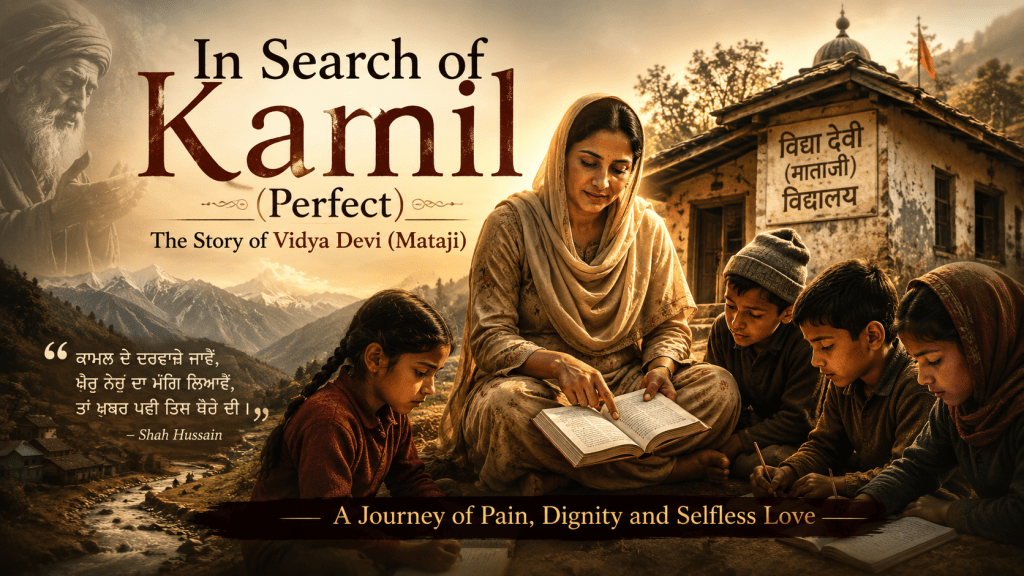
The old faqir sat quietly outside the shrine.
Evening sunlight rested softly upon the ancient walls. In his wrinkled fingers moved a worn wooden tasbih. People came and went, whispering prayers, asking for blessings, searching for miracles.
A young traveler stopped before him and asked:
“Baba Ji… who is Kamil?
Who is truly perfect?”
The faqir smiled faintly.
His tired eyes looked far away, as if searching through lifetimes.
Then he spoke slowly:
“If you ever find such a person…
come back and tell me.
I too have spent my whole life searching.”
The traveler sat beside him.
And the faqir began telling a story.
THE CHILD NOBODY SAW
Many years ago, in a remote village of Jammu & Kashmir, a little girl named Vidya lost both her parents before she turned five.
Her uncle and aunt took her into their home.
The villagers praised them.
“What noble people,” they said.
But inside that house, kindness rarely entered.
Vidya woke before sunrise every day.
She swept floors.
Fetched water from distant wells.
Cooked meals.
Washed utensils in freezing winters.
No one asked whether she was tired.
No one asked whether she wished to study.
“Girls do not need education,” her aunt would say sharply.
But inside the little girl lived a strange hunger.
Not for food.
For learning.
Whenever village girls returned from school, Vidya secretly borrowed their old torn books.
At night, after everyone slept, she lit a tiny oil lamp and tried to read the faded pages.
She traced letters with her finger upon mud floors.
Sometimes she stood silently behind the village school wall, listening to the teacher’s voice drifting through broken windows.
Slowly…
without school, without teacher, without help…
she taught herself to read and write.
No one knew that the servant girl living in darkness was quietly building light within herself.
Years passed.
She grew into an extraordinarily beautiful young woman.
And beauty, in cruel societies, often becomes another form of helplessness.
SOLD
One freezing winter evening, her aunt brought out colorful clothes and glass bangles.
For the first time in years, Vidya saw herself dressed like a bride.
A strange hope entered her heart.
Perhaps life was finally changing.
But before midnight, she understood the truth.
She had been sold.
An aging feudal lord from another district had paid heavily for her.
No wedding.
No consent.
No dignity.
Only silence.
As the bullock cart disappeared into the snowy night, Vidya looked back once toward her village.
Nobody came after her.
Nobody stopped the cart.
THE GOLDEN PRISON
The haveli was magnificent.
Marble floors.
Crystal chandeliers.
Servants standing silently.
But Vidya lived there like a bird trapped inside a golden cage.
The feudal lord possessed wealth, land, horses, servants…
and women.
Some women had surrendered to fate.
Some had become bitter.
Some had forgotten how to smile.
But Vidya remained strangely calm.
Every dawn she lit a small lamp near her window and whispered prayers softly into the cold air.
Whenever possible, she read books secretly.
Poetry.
Scriptures.
Stories of saints.
Books became her only companions.
Years passed.
She bore no child.
People in the haveli whispered that she was cursed.
But perhaps destiny was protecting her from deeper chains.
FREEDOM
Fifteen years later, the feudal lord died suddenly.
His legal heirs divided the estate like vultures dividing prey.
Since Vidya was never officially married, she received only a small forgotten amount of money.
The world expected her to disappear into poverty.
But for the first time in her life…
she was free.
THE SCHOOL NEAR THE BORDER
Near a lonely border village stood an abandoned mud building with a broken roof.
Using her small inheritance, Vidya repaired the walls and opened a tiny free school.
Children of laborers, widows, shepherds, and poor farmers began gathering there.
Some came barefoot.
Some came hungry.
Before teaching alphabets, she fed them warm bread.
During harsh winters, she stitched woolen clothes for orphan children with her own hands.
She often told the children:
“Knowledge is the only wealth
nobody can steal.”
Slowly the village began changing.
Girls who were never allowed education started learning.
Boys wandering aimlessly discovered discipline.
Years later, she adopted two orphan children and raised them as her own.
She never remarried.
Never spoke bitterly about her past.
Never cursed the people who destroyed her childhood.
THE FAQIR
One cold evening, an old wandering faqir stopped outside her school.
He watched quietly as Vidya fed hungry children before teaching them.
The faqir’s eyes became moist.
Softly, almost like a prayer, he recited Shah Hussain’s verse:
“ਕਾਮਲ ਦੇ ਦਰਵਾਜ਼ੇ ਜਾਵੈਂ,
ਖ਼ੈਰੁ ਨੇਹੁੰ ਦਾ ਮੰਗਿ ਲਿਆਵੈਂ,
ਤਾਂ ਖ਼ਬਰ ਪਵੀ ਤਿਸ ਥੇਂਹ ਦੀ ।”
Then he turned toward the villagers standing nearby and said:
“You search for Kamil in shrines, robes, miracles, and sermons…
but perhaps Kamil is the one
whose pain becomes mercy for others.”
Vidya lowered her eyes silently.
For the first time in years, tears rolled down her face.
VIDYA DEVI — MATAJI
Time passed quietly.
The little school near the border kept growing.
Children who once came barefoot became teachers, soldiers, nurses, and clerks.
Girls who would never have entered a classroom started reading books beneath the same oil lamps under which Vidya had once taught herself.
The villagers slowly stopped calling her merely “Vidya.”
Out of affection and reverence, they began calling her:
“Vidya Devi.”
But the children called her something even more beautiful:
“Mataji.”
Soon the entire village began addressing her by that name.
Travelers came seeking blessings from the woman who owned almost nothing…
yet gave everything.
No one remembered her past anymore.
No one spoke of the haveli.
No one called her fallen.
In the hearts of the people, she had become a mother.
One evening, a villager asked softly:
“Mataji… after all the suffering life gave you,
how do you still love people?”
She remained silent for a moment.
Then she smiled gently and replied:
“Pain either turns a person into stone…
or into shade for tired souls.”
THE FINAL TRUTH
When Mataji died, the entire village wept.
Men who once judged her carried her bier barefoot.
Women lit lamps outside their homes.
Children covered her resting place with flowers.
Years later, the villagers built a small shrine in her memory.
Not because she performed miracles.
Not because she preached religion.
But because she healed wounded hearts.
The old faqir finished the story.
Evening had turned into night.
The shrine lamps flickered softly in silence.
Then the faqir whispered:
“Maybe this is Kamil.
Not someone without wounds…
but someone whose wounds become compassion for the world.”
Guchi.

