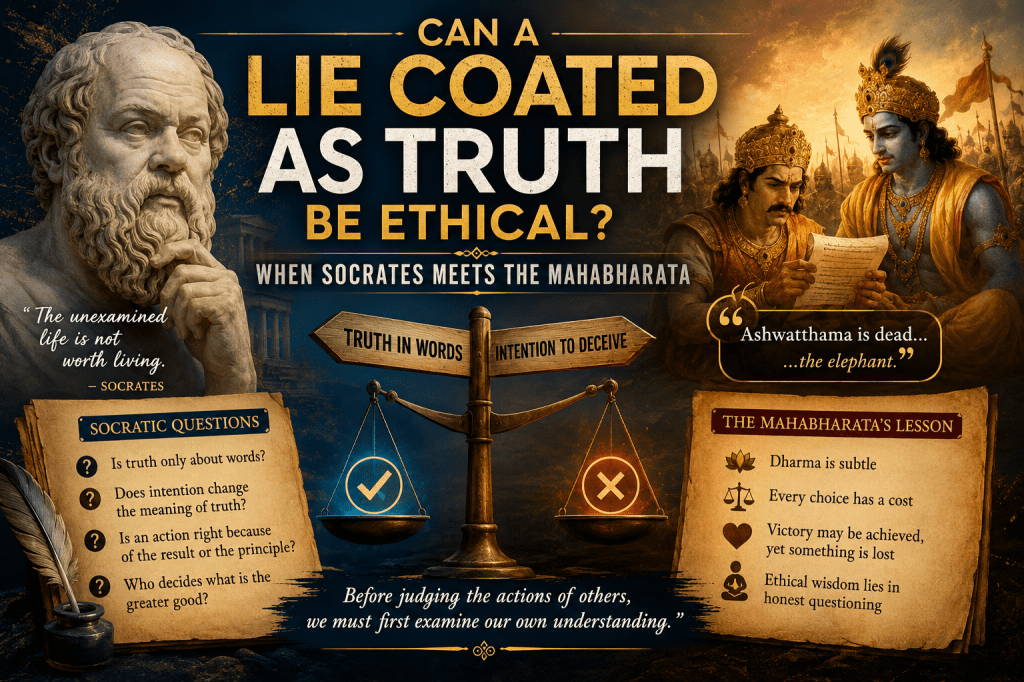
“The unexamined life is not worth living.” — Socrates
One of the most intriguing questions in ethics is whether a statement that is technically true, but deliberately intended to mislead, can be considered morally acceptable.
The question is not merely philosophical. It confronts us in everyday life, politics, diplomacy, warfare, and even personal relationships.
Thousands of years ago, the Mahabharata presented this dilemma in one of its most famous episodes—the death of Dronacharya.
Perhaps Socrates himself would have enjoyed debating it.
The Incident
During the Kurukshetra war, Dronacharya was proving nearly invincible. As commander of the Kaurava army, he was inflicting immense damage on the Pandava forces.
Krishna realized that defeating him through conventional means would be nearly impossible.
A plan was devised.
An elephant named Ashwatthama was killed. Thereafter, Yudhishthira—the very embodiment of truthfulness—announced:
“Ashwatthama is dead.”
Then, in a much softer voice, he added:
“The elephant.”
Dronacharya heard only the first part.
Believing that his beloved son Ashwatthama had been killed, he lost the will to fight, laid down his weapons, and was subsequently slain.
The statement was factually true.
Yet it was intentionally misleading.
Was it ethical?
A Socratic Inquiry
Socrates rarely gave answers.
Instead, he asked questions.
Let us examine the episode through a Socratic lens.
Question One
Was Yudhishthira’s statement true?
Yes.
An elephant named Ashwatthama had indeed died.
Question Two
Did Yudhishthira intend Dronacharya to misunderstand?
Again, yes.
The entire strategy depended upon Dronacharya believing that his son was dead.
Question Three
If a person intentionally creates a false belief in another’s mind while speaking technically true words, has he spoken the truth?
Now the matter becomes complicated.
Truth is not merely about words.
It is also about intention.
Truth and Intention
Imagine a traveler asking for directions.
Suppose I knowingly point him toward the wrong road while speaking words that are technically accurate.
Have I helped him?
Or have I deceived him?
Most people would say that my intention matters.
The same question arises in the Mahabharata.
The words were true.
The purpose was deception.
Can truth remain truth when its purpose is to mislead?
The Ethical Dilemma
Here we encounter two competing moral principles.
Principle One: Truth Must Never Be Compromised
According to this view, honesty is a virtue in itself.
If deception is intended, then even technically true statements become ethically questionable.
A Socratic thinker might argue that truthfulness loses its meaning when used as a disguise for falsehood.
Principle Two: The Greater Good
The opposing argument asks:
What were the consequences?
Had Dronacharya continued fighting, countless more soldiers may have died.
The war might have lasted longer.
The cause of Dharma may have suffered.
If a limited deception prevents a greater tragedy, can it be justified?
This is the argument Krishna appears to advance.
The Mahabharata’s Unique Perspective
The genius of the Mahabharata lies in the fact that it does not offer easy answers.
It neither completely condemns nor completely celebrates the act.
Instead, it acknowledges the moral cost.
Tradition tells us that before this incident, Yudhishthira’s chariot floated slightly above the earth because of his perfect truthfulness.
After the Ashwatthama episode, the chariot touched the ground.
Whether literal or symbolic, the message is profound:
Even justified deception leaves a mark on the soul.
Victory may be achieved.
Yet something is lost.
A Question for Modern Times
The dilemma remains relevant today.
Governments sometimes conceal information for national security.
Doctors occasionally soften painful truths for patients.
Military commanders use deception in warfare.
Parents may tell comforting half-truths to protect children.
Each case raises the same question:
Can a lie coated as truth ever be ethical?
Or does the intention to deceive make it morally flawed regardless of the outcome?
What Would Socrates Ask?
Rather than answering, Socrates might ask:
- Is an action right because it produces good results?
- Or is it right because it is morally correct in itself?
- If deception is allowed for noble purposes, who decides what is noble?
- Can society remain ethical if everyone justifies deception by appealing to a greater good?
These questions remain as challenging today as they were twenty-four centuries ago.
My Reflection
The episode of Ashwatthama is not simply about truth or falsehood.
It is about the tragic complexity of human life.
Sometimes we are forced to choose not between right and wrong, but between two competing notions of right.
The Mahabharata teaches us that Dharma is often subtle.
Socrates teaches us that every moral claim deserves examination.
Together they remind us that ethical wisdom is not found in easy answers but in honest questioning.
Perhaps the most important lesson is this:
Before judging the actions of others, we must first examine our own understanding of truth, intention, duty, and consequence.
And that, Socrates would say, is where genuine wisdom begins.
Guchi.
 Improve Your Life