By Major General (Retd.) Gurcharan Aulakh
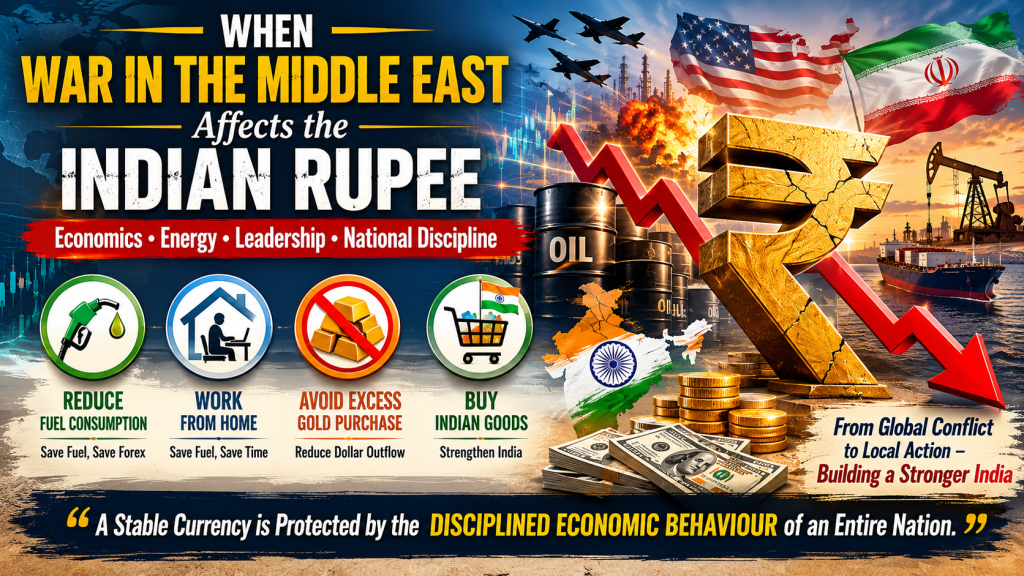
When War in the Middle East Affects the Indian Rupee.
Lessons in Economics, Energy, Leadership and National Discipline
The recent tensions involving the USA and Iran once again reminded the world how deeply geopolitics affects economics. Whenever conflict erupts in the Middle East, oil prices react immediately, financial markets become nervous, and currencies of oil-importing countries come under pressure.
India, being one of the world’s largest importers of crude oil, naturally feels the impact strongly. Many people ask:
“Why does the Indian Rupee weaken during such international conflicts?”
The answer lies in a combination of oil dependency, global investor psychology, inflation, foreign exchange demand, and economic confidence.
Why Rising Crude Oil Weakens the Rupee
India imports nearly 85% of its crude oil requirements.
When war or instability threatens oil-producing regions like Iran or the Strait of Hormuz, global crude prices rise sharply because markets fear disruption in supply.
Suppose crude oil rises from:
- $70 per barrel to $100 per barrel.
India then needs billions of extra dollars to buy the same quantity of oil.
This creates immediate pressure:
- Indian companies sell more rupees,
- buy more dollars,
- and the rupee weakens.
In simple economic terms:
greater demand for dollars reduces the value of the rupee.
The Domino Effect on the Indian Economy
Higher oil prices do not remain confined to petrol pumps.
They affect:
- transport,
- fertilizers,
- aviation,
- electricity,
- logistics,
- manufacturing,
- and food prices.
Diesel is the backbone of transportation in India. When diesel prices rise, transportation costs increase and inflation spreads across the economy.
As inflation rises:
- household spending weakens,
- production costs increase,
- and GDP growth slows.
Thus, a conflict thousands of kilometres away begins affecting the daily life of an ordinary Indian citizen.
Foreign Investors and the Share Market
During global uncertainty, foreign institutional investors (FIIs) often pull money out from emerging markets like India and move towards safer assets such as US government bonds.
This causes:
- selling in Indian stock markets,
- fall in Sensex and Nifty,
- and further pressure on the rupee.
The process becomes self-reinforcing:
fear weakens markets,
and weak markets create more fear.
The Psychological Side of Economics
Currencies are influenced not only by facts but also by expectations.
If traders believe:
- war may escalate,
- oil prices may rise further,
- or shipping routes may get disrupted,
they begin buying dollars aggressively.
Sometimes fear itself moves markets faster than actual economic damage.
Why Prime Minister Modi’s Advice Makes Economic Sense
During such uncertain periods, Prime Minister Narendra Modi has often advised citizens to:
- reduce fuel consumption,
- work from home where possible,
- avoid excessive gold purchases,
- and support Indian-made products.
At first glance, these suggestions may appear simple.
But economically, they are extremely significant.
Reducing Fuel Consumption
Fuel conservation directly reduces oil imports.
Even small behavioural changes by millions of citizens create massive national savings.
If crores of Indians:
- reduce unnecessary driving,
- use public transport,
- or conserve electricity,
India imports less crude oil and spends fewer dollars.
This helps:
- reduce pressure on the rupee,
- lower inflation,
- and improve economic stability.
Energy conservation thus becomes not merely a personal habit, but a national economic responsibility.
Work From Home and Economic Efficiency
The COVID period demonstrated that millions of people commuting daily consume enormous amounts of fuel.
Remote work:
- reduces fuel consumption,
- lowers traffic congestion,
- decreases pollution,
- and saves foreign exchange.
For a country heavily dependent on imported oil, work-from-home policies can indirectly support currency stability.
Why Excessive Gold Buying Hurts the Economy
India has a deep cultural attachment to gold.
However, most gold is imported using precious foreign exchange.
When citizens buy large quantities of imported gold:
- billions of dollars leave India,
- current account deficit widens,
- and pressure on the rupee increases.
Unlike factories or industries, idle gold stored in lockers does not significantly contribute to productivity or economic growth.
Therefore, governments encourage investments in:
- businesses,
- infrastructure,
- manufacturing,
- and financial markets instead of excessive gold imports.
Buying Indian Goods and Strategic Self-Reliance
The call to support Indian products is linked to the broader vision of “Atmanirbhar Bharat” — a self-reliant India.
When citizens buy locally manufactured goods:
- domestic industries grow,
- employment rises,
- tax revenues increase,
- and imports reduce.
Economic self-reliance is not only an economic policy.
It is also a strategic necessity.
Recent global conflicts have shown how excessive dependence on foreign supply chains can become a national vulnerability.
A Military Perspective on Economic Discipline
As someone from a military background, I often see striking similarities between economics and military logistics.
During prolonged military operations:
- fuel discipline,
- resource conservation,
- supply chain security,
- and redundancy become critical.
A nation’s economy functions similarly.
Foreign exchange reserves are like strategic reserves.
Oil supply lines resemble wartime logistics.
Investor confidence resembles troop morale.
And just as armies prepare for uncertainty through discipline and planning, nations too must strengthen themselves through economic prudence and self-reliance.
Final Thoughts
The fall of the Indian Rupee during international crises is not caused by one factor alone.
It is the combined result of:
- rising crude oil prices,
- higher dollar demand,
- foreign investor behaviour,
- inflationary pressure,
- market psychology,
- and structural dependence on imports.
At the same time, simple national habits can collectively strengthen economic resilience:
- conserving fuel,
- supporting domestic industry,
- reducing unnecessary imports,
- and investing productively.
In the modern world, economic strength is as important as military strength.
And a stable currency is not protected merely by central banks —
it is protected by the disciplined economic behaviour of an entire nation.
Guchi.
 Improve Your Life
This is a very clear, thoughtful, and accessible explanation of how global geopolitics directly affects everyday economic life in India. What makes the piece especially effective is the way it simplifies complex economic concepts — oil dependency, currency pressure, inflation, investor behavior, and market psychology — into language that ordinary readers can easily understand without losing depth or seriousness.
LikeLiked by 1 person