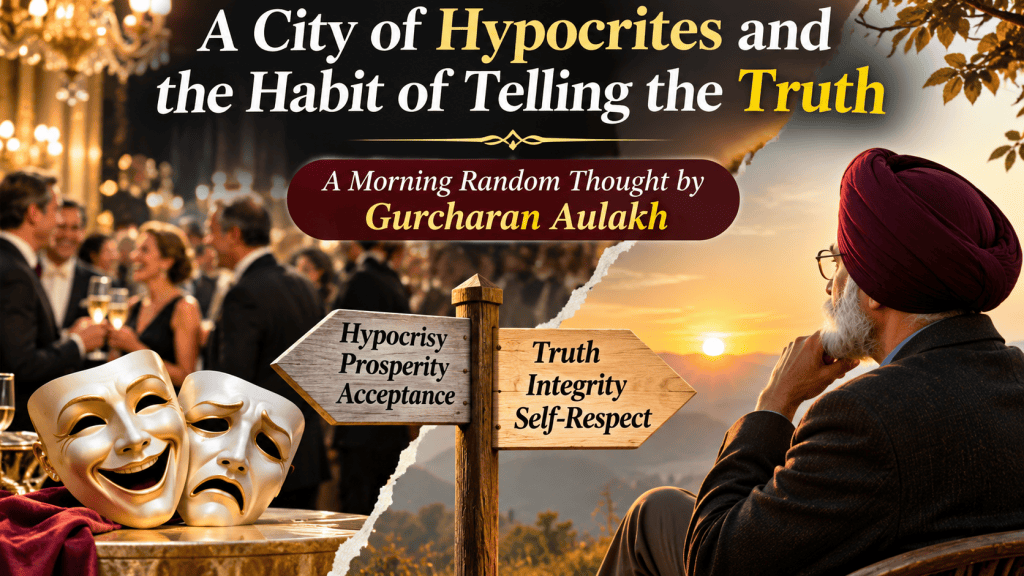
A Morning Random Thought by Gurcharan Aulakh
(Inspired by the beautiful couplet of Parveen Shakir):
خوش آئے تجھے شہرِ منافق کی امیری
ہم لوگوں کو سچ کہنے کی عادت بھی بہت تھی
Khush aaye tujhe shahr-e-munafiq ki amiri,
Hum logon ko sach kahne ki aadat bhi bahut thi.
May the prosperity of the city of hypocrites please you;
We, however, were rather accustomed to speaking the truth.
When prosperity and principles travel in opposite directions
There are certain poetic expressions that make you pause, listen again and reflect. Parveen Shakir’s above-mentioned couplet is one such expression. At first glance, it appears to be a simple contrast between two individuals or two ways of life. But on reflection, it opens up a much larger debate about society, human relationships, material prosperity and personal integrity.
What exactly is a city of hypocrites? Is it a geographical location, a particular social class, or a metaphor for a society where appearances matter more than substance?
Perhaps all three, depending on the circumstances.
We often associate hypocrisy with people who profess certain values but practise something entirely different. They speak of honesty but conveniently compromise it. They preach simplicity but pursue extravagance. They advocate equality but practise discrimination. They celebrate friendship but measure relationships by personal advantage.
Unfortunately, this is not an uncommon phenomenon.
The sophisticated world of social hypocrisy
One does not have to look very far to encounter this contradiction. In certain sections of what is popularly described as high society, social acceptance can sometimes become more important than personal conviction.
There are people who have mastered the art of saying the right things to the right people at the right time. Compliments are generously distributed, disagreements are carefully concealed, and relationships are maintained through calculated diplomacy.
Flattery is mistaken for good manners. Silence is interpreted as wisdom. Compromise is presented as maturity. And sometimes, speaking an inconvenient truth is considered a social offence.
The irony is that such environments may appear extremely sophisticated from the outside. Expensive homes, impressive social gatherings, influential acquaintances and polished conversations create an image of success.
But sophistication without sincerity is merely decoration.
Let us be clear, however: wealth is not a vice, high society is not inherently hypocritical, and diplomacy is not necessarily dishonesty. The problem arises when social status becomes more important than character and appearances take precedence over authenticity.
The price of speaking the truth
Now comes the other half of Parveen Shakir’s couplet.
“We had the habit of speaking the truth.”
Notice the choice of the word habit. It is not an occasional act of courage or a calculated display of honesty. It suggests a deeply ingrained characteristic, something that has become part of one’s personality.
And perhaps this is where the real difficulty begins.
Truthfulness is admirable in principle, but not always welcome in practice. People appreciate honesty as long as it does not question their conduct, expose their contradictions or disturb their convenience.
A person who habitually speaks the truth may find himself uncomfortable in environments where pleasing others is considered more important than being sincere.
He may lose invitations, friendships, opportunities and even social standing. His straightforwardness may be labelled arrogance, his disagreement negativity and his refusal to flatter an inability to adjust.
Sometimes, the honest person is not rejected because he is wrong, but because his presence makes others uncomfortable.
Yet there is a distinction between being truthful and being unnecessarily blunt. Honesty does not require discourtesy. One can disagree without humiliating, correct without insulting and speak firmly without becoming offensive.
Truth needs courage, but it also needs sensitivity.
Are we all participants in this hypocrisy?
It would be convenient to blame the so-called elite, wealthy or influential sections of society. But that would be an incomplete assessment.
Hypocrisy is not restricted to any particular economic class, profession, generation or social group. It can exist in a drawing room, a corporate office, a political establishment, a family gathering or even among people who publicly claim to uphold the highest moral and spiritual values.
We all need to examine ourselves.
Have we ever praised someone publicly while criticising them privately? Have we ever supported an argument merely because it came from someone influential? Have we remained silent when we should have spoken? Have we sacrificed a principle to preserve a relationship or secure a personal advantage?
These are uncomfortable questions, but necessary ones.
After all, it is relatively easy to identify hypocrisy in others. Recognising it in ourselves requires considerably greater honesty.
The luxury of belonging versus the dignity of independence
There is an important philosophical choice hidden in this couplet.
Should one adjust one’s convictions to remain acceptable in a particular social environment, or preserve one’s individuality even if it means standing apart?
There is nothing wrong with adjustment. Human relationships require accommodation, patience and compromise. No society can function if everyone insists on having the final word.
But there is a difference between adjusting one’s behaviour and surrendering one’s conscience.
We can be polite without being pretentious, diplomatic without being dishonest, ambitious without being manipulative and prosperous without losing our principles.
Material prosperity is a legitimate aspiration. Social recognition is not necessarily undesirable. But neither should become so important that we begin negotiating our integrity.
There is a certain dignity in being able to look at oneself without embarrassment.
Perhaps that is the real freedom: not having to remember what one said to whom, not having to maintain different versions of oneself in different company, and not having to compromise one’s convictions merely to remain in someone’s good books.
A final reflection
Parveen Shakir’s couplet carries a quiet sadness, but also a certain defiance. It does not appear to plead for acceptance or seek approval. It simply draws a line between two different ways of living.
One may choose the prosperity of a city where hypocrisy is the accepted currency. Another may choose the relative discomfort of a life governed by honesty.
The choices have different consequences, and neither comes without a price.
But perhaps we should ask ourselves one final question:
What is the point of reaching the highest social circles if, somewhere along the way, we lose the very character that made us worthy of reaching there?
A society does not become truly prosperous merely because its people become wealthy. Its real prosperity lies in the honesty of its relationships, the integrity of its institutions and the dignity with which its people treat one another.
I would rather belong to a modest circle where words mean something than an impressive one where every word has to be weighed for personal advantage.
After all, wealth can purchase a place in a city. It cannot purchase the peace of a clear conscience.
And if speaking the truth occasionally makes us unwelcome, perhaps we should examine the company rather than abandon the habit.
Guchi.


A deeply thought-provoking reflection, Gurcharan ji! Parveen Shakir’s beautiful couplet captures a timeless conflict between material prosperity and personal integrity. Your interpretation brings out the uncomfortable realities of a society where appearances, convenience and personal gains sometimes take precedence over honesty and principles.
LikeLiked by 1 person
Thank you Sir, for your wise amplification. Much appreciated.
LikeLike