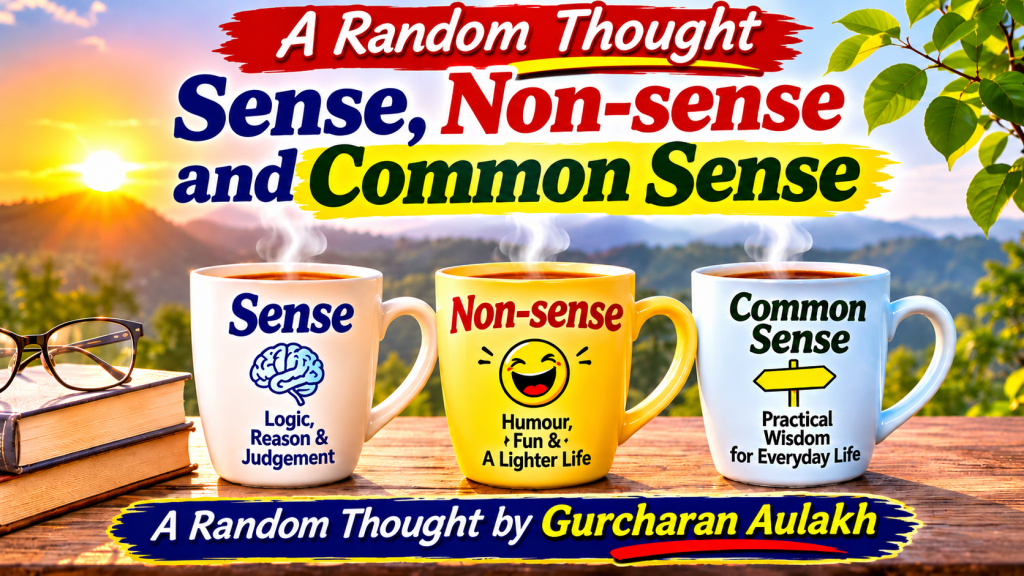
Sense, Non-sense and Common Sense!
Three companions of the human mind — not always travelling in the same direction!
We human beings are interesting creatures. We possess an extraordinary capacity to make sense of things, an equally extraordinary ability to talk nonsense, and an often questionable claim to possessing common sense!
All three coexist within us. The proportions may differ, but nobody is entirely devoid of any one of them.
Let us examine these three rather interesting dimensions of human behaviour.
1. Sense – The business of being sensible
Sense is our ability to understand, reason, judge and respond appropriately to situations. It is what helps us distinguish between right and wrong, practical and impractical, relevant and irrelevant.
It is closely associated with logic, experience, intelligence and sound judgement.
But there is a catch!
Too much dependence on logic can make life rather predictable, mechanical and sometimes boring. A person who insists on rationalising every conversation, every joke and every human emotion may be perfectly logical but not necessarily pleasant company.
Life is not a mathematical equation. Not everything needs a solution, an explanation or a conclusion.
Sometimes, a little irrationality is perfectly rational!
2. Non-sense – The art of not making sense!
Now comes the interesting part.
Nonsense is generally understood as something that lacks logical meaning, coherence or practical purpose. But does that necessarily make it useless?
Absolutely not!
Humour, satire, absurdity, playful exaggeration and spontaneous banter often thrive on deliberate nonsense.
A good joke does not necessarily need to make sense. It needs to make people laugh.
A humorous conversation need not have a beginning, a middle and an end. Sometimes its entire purpose is to provide a few moments of unadulterated amusement.
Think of children. They can laugh at the most ridiculous things, invent imaginary situations and enjoy conversations that make absolutely no sense to adults.
Perhaps they understand something we have forgotten: not every moment of life needs to be serious.
There is a difference between harmless nonsense and irresponsible nonsense. The former adds colour to life; the latter can create confusion and trouble.
Nonsense, without malice or ulterior motive, is sometimes the most sensible way of enjoying life!
3. Common Sense – The most uncommon of the three!
Here is where things become even more interesting.
Common sense is generally understood as practical wisdom: the ability to make reasonable decisions in ordinary, everyday situations without needing elaborate analysis or expert advice.
It is not necessarily associated with academic qualifications, intellectual brilliance, professional standing or age.
A highly educated person may lack common sense, while someone with very little formal education may demonstrate remarkable practical wisdom.
Why is it called common sense when it appears to be so uncommon?
Perhaps because everybody claims to possess it, particularly when somebody else fails to demonstrate it!
Common sense is also contextual. What seems perfectly obvious to one person may not occur to another. Experience, upbringing, observation and the ability to understand consequences all play their part.
And there is another interesting distinction:
- Sense helps us understand.
- Common sense helps us deal with everyday situations.
- Non-sense sometimes helps us forget, for a while, that everything in life needs to be understood!
4. The interesting relationship between the three
These three are not necessarily enemies. They complement one another.
Sense provides direction. Common sense provides practical navigation. Nonsense provides entertainment and occasionally challenges our rigid thinking.
Even philosophy has explored this relationship. Wittgenstein examined the boundaries between meaningful language and nonsense, while philosophers studying humour have explained how unexpected contradictions and incongruities can produce laughter.
Interestingly, humour is not merely an absence of logic. It can be a different way of looking at reality. A joke often works precisely because it takes us somewhere our conventional reasoning did not expect.
A person who has only sense may become a walking instruction manual.
A person who has only nonsense may become a walking complication.
And a person who believes that he alone possesses common sense may become a walking advertisement for its scarcity!
5. When sense becomes a burden!
There is a peculiar breed of people who cannot resist making every conversation an exercise in intellectual superiority.
They analyse a joke, question an exaggeration, correct a casual remark, challenge a figure of speech and sometimes even explain why something funny is not actually funny!
They may be right on facts, but they can be quite wrong about the occasion.
Life is not a debating society. Every conversation does not require a winner, every disagreement does not require a verdict, and every humorous remark does not need a disclaimer.
There is also a difference between wit and wisdom.
Wit can make people laugh. Wisdom can make people think. The rare individual knows when to use which.
And then there are clichés and stereotypes. They are often shortcuts for the mind, but excessive dependence on them makes our thinking repetitive. We begin to respond to situations automatically rather than understand them afresh.
Sometimes, what we call common sense is merely conventional thinking dressed up as wisdom!
6. A little nonsense is good for the soul!
Imagine a gathering where everybody speaks sensibly, discusses serious subjects, quotes statistics, offers advice and arrives at logical conclusions.
After two hours, everybody leaves feeling intellectually enriched but desperately in need of entertainment!
Now imagine another gathering where people laugh at themselves, exchange harmless jokes, indulge in absurd observations and occasionally say things that make absolutely no sense.
Which gathering would you prefer to revisit?
I suspect the second one!
There is something liberating about humour without an agenda. No hidden message, no moral sermon, no political insinuation, no personal attack and no strings attached.
Just laughter!
Of course, humour should not become an excuse for insulting people or making somebody else uncomfortable. The best humour includes the ability to laugh at oneself.
Perhaps that is also a sign of emotional maturity.
7. My concluding thought
We need all three.
We need sense to keep our feet on the ground, common sense to prevent us from making avoidable mistakes, and nonsense to keep life from becoming unbearably serious.
Too much logic can make conversations dry. Too much nonsense can make them meaningless. Too much assumed common sense can make us intolerant of people who think differently.
The real art is knowing when to be sensible, when to be practical and when to be delightfully ridiculous!
After all, we spend a considerable part of our lives trying to make sense of things. Perhaps we should occasionally allow ourselves the luxury of not making any sense at all.
My prescription for the day:
- Use your sense when making decisions.
- Apply common sense before taking action.
- Enjoy nonsense whenever the occasion permits.
- Never take yourself so seriously that you forget how to laugh!
And finally, a little piece of nonsense, which might actually make some sense:
Common sense tells us to behave sensibly. Sense tells us why. Nonsense tells us that behaving sensibly all the time can itself be quite senseless!
A morning thought worth neither debating nor analysing. Just smile and get on with the day!
Gurcharan Aulakh

