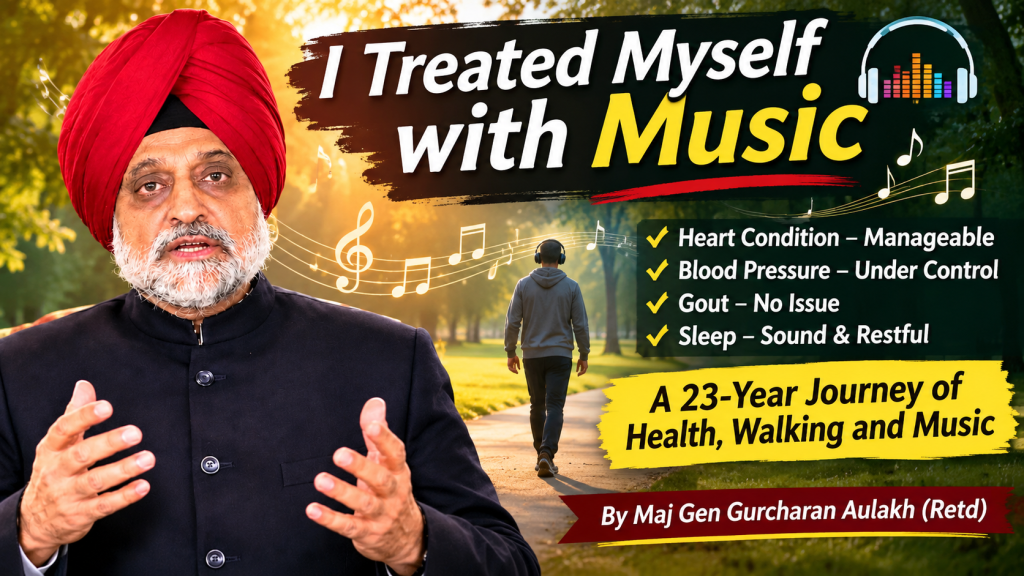
23 Years of Living with Music, Walking with Music, and Finding a Better Way to Live
By Maj Gen Gurcharan Aulakh (Retd.)
There are medicines that treat the body. There are therapies that help the mind. And then there is something that has accompanied me through the better part of my adult life — something I never prescribed to myself, never purchased on a doctor’s recommendation, and never considered a medical treatment.
MUSIC.
For me, music has been much more than entertainment. It has been a companion during difficult times, a source of motivation during physical activity, a means of relaxation when life becomes demanding and, above all, an integral part of my daily existence.
I sometimes say, with a little humour, that I treated myself with music.
This is not a medical claim. It is a personal account of an experience spanning nearly 23 years. Every word of it is true to the best of my recollection.
And perhaps there is a lesson in this experience worth sharing.
THE BEGINNING: WHEN THE BODY STARTED SENDING SIGNALS
My relationship with music as a source of personal comfort became particularly important when I began experiencing health challenges.
Let me put the chronology on record.
- 2001: Hypertension.
- 2003: Angina Pectoris, with partial blockages in the coronary arteries.
- 2005: Gout.
- 2006: Slightly elevated blood sugar levels and disturbed sleep, including insomnia.
At that time, I was still serving in the Indian Army. Military life, with its responsibilities, commitments, professional demands and occasional operational pressures, was hardly a relaxed existence.
I managed my conditions with prescribed medicines, exercise and other appropriate measures. But somewhere along the way, I discovered that music, particularly when combined with walking, had an extraordinary place in my everyday routine.
I was fascinated by music even before these health challenges. What changed was the way I began incorporating it into my life.
I retired from the Army in 2009. Seventeen years have passed since then.
Today, my heart condition remains manageable. I have had no stents and no cardiac operation. Gout is no longer an issue in my everyday life. My blood pressure is well controlled, my sleep is sound, and I continue to enjoy considerable physical energy.
I am approaching 76, and I still have an enthusiasm for life that I consider one of my greatest blessings.
I do not attribute all these outcomes to music. That would be an irresponsible medical conclusion. But I cannot ignore the role music has played in helping me maintain a disciplined, active and positive lifestyle.
365 DAYS A YEAR: THE DISCIPLINE OF WALKING
If there is one habit I would single out from my life after retirement, it is my morning walk.
I have walked with music for years. It has become almost impossible for me to imagine a morning walk without headphones and music.
Rain or sunshine, summer or winter, I try not to miss it.
I have maintained this routine for 365 days a year. When the weather does not permit outdoor walking, I walk indoors, including in the basement. During air travel, I use the long corridors between airport terminals to keep moving. Sometimes I use a treadmill, but nothing quite replaces my morning walk.
Music provides the rhythm, motivation and companionship.
I do not have to persuade myself to exercise every morning. The music itself draws me out of bed.
This, perhaps, is one of the most valuable discoveries of my life: find an activity that you enjoy so much that discipline no longer feels like a burden.
For me, music transformed walking from an exercise prescription into a pleasure.
I am not suggesting that everybody must walk as much as I do. The duration and intensity of physical activity must be appropriate to one’s age, fitness and medical condition. Consistency matters more than competition.
WHAT DO I LISTEN TO? ALMOST EVERYTHING!
I have never restricted myself to a particular genre or school of music. My musical interests are wide-ranging:
- Indian classical music and ragas.
- Meditational and instrumental tracks.
- Sufi music and the poetry of Sufi saints.
- Ghazals.
- Bollywood melodies, old and new.
- Punjabi cultural and folk songs.
- Shabads of Gurbani.
- Mantras and Shalokas.
- Devotional music from different traditions.
I believe music has no boundaries. It does not ask about your religion, nationality, language, age or profession.
A raga can transport me into a different world. A Sufi composition can make me reflect on the meaning of existence. A beautiful ghazal can bring back memories. A lively Bollywood number can increase my walking enthusiasm. A Shabad can bring an entirely different kind of peace.
Sometimes I want rhythm; sometimes I want silence between musical notes. Sometimes I want to listen to a powerful composition, and sometimes a gentle flute is enough.
The choice depends on my mood.
I don’t select music according to a prescription. I select it according to what my mind needs at that particular moment.
MUSIC, STRESS AND BLOOD PRESSURE: MY PERSONAL EXPERIENCE
There are occasions when I find my blood pressure slightly elevated.
My usual response is to remain calm, follow my medical advice and, when it is appropriate and safe, go for a gentle walk with music.
On returning, I often find that my blood pressure has settled into an acceptable range.
I have experienced this repeatedly. But I am conscious that an individual experience is not proof of a medical relationship. Walking, rest, relaxation, medication and several other factors can influence blood pressure.
What I can confidently say is that music helps me relax and prevents me from becoming unnecessarily preoccupied with occasional fluctuations.
Life has its challenges. At my age, as at any age, there are moments of disappointment, anxiety, uncertainty and emotional disturbance.
I have discovered a simple personal remedy.
I put on my headphones and walk.
If I do not feel like walking, I sit in front of my music system and listen. Sometimes I choose Sufi music, sometimes Gurbani, sometimes mantras or Shalokas.
Gradually, my attention moves away from whatever was troubling me. I become calmer. My thoughts become more organised, and the problem often appears less overwhelming.
The problem may not have disappeared, but my relationship with the problem has changed.
That is an important distinction.
Music does not necessarily change our circumstances. It can change the emotional space from which we face them.
WHAT DOES SCIENCE SAY?
My experience is personal, but the relationship between music, relaxation and human well-being has also attracted considerable scientific interest.
There is an interesting body of research worth mentioning.
1. Music and stress reduction
A systematic review published in 2020 examined 104 randomised controlled trials involving 9,617 participants. The researchers found that music interventions had beneficial effects on physiological and psychological measures of stress, including heart rate, blood pressure and anxiety-related experiences.
This suggests that music may influence not only how we feel but also certain measurable bodily responses.
2. Music and cardiovascular health
Research involving people with coronary heart disease has examined whether listening to music can help reduce anxiety and stress associated with cardiac conditions.
A Cochrane review covering 26 trials and 1,369 participants found indications of benefits for anxiety, heart rate and systolic blood pressure, although the researchers cautioned that the studies were generally small and the clinical importance of some findings was uncertain.
3. Music and sleep
Sleep is another area where music has attracted scientific attention.
A Cochrane review of 13 studies involving 1,007 adults examined the effects of listening to recorded music for people experiencing sleep difficulties. The findings suggested improvements in subjective sleep quality.
This is particularly relevant to my own experience. I listen to music through headphones before going to sleep, and I generally sleep very soundly.
4. Walking and healthy ageing
The World Health Organization recommends regular physical activity for older adults. Its guidelines recognise the benefits of physical activity for cardiovascular health, blood pressure, diabetes prevention, mental health, cognitive health and sleep.
For older adults, the WHO recommends 150–300 minutes of moderate-intensity aerobic activity per week, along with appropriate muscle-strengthening and balance activities.
The scientific picture, therefore, is encouraging but requires sensible interpretation.
Music can be a useful companion to a healthy lifestyle. Walking has well-established health benefits. Combining the two may make physical activity more enjoyable and sustainable.
That is precisely what happened in my life.
MY RELATIONSHIP WITH MUSIC THROUGHOUT THE DAY
Music is not confined to my morning walk. It accompanies me at different times and in different moods.
Early morning: 4:30 AM
I am generally awake by 4:30 in the morning.
Before the household becomes active, I put on my headphones and listen to meditation tracks. I keep the volume comfortable so that my wife is not disturbed.
It is a peaceful beginning to the day.
Morning walk
This is my principal musical session. I may listen to anything from a classical raga to a Sufi composition, from a Punjabi song to an instrumental piece.
I walk, listen and enjoy the surroundings.
When I am not feeling well
If I am feeling a little low, physically or emotionally, I sometimes take a gentle walk with music, provided my condition permits it. The movement and music often help lift my spirits.
When life becomes demanding
There are occasions when I simply sit in front of my television and music system and listen for 30–40 minutes.
In the evenings, I particularly enjoy soft music, although my choice is not always restricted to gentle compositions.
A good sound system can make the experience quite immersive.
Music allows me to disconnect temporarily from the demands of the day.
Before sleeping
I listen to music through headphones before going to sleep. It has become part of my bedtime routine.
I do not need elaborate preparations. A familiar, soothing composition is often enough.
FROM LISTENER TO LYRICIST: MUSIC HAS GIVEN ME ANOTHER CREATIVE LIFE
Something interesting has happened in recent years.
I have moved beyond merely listening to music. I have started writing lyrics based on my own thoughts, observations, experiences and reflections on life.
With the help of Artificial Intelligence tools, I now compose music and turn some of these lyrics into songs.
It has opened up an entirely new creative world.
Sometimes I write a motivational song. Sometimes a Sufi-inspired composition. At other times, I put together a Punjabi or Hindi song, a reflective melody or a musical expression of an idea that has been occupying my mind.
I then listen to my own compositions.
There is a special pleasure in listening to something that originated as a thought in one’s mind, became words on paper and eventually took the form of music.
I have discovered that music is not only something to consume. It is something to create.
It keeps the mind occupied, curious and imaginative.
Perhaps this is another dimension of healthy ageing: continuing to learn, experiment and create rather than allowing retirement to become a period of inactivity.
EVEN GOLF BECOMES A MUSICAL EXPERIENCE
I occasionally play golf, usually alone rather than as part of a foursome.
I carry my mobile phone and listen to music between shots. I enjoy the game at my own pace, without the pressure of competition or conversation.
And there is another pleasure.
When I spot a beautiful bird, a peacock or a group of blue bulls running across the golf course, I stop to take photographs.
Golf, music, nature and photography come together in one experience.
I am not necessarily trying to improve my handicap. I am enjoying the outdoors, keeping physically active and appreciating the little things that nature offers.
I sometimes wonder whether we make life unnecessarily complicated by trying to turn every activity into a competition.
There is tremendous satisfaction in doing something simply because we enjoy it.
RETIREMENT IS NOT THE END OF AN ACTIVE LIFE
I served in the Indian Army for 38 years, in addition to four years of military training. I was commissioned in 1971 and retired in 2009.
Military service teaches discipline, perseverance, physical endurance and the importance of routine.
Perhaps those years shaped my approach to retirement.
I never considered retirement an invitation to slow down mentally or physically. It was an opportunity to organise life differently.
Seventeen years into retirement, I continue to walk, write, create music, experiment with technology, travel, explore ideas and enjoy nature.
I do take vitamins and some medicines as appropriate for my age and medical needs. I am not trying to prove that age has no consequences. Growing older is natural, and looking after one’s health becomes increasingly important.
But I believe that maintaining enthusiasm is equally important.
Music has been one of my strongest companions in this journey.
CAN MUSIC REPLACE MEDICINES?
Let me make one thing absolutely clear.
I am not a doctor. I do not claim that music can remove arterial blockages, cure angina, eliminate hypertension, treat gout or replace any medical procedure.
I have never suggested that anybody should discontinue prescribed medication because they enjoy listening to music.
If someone has coronary artery disease, hypertension or diabetes, proper medical assessment, medication when prescribed, and appropriate lifestyle management remain essential.
Nor should anyone with a cardiac condition suddenly begin a strenuous walking programme without medical guidance.
Music is not a substitute for medical treatment.
But why should we ignore something that is accessible, enjoyable and may help us manage everyday stress, improve our mood and make physical activity more pleasurable?
Why should we not use music as a complementary part of our lifestyle?
One should also take sensible precautions: keep headphone volume at a safe level, remain aware of traffic and surroundings when walking outdoors, and avoid using headphones in situations where they compromise safety.
And that is where I believe music deserves much greater recognition in our everyday lives.
MY PERSONAL PRESCRIPTION: MUSIC, MOVEMENT AND MINDFULNESS
If I were to summarise my experience of the last 23 years, I would put it into three words:
MUSIC. MOVEMENT. MINDFULNESS.
Music gives me pleasure and emotional companionship.
Movement keeps me physically active.
Mindfulness helps me remain composed and appreciate the present.
I have not followed a complicated programme. I have simply developed a routine that I enjoy and have sustained over many years.
I walk with music. I relax with music. I sleep with music. I create music. And when I encounter difficulties, music is often among the first things I turn to.
There are days when I listen to a Shabad and reflect on its message. There are days when a Sufi poet expresses something that I could not articulate myself. There are days when an old Bollywood melody takes me back several decades.
And there are days when an instrumental composition says everything without a single word.
Perhaps that is the beauty of music.
It speaks to different people in different ways, and sometimes it speaks to the same person differently at different stages of life.
A MESSAGE TO MY FELLOW SENIOR CITIZENS
I would like to share something with those who have retired or are approaching retirement.
Do not allow retirement to become a waiting room.
Find something that gives you pleasure and a reason to get up every morning.
It could be walking, gardening, music, reading, painting, writing, photography, swimming, playing an instrument or simply spending time in nature.
Do not make physical activity a punishment. Find a way to enjoy it.
Do not underestimate the importance of mental engagement. Keep learning. Explore new technologies. Write something. Create something. Share your experiences.
And above all, do not postpone happiness.
You do not need an expensive membership, elaborate equipment or a complicated lifestyle to begin enjoying many of these activities.
Sometimes, all you need is a pair of comfortable walking shoes and a collection of music you love.
Of course, adapt everything to your health and circumstances.
MY FINAL REFLECTION
I have spent 42 years in the military environment, including training, followed by 17 years of retirement.
I have experienced professional challenges, responsibilities, health concerns and the ordinary ups and downs of life.
But for approximately 23 years, one companion has remained remarkably consistent.
MUSIC.
I do not know whether my present state of health would have been different without music. Nobody can establish that from my personal experience.
What I do know is that music has made my days more enjoyable, my walks more attractive, my moments of stress easier to manage and my retirement considerably more fulfilling.
At times, when I am listening to a beautiful composition through my headphones during an early morning walk, I feel that I am not merely exercising.
I am celebrating life.
I have no medical prescription to offer. I have only an experience to share.
And if there is one thought I would like readers to take away from this article, it is this:
DO NOT JUST ADD YEARS TO YOUR LIFE. ADD MUSIC, MOVEMENT AND JOY TO THOSE YEARS.
I treated myself with music.
And after 23 years, I am still listening!
Maj Gen Gurcharan Aulakh (Retd.)
Written from personal experience. This article is an account of an individual’s lifestyle and is not a medical advice.


What a wonderful and inspiring account, General! Your 23-year journey beautifully demonstrates how music can become more than entertainment—it can be a source of motivation, companionship and emotional well-being. I especially appreciate your emphasis on discipline and consistency, walking 365 days a year, adapting to circumstances rather than making excuses.
LikeLike