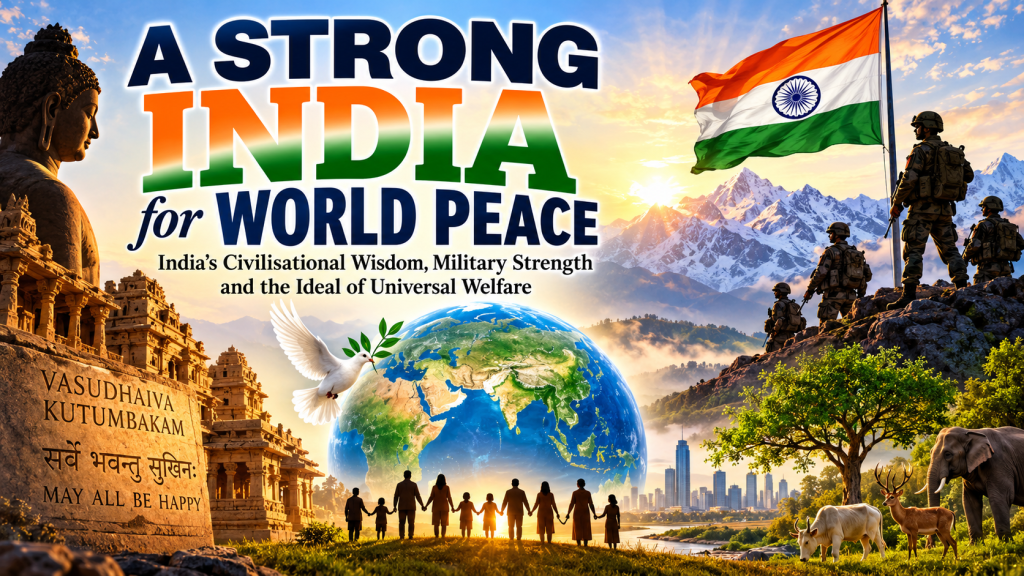
The Civilisational Philosophy of Strength, Restraint and Universal Welfare
Concept and reflections by Gurcharan Aulakh
1. Introduction: The Strength of a Civilisation
India, or Bharat, represents one of the world’s oldest continuing civilisational traditions. Its intellectual, spiritual and cultural heritage, extending from the Vedic traditions to the teachings of the Upanishads, Buddhism, Jainism, Sikhism and numerous other philosophical streams, offers a profound vision of human existence.
At the heart of this heritage lies an aspiration that transcends geographical boundaries, political divisions and differences of faith: the welfare of all living beings.
The ancient Indian expression Sarve Bhavantu Sukhinah — may all be happy — conveys a universal wish for the well-being of humanity. The principle of Vasudhaiva Kutumbakam, the world is one family, invites us to look beyond narrow national interests and recognise our shared responsibilities as inhabitants of one planet.
These are not merely spiritual sentiments. They can also guide the conduct of nations.
A country that aspires to greatness must seek more than economic prosperity, technological advancement or military superiority. It must also cultivate wisdom, restraint, compassion and a sense of responsibility towards the wider world.
This brings us to a central proposition: a strong India, guided by the principles of peaceful coexistence and universal welfare, can make a meaningful contribution to world peace.
2. The Indian Worldview: Welfare Beyond Humanity
One of the distinctive features of India’s philosophical heritage is its expansive understanding of life.
The traditional Indian worldview does not always draw a rigid boundary between human welfare and the welfare of the natural world. Human beings, animals, forests, rivers and vegetation are understood within a wider web of existence, interdependence and responsibility.
The Vedic invocation Sarve Bhavantu Sukhinah expresses a universal aspiration for happiness and freedom from suffering. The idea of Ahimsa, especially developed in Jainism and Buddhism and influential across Indian ethical traditions, places non-violence at the centre of moral conduct.
The Upanishadic traditions invite reflection on the underlying unity of existence. Later Indian philosophical and devotional movements carried related ideas into different languages, communities and forms of worship.
This heritage does not imply that every historical ruler or society always lived according to these ideals. Rather, it provides a moral framework by which conduct can be examined and improved.
The aspiration is clear: prosperity should not be achieved through needless suffering, and human advancement should not come at the cost of the natural world.
In an age of environmental degradation, climate change, biodiversity loss and conflict over resources, this philosophy has renewed relevance.
A peaceful world must be one in which people can live with dignity, animals are treated with compassion, and nature is protected for future generations.
3. A Civilisation of Assimilation and Accommodation
Indian civilisation developed through centuries of interaction among diverse peoples, languages, religious traditions, philosophical schools and cultural influences.
Rather than following a single, uniform path, it evolved through a complex process of dialogue, adaptation, coexistence and contestation.
India has been home to Hindu, Buddhist, Jain, Sikh, Islamic, Christian, Jewish, Zoroastrian and numerous indigenous traditions. Their experiences have not always been free from conflict or discrimination, but their long coexistence has contributed to a remarkably diverse cultural landscape.
Indian music, architecture, literature, cuisine, languages and artistic traditions reflect this interaction. The development of Hindustani classical music, for example, illustrates how different cultural streams contributed to a shared artistic tradition without completely losing their distinct identities.
The Bhakti and Sufi movements, in their varied forms, often emphasised devotion, humility, love and the limitations of religious arrogance. Their poets and saints communicated across social and linguistic boundaries.
This capacity for accommodation is an important civilisational resource.
Accommodation does not mean surrendering one’s identity. Nor does it mean accepting injustice or abandoning one’s convictions. It means recognising that differences need not automatically become grounds for hostility.
For a diverse nation such as India, this principle has particular significance. Its unity is strengthened when different communities can preserve their identities while participating in a common national life.
The same principle can inform relations among nations: cooperation does not require uniformity, and peaceful coexistence does not demand that every country share the same political system, religion or worldview.
4. India and the Historical Question of War
India’s civilisational traditions contain powerful teachings about restraint, yet its history, like that of other major civilisations, includes both periods of peace and periods of warfare.
It would be historically inaccurate to claim that Indian states never attacked neighbouring territories or pursued territorial expansion. Ancient and medieval Indian history records wars of conquest, shifting kingdoms and competing empires. The Mauryan Empire, the Chola Empire and other historical powers expanded their influence through military campaigns.
However, this complexity does not diminish the importance of India’s traditions of ethical restraint.
The transformation of Emperor Ashoka after the devastating Kalinga War is a striking historical example. His inscriptions express remorse over the suffering caused by war and promote Dhamma, moral conduct and concern for the welfare of his subjects and others.
Ashoka’s experience demonstrates that a ruler can reassess the meaning of victory and recognise the human cost of military conquest.
The Indian epic tradition also reflects the moral complexity of war. The Bhagavad Gita, set on the battlefield of Kurukshetra, explores duty, moral responsibility, disciplined action and the difficulty of making choices in circumstances of conflict.
These texts should not be reduced to simplistic slogans. Their continuing value lies partly in the difficult questions they ask about power, duty, justice and the consequences of human action.
In modern times, independent India has generally presented itself as a supporter of sovereignty, peaceful coexistence, diplomacy and the peaceful settlement of disputes. Its experience of colonial rule helped shape its commitment to political independence and resistance to domination by external powers.
The historical lesson is not that India has never used force. It is that military power and moral restraint must be examined together, and that the pursuit of peace requires learning from both the achievements and the failures of history.
5. Sovereignty, Independence and Non-Interference
India emerged as an independent nation in 1947 after a long struggle against British colonial rule.
The experience of colonial domination gave particular importance to sovereignty, self-determination and freedom from external control.
These principles are reflected in India’s foreign policy, including its participation in the Non-Aligned Movement and its support for the independence of countries emerging from colonial rule.
The Panchsheel principles, articulated in the 1954 agreement between India and China, included mutual respect for territorial integrity and sovereignty, mutual non-aggression, mutual non-interference in internal affairs, equality and mutual benefit, and peaceful coexistence.
The subsequent course of India-China relations demonstrates that such principles are aspirations requiring sustained effort, not guarantees against conflict.
For India, the broader principle remains important: every sovereign nation should have the freedom to determine its own future without coercion or unjustified interference from another state.
At the same time, sovereignty must coexist with international obligations, respect for human rights and the need for cooperation when problems cross national borders.
Non-interference should not become indifference to human suffering. Equally, humanitarian concerns should not be used casually as a justification for domination.
A mature foreign policy must balance national independence, international law, moral responsibility and practical realities.
6. Peace Requires Strength: The Principle of Deterrence
Peace is an aspiration, but it also requires protection.
History repeatedly demonstrates that goodwill alone cannot always prevent aggression. Nations must therefore possess the capacity to protect their sovereignty, population, territory and vital interests.
For India, a capable and modern military is an essential instrument of national security.
The purpose of military strength need not be territorial expansion or the domination of neighbours. It can instead be the prevention of war by convincing potential aggressors that the costs of aggression would be unacceptable.
This is the basic logic of deterrence.
A credible conventional military capability, supported by modern equipment, effective leadership, intelligence, logistics, training and technological innovation, reduces the temptation for an adversary to assume that India can be pressured with impunity.
Conventional deterrence also depends on resilience: secure communications, reliable supply chains, protected infrastructure, cyber defence, space-based capabilities and the capacity to sustain operations when challenged.
For a country with India’s geography and security environment, preparedness cannot be neglected.
Nuclear deterrence presents an even more serious responsibility. India maintains a nuclear arsenal as part of its national security posture and has publicly articulated a policy of credible minimum deterrence and a no-first-use commitment, subject to the qualifications contained in its stated doctrine.
Nuclear weapons, however, are fundamentally different from conventional arms. Their destructive consequences could extend far beyond the battlefield and affect generations.
Nuclear deterrence therefore requires exceptionally careful political control, secure command-and-control systems, responsible doctrine, effective communication and continuing efforts to reduce the risk of miscalculation.
The objective must never be to make war more attractive. It must be to make the initiation of war less likely.
The ultimate measure of military preparedness is not how frequently a nation uses its power, but how effectively it protects its people while helping to prevent conflict.
7. A Strong India Must Also Be a Responsible India
Military strength alone cannot guarantee peace. Indeed, military power without political wisdom can increase insecurity.
A responsible India must combine defence preparedness with diplomacy, economic resilience, scientific advancement, social cohesion and institutional credibility.
A nation is stronger when its citizens trust its institutions, its economy creates opportunities, its infrastructure withstands disruption, and its young people have access to education and employment.
It is stronger when scientific research contributes to national security while also improving healthcare, agriculture, communications, energy and environmental protection.
It is stronger when its armed forces are professionally trained, its veterans are respected, and its national security decisions are informed by sound analysis rather than emotion.
Above all, it is stronger when its internal diversity becomes a source of resilience rather than division.
Social harmony is not separate from national security. A society weakened by hatred, discrimination or persistent internal conflict has fewer resources available for national development and international engagement.
India’s civilisational ideals of accommodation and universal welfare can therefore reinforce the practical requirements of modern statecraft.
A confident nation need not feel threatened by every difference. Nor does it need to demonstrate its strength through constant confrontation.
True confidence allows a country to defend its interests firmly while remaining open to dialogue.
8. India’s Role in a World of Conflicts
The contemporary world faces armed conflicts, territorial disputes, terrorism, strategic rivalry, humanitarian crises and competition over energy, water, food and critical technologies.
In such circumstances, India can contribute to peace through several complementary approaches.
First, it can encourage dialogue and negotiated settlements wherever its relationships and diplomatic standing allow it to do so.
Second, it can support the principles of the United Nations Charter, including sovereign equality, the prohibition on the threat or use of force contrary to the Charter, and the peaceful settlement of international disputes.
Third, India can continue contributing to United Nations peacekeeping, humanitarian assistance, disaster relief and emergency medical support.
Fourth, it can use its economic and technological capabilities to support development, food security, public health, digital inclusion and climate resilience.
Fifth, India can strengthen regional cooperation in areas where neighbouring countries share common interests, such as disaster management, public health, environmental protection and trade.
India’s diplomatic approach has at times involved balancing competing international relationships rather than aligning completely with one power bloc. This creates opportunities for engagement, although it can also produce difficult choices and criticism.
A country that wishes to be a credible contributor to peace must be prepared to explain its decisions, listen to other perspectives and apply its principles consistently.
It must also recognise that not every conflict can be resolved through immediate dialogue, and that diplomacy sometimes requires patient negotiations, security guarantees and sustained international engagement.
The aim should be to prevent escalation, protect civilians and create conditions in which durable settlements become possible.
9. The World as One Family: From Philosophy to Practice
The expression Vasudhaiva Kutumbakam has acquired renewed international significance because the world’s most serious challenges do not respect national borders.
Climate change affects every continent. Pandemics can spread across the globe. Disruptions to food and energy supplies can affect millions of people far from the original crisis. Nuclear conflict would have consequences extending well beyond the countries directly involved.
No nation, however powerful, can insulate itself completely from these realities.
This interdependence makes international cooperation a necessity rather than an act of charity.
India can draw upon its philosophical heritage while contributing practical solutions: affordable medicines, renewable energy, digital public infrastructure, agricultural innovation, disaster-response capabilities and educational cooperation.
The protection of animals and vegetation also belongs within this vision. Forest conservation, biodiversity protection, water management and sustainable agriculture are essential to the well-being of future generations.
A country that seeks universal welfare must look beyond short-term national advantage and consider how its actions affect the shared environment.
The world as one family does not mean that national borders should disappear or that countries must abandon their interests. It means that national interests should be pursued with an awareness of mutual dependence and shared responsibility.
10. The Paradox of Strength: Preparedness Without Aggression
There is an apparent paradox in the idea that a stronger military can contribute to peace.
If military strength is used to intimidate, dominate or humiliate others, it may create resentment, provoke countermeasures and increase the danger of conflict.
But if it is maintained for credible defence, combined with diplomatic engagement and governed by responsible political leadership, it can help discourage aggression.
The distinction lies in purpose, doctrine, conduct and restraint.
A nation must be capable of defending its borders without assuming that every neighbour is an enemy. It must be prepared for conflict without becoming eager for conflict. It must protect its interests without dismissing the legitimate interests of others.
This approach requires more than weapons. It requires sound intelligence, strategic patience, crisis-management mechanisms, reliable communication and a willingness to pursue diplomatic solutions even when relations are difficult.
Deterrence is most valuable when it prevents the test of strength from taking place.
Peace is not secured by weakness, but neither is it guaranteed by unlimited armament. It emerges from a combination of credible defence, mutual understanding, economic interdependence, international norms and political wisdom.
For India, the challenge is to ensure that growing capabilities remain firmly connected to the larger purpose of national security and regional stability.
11. What Would a Strong India Mean for the World?
A stronger India could contribute to global stability in several ways, provided that its capabilities are accompanied by responsible policies.
It could help preserve a balance in the international system in which no single power can easily impose its will on others.
It could support countries seeking development without requiring them to abandon their sovereignty.
It could contribute to maritime security, counter-piracy, disaster relief and the protection of vital international trade routes.
It could provide scientific and technological solutions to problems affecting developing countries.
It could support multilateral institutions while advocating reforms that give a wider range of countries a meaningful voice in international decisions.
It could also demonstrate that a country with immense cultural, linguistic and religious diversity can aspire to national unity without requiring complete social or cultural uniformity.
None of these outcomes is automatic. The effect of a country’s growing power depends on how it is exercised, how others perceive its intentions and whether its conduct strengthens or weakens international trust.
Nevertheless, a strong India committed to defensive preparedness, peaceful coexistence, international cooperation and respect for sovereignty has the potential to make a constructive contribution to a more stable world.
The responsibility accompanying national strength is as important as the strength itself.
12. Conclusion: Strength in the Service of Peace
India’s civilisational heritage offers a powerful vocabulary for thinking about peace: Sarve Bhavantu Sukhinah, Ahimsa, Vasudhaiva Kutumbakam and the enduring aspiration for harmony among diverse peoples.
These ideals should not be treated as proof that India has always lived up to them. They are better understood as standards by which present conduct and future ambitions can be judged.
India’s history includes conflict as well as accommodation, conquest as well as restraint, and periods of division as well as remarkable cultural synthesis. A mature appreciation of its heritage acknowledges this complexity without abandoning its highest aspirations.
As an independent nation, India has both the right and the responsibility to protect its sovereignty, strengthen its defence capabilities and safeguard its people. Such preparedness is compatible with a foreign policy that favours dialogue, peaceful coexistence and the settlement of disputes through diplomatic means.
The goal is not to build a nation feared by the world. It is to build a nation whose strength discourages aggression, whose conduct earns trust, whose culture encourages accommodation, and whose achievements benefit humanity.
A strong India should be capable of saying no to aggression, yes to dialogue, no to domination, and yes to cooperation.
It should be able to defend its borders while extending a hand of friendship, preserve its identity while respecting the identities of others, and pursue national prosperity while contributing to global welfare.
The ultimate aspiration is a world in which nations are secure enough to cooperate, strong enough to resist aggression and wise enough to recognise the human cost of war.
A strong India, guided by wisdom and restraint, can be a force for peace — not because strength alone creates harmony, but because strength placed in the service of justice, security and universal welfare can help make peace more sustainable.
The ancient aspiration remains relevant:
Sarve Bhavantu Sukhinah.
May all be happy. May all be free from suffering.
May humanity learn to coexist, and may the strength of nations serve the peace of the world.
Gurcharan Aulakh


What a beautifully evocative poem! 🌅✨ Your imagery of desire floating through the sky, the warmth of amber light, and the Sun surrendering to the embrace of the earth creates a wonderfully sensual yet cosmic atmosphere. I especially love the transition from the fiery energy of sunset to the quiet mystery of night beneath the stars.
LikeLike
A thoughtful and profound reflection on the true meaning of civilisational strength. 🙏 I especially appreciate the emphasis on Sarve Bhavantu Sukhinah and Vasudhaiva Kutumbakam, which remind us that genuine greatness lies not merely in power or prosperity, but in wisdom, compassion, restraint, and responsibility towards all living beings. I also find the distinction between accommodation and surrendering one’s identity particularly meaningful. In today’s divided world
LikeLike