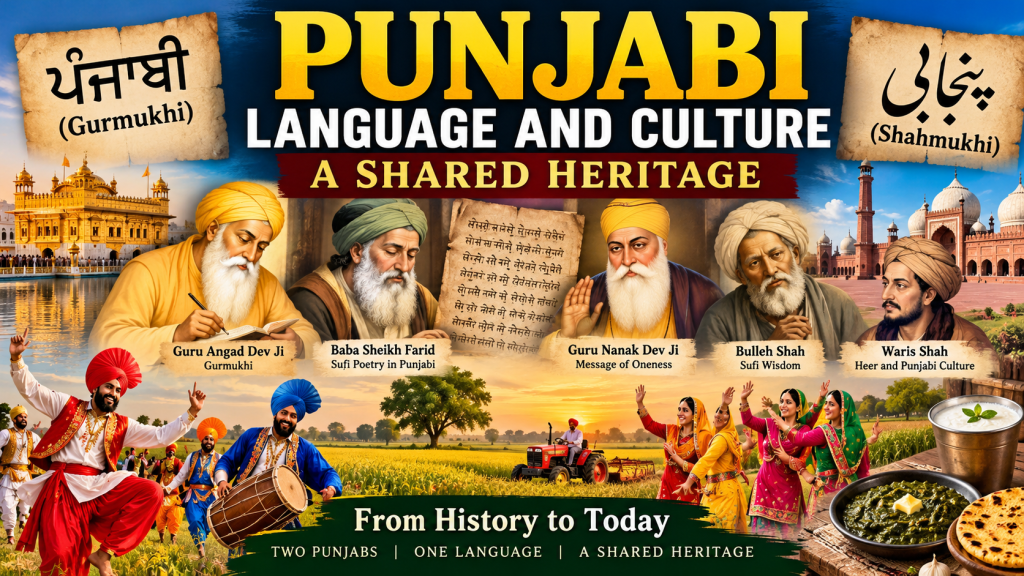
From Baba Sheikh Farid and Guru Angad Dev Ji to the undivided Punjab
Introduction: Punjabi Is More Than a Language
Punjab has given the world a remarkable legacy of courage, hard work, hospitality, spiritual wisdom, poetry, music and cultural richness. For centuries, people of different religions and communities have inhabited this land of five rivers, sharing its villages, markets, agricultural traditions, folk songs and oral literature.
Yet some fascinating questions arise when we explore Punjabi history. If Punjabi is an ancient language, what script did people use before Guru Angad Dev Ji standardised Gurmukhi? Why do Punjabi-speaking Muslims in Pakistan write Punjabi in Shahmukhi, a script closely related to Urdu? What does the poetry of Baba Sheikh Farid tell us about the antiquity of Punjabi? And what common heritage continues to connect Indian Punjab with Pakistani Punjab?
To answer these questions, we must distinguish between a language and the script used to write it, trace the evolution of Punjabi, and rediscover the cultural traditions that existed long before the Partition of 1947.
1. The Origin and Evolution of Punjabi
Punjabi belongs to the Indo-Aryan branch of the Indo-European language family. It developed gradually in the northwestern Indian subcontinent through centuries of linguistic evolution.
Its history is associated with the broader development of Indo-Aryan languages, including regional Prakrits and Apabhraṃśa traditions. Over time, the speech of the Punjab region acquired its own distinctive vocabulary, grammar, pronunciation and literary character.
Punjabi did not originate on a particular date, nor was it created by a single individual. Like other living languages, it emerged through the everyday communication of generations.
By the medieval period, Punjabi speech forms were increasingly visible in devotional poetry, folk traditions and regional literary expression. The poetry associated with Baba Sheikh Farid, who lived in the 12th and 13th centuries, is an important landmark in this history.
One historical distinction is essential: although the Indus Valley Civilisation flourished in the broader region thousands of years ago, its script remains undeciphered. There is no conclusive evidence that its inhabitants spoke Punjabi in its present or recognisable historical form.
Punjabi is therefore best understood as the product of a long linguistic evolution, deeply rooted in the history of northwestern South Asia.
2. What Was the Script of Punjabi Before Gurmukhi?
This is one of the most interesting questions in the history of the language.
Guru Angad Dev Ji, the second Sikh Guru, played a decisive role in systematising and popularising Gurmukhi during the 16th century. However, Punjabi was spoken long before this development.
Before Gurmukhi became established, different writing traditions were used in the Punjab region. The choice depended on geography, occupation, education, religious tradition and the purpose for which something was being written.
Landa and other regional scripts
Landa was a family of abbreviated mercantile scripts used by traders and record-keepers in parts of northwestern India, including Punjab. Its writing conventions did not always represent vowels explicitly, making some forms less suitable for unambiguous literary texts.
Takri and related regional scripts were also part of the wider northwestern Indic writing landscape, although their use varied from place to place.
The Persian script
Persian became an important language of administration, scholarship and elite literary culture under successive Muslim-ruled states. Punjabi was also written in forms of the Perso-Arabic script, particularly in literary and educational settings associated with Muslim communities.
It would therefore be inaccurate to claim that all Punjabi speakers used one universal script before Gurmukhi. Different communities used different writing traditions, and much everyday Punjabi continued to be transmitted orally.
3. Guru Angad Dev Ji and the Standardisation of Gurmukhi
Guru Angad Dev Ji’s contribution to Punjabi’s written history was profound.
By systematising and promoting Gurmukhi, he helped establish a consistent writing tradition that could support religious teaching, literacy, literature and the transmission of knowledge.
Gurmukhi subsequently became central to Sikh scripture and education. In 1604, Guru Arjan Dev Ji compiled the Adi Granth, incorporating the compositions of Sikh Gurus as well as those of several Bhagats and other spiritual figures.
This literary tradition preserved voices from different religious backgrounds and helped secure Punjabi’s place as a language of spiritual and philosophical expression.
It is important, however, to distinguish between the origin of a language and the development of its script.
Guru Angad Dev Ji did not create the Punjabi language. His historic contribution was to systematise and promote Gurmukhi, giving Punjabi and the Sikh scriptural tradition a durable written foundation.
4. Baba Sheikh Farid: Punjabi Poetry Before Gurmukhi
Baba Fariduddin Ganjshakar, widely revered as Baba Sheikh Farid, was a great Chishti Sufi saint who lived approximately from 1173 to 1265. His spiritual legacy is closely associated with the region of present-day Pakistan, particularly Pakpattan.
Baba Farid occupies an important place in the history of Punjabi devotional literature. Verses attributed to him are preserved in the Guru Granth Sahib, where they are written in Gurmukhi.
His poetry explores the impermanence of human life, humility, patience, spiritual discipline, freedom from ego and the importance of turning towards the Divine.
One of the well-known verses attributed to him is:
Farida bure da bhala kar, gussa man na handhae;
Dehi rog na lagai, palai sabh kichh paae.
The verse urges us to respond to wrongdoing with goodness rather than anger, reminding us that the condition of the heart matters as much as outward conduct.
Baba Farid’s legacy is significant for another reason. He lived several centuries before Gurmukhi was systematised in its established form. His poetry therefore illustrates the existence of Punjabi devotional expression before that script became prominent.
Scholars have debated the transmission and precise attribution of some verses associated with Baba Farid, so every individual composition cannot necessarily be dated with certainty. Nevertheless, his place in the early history of Punjabi Sufi literature is firmly established.
His enduring message transcends the boundaries of language and religion: humility, patience, compassion and spiritual awareness are essential to a meaningful life.
5. Why Is Punjabi Written in Shahmukhi in Pakistan?
Punjabi is predominantly written in Gurmukhi in Indian Punjab and in Shahmukhi in Pakistani Punjab.
Shahmukhi is based on the Perso-Arabic writing tradition and is closely related to the script used for Urdu. It is written from right to left.
Its development is connected to the historical influence of Persian in the Punjab region. For centuries, Persian played an important role in administration, scholarship and literary culture. As a result, writers familiar with Persian and related scripts could adapt them to Punjabi.
During British rule, Urdu also acquired a prominent position in education and administration. After Pakistan was established in 1947, Urdu retained its status as the national language and became deeply embedded in formal institutions.
Punjabi, meanwhile, continued to be spoken widely in Pakistani Punjab, but its position in formal education and administration remained comparatively limited.
Shahmukhi nevertheless continued as an important script for Punjabi poetry, literature and publishing.
Consider the word Punjabi:
- Gurmukhi: ਪੰਜਾਬੀ
- Shahmukhi: پنجابی
Both represent the same language.
The scripts differ in their letters, direction of writing and conventions for representing vowels. Gurmukhi generally represents vowels more explicitly, while Shahmukhi often relies more on context for short vowels.
Consequently, knowing one script does not automatically make a person literate in the other.
The difference between Indian and Pakistani Punjabi is therefore not simply a difference in spoken language. It also reflects distinct educational systems, literary institutions and historical experiences.
6. The Shared Cultural Heritage of Indian and Pakistani Punjab
Before Partition in 1947, Punjab was a connected cultural region, although its communities differed in religion, dialect, customs and local traditions.
People travelled between towns and villages for trade, pilgrimage, marriage, education, agricultural work and social gatherings. Shared landscapes, agricultural cycles, folk songs and oral storytelling helped shape a common cultural world.
Partition divided this region politically and geographically, but much of its cultural inheritance survived.
Agriculture and village life
Agriculture has shaped Punjabi society for centuries. Wheat cultivation, mustard fields, dairy farming, irrigation and the rhythms of sowing and harvesting influenced the region’s food, music, celebrations and social organisation.
Baisakhi, harvest festivities, village fairs and communal meals reflect the close relationship between the land and Punjabi identity.
Although agricultural practices and local customs have evolved, the connection between the soil, the farmer and the community remains powerful on both sides of the border.
Folk music and dance
Bhangra, Giddha, the dhol, tumbi, algoza, boliyan and wedding songs are familiar elements of Punjabi cultural expression.
Their forms vary by region, and each community has developed distinctive musical and performance traditions. Nevertheless, the rhythmic energy, humour, emotional intensity and communal spirit of Punjabi folk culture are shared across the region.
Folk music also preserves the experiences of ordinary people: love, separation, marriage, migration, work, celebration and loss.
Food and hospitality
Punjabi cuisine reflects the region’s agricultural wealth and diverse religious and community traditions.
Makki di roti, sarson da saag, wheat breads, pulses, dairy products, parathas and lassi are familiar examples, although ingredients and recipes differ between households and localities.
Hospitality is another important shared value. Welcoming guests, offering food, maintaining family ties and celebrating weddings collectively have long been central to Punjabi social life.
The details vary, but the underlying emphasis on generosity, kinship and community remains recognisable across both Punjabs.
7. Sufi, Sikh and Bhakti Traditions: A Shared Spiritual Landscape
Perhaps the most profound part of Punjab’s heritage lies in its spiritual and literary traditions.
The region produced thinkers and poets whose works explored universal human concerns: truth, humility, love, ego, justice, compassion and the relationship between the individual and the Divine.
Baba Sheikh Farid expressed spiritual wisdom through the language of the people, emphasising humility, patience and the impermanence of worldly life.
Guru Nanak Dev Ji taught the oneness of the Divine, truthful living, honest work, sharing with others and the equality of human beings.
Bulleh Shah, the celebrated Sufi poet, challenged hypocrisy, ego and narrow religious divisions through his powerful Punjabi verse.
Waris Shah, through his masterpiece Heer, portrayed love, family authority, social conventions and the complex relationships that shaped Punjabi society.
These figures belonged to different religious and historical traditions and should not be assumed to have taught identical doctrines. Yet their works became an enduring part of Punjabi literary memory.
Their poetry continues to be recited, sung and interpreted across generations, demonstrating how a shared language can preserve ideas that reach beyond particular religious communities.
8. Partition in 1947: The Border Divided the Land, but Not Its Entire Heritage
The Partition of 1947 transformed Punjab’s demographic, social and cultural geography.
Millions of people were displaced. Many Hindu and Sikh families moved from western Punjab to India, while many Muslim families moved from eastern Punjab to Pakistan. Communities were uprooted, families separated, and centuries-old relationships disrupted.
The consequences extended beyond personal loss. Religious institutions, literary networks, local traditions, property ownership and patterns of education were profoundly affected.
The two Punjabs subsequently developed within different political and institutional settings.
In Indian Punjab, Gurmukhi became the dominant script for Punjabi, which gained official status in the state formed in 1966.
In Pakistani Punjab, Urdu retained a prominent institutional role, while Punjabi continued as the everyday language of a large proportion of the population and Shahmukhi remained its principal literary script.
These different paths did not erase the historical connections between the two regions. Punjabi literature, music, food, folklore and family traditions continue to preserve elements of a common past.
The historical relationship between Lahore and Amritsar, the significance of Nankana Sahib to Sikhs, the Sufi heritage of Pakpattan and the continuing popularity of Punjabi poetry all illustrate the depth of this shared inheritance.
9. A Language That Can Build Bridges
The history of Punjabi offers an important lesson: language, script, religion and political identity are connected, but they are not the same thing.
Gurmukhi is fundamental to Sikh scripture and the literary tradition of Indian Punjabi. Shahmukhi is central to the written Punjabi tradition of Pakistan.
Both have their own history and cultural significance. Recognising one does not require diminishing the other.
From Baba Farid to Guru Nanak, from Bulleh Shah to Waris Shah, Punjabi literature has explored questions that remain relevant to humanity: How should we live? How should we treat others? What is the meaning of humility? How can we rise above ego, hatred and prejudice?
The answers are preserved not only in manuscripts and books but also in songs, proverbs, village stories, family memories and the everyday language of ordinary people.
Punjabi is more than the language of Indian Punjab or Pakistani Punjab. It is the expression of a cultural inheritance whose roots extend across both sides of the modern border.
We should cherish our language, respect both its major scripts and preserve the rich traditions inherited from earlier generations.
Political boundaries can divide territory. They can disrupt communities and alter institutions. But the full richness of a language, the emotional power of poetry and the memory of a shared cultural past cannot be confined so easily.
The responsibility of the present generation is to pass this heritage to the next generation with knowledge, respect and an open mind.
(Dedicated to the history, language and shared cultural heritage of Punjab)
Guchi.


A fascinating and informative exploration of Punjabi language, literature, and shared cultural heritage! The lives and teachings of Baba Sheikh Farid Ji and the contribution of Guru Angad Dev Ji beautifully illustrate how language transcends religious and geographical boundaries. I particularly appreciate your explanation of the difference between a language and its script. The wisdom of Baba Farid Ji, encouraging us to respond to hatred with kindness, remains profoundly relevant even today. Our shared heritage is a reminder that culture, poetry, spirituality, and humanity can unite people beyond borders. Thank you for sharing this valuable piece of history!
LikeLike