There are paintings that simply capture a moment.
And then there are paintings that seem to capture something about the human condition.
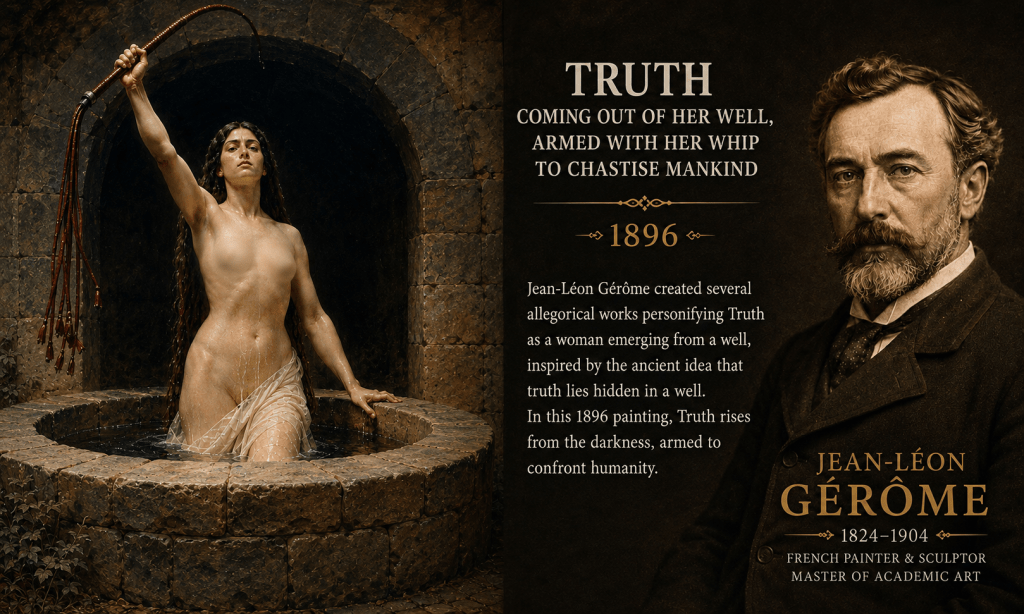
In 1896, the French painter and sculptor Jean-Léon Gérôme created one of those images.
He called it Truth Coming Out of Her Well, Armed with Her Whip to Chastise Mankind.
Gérôme was one of the most celebrated academic painters of nineteenth-century France. Born in Vesoul in 1824, he studied in Paris under the influential painter Paul Delaroche and later Charles Gleyre. He became famous for his meticulously detailed historical, classical and Orientalist paintings, and eventually became a professor at the École des Beaux-Arts. He was also a passionate defender of academic painting and a determined opponent of the rising Impressionist movement.
By the 1890s, Gérôme was increasingly fascinated by the idea of Truth.
He produced several works in which Truth was personified as a woman associated with a well. The idea had an ancient philosophical lineage, connected with a saying attributed to the Greek philosopher Democritus: truth is hidden in a well—or, more literally, in an abyss.
Then came the striking image of 1896.
Truth emerges from the darkness of the well.
She is no longer hidden.
She has returned.
And she carries a whip.
It is an extraordinary metaphor.
Truth has been buried.
Truth has been ignored.
Truth has been hidden away.
But eventually, Truth comes out.
And when she does, she does not necessarily bring comfort.
She brings confrontation.
The Story That Grew Around the Painting
There is a popular story now widely circulated alongside Gérôme’s painting.
It tells of Truth and Lie meeting one another.
The Lie says to Truth:
“Let’s take a bath together. The water is wonderful.”
Truth agrees.
They enter the well and bathe together.
But suddenly, the Lie climbs out.
She takes Truth’s clothes, puts them on, and runs away.
Truth climbs out after her, furious and exposed.
She wants her clothes back.
But when the world sees Truth without her familiar covering, something unexpected happens.
People turn away.
They are uncomfortable.
Some are angry.
Some are ashamed.
Some even look upon Truth with contempt.
Truth realizes that the world does not necessarily want to see her as she really is.
So she returns to the well.
And disappears.
Meanwhile, the Lie continues walking through the world…
wearing the clothes of Truth.
It is a powerful story.
But there is an important distinction.
There is no good evidence that this longer Lie-and-Truth bathing story was written or spoken by Gérôme himself. It is better understood as a later parable inspired by the imagery and symbolism associated with his painting.
And perhaps that makes it even more interesting.
Because the story has taken Gérôme’s image and transformed it into a moral lesson for another age.
Why Does the Story Feel So Modern?
Think about the world we live in.
A lie does not necessarily announce itself as a lie.
It can be polished.
It can be beautifully presented.
It can sound authoritative.
It can be repeated until it becomes familiar.
It can be accompanied by photographs, statistics, confident voices and thousands of approving people.
The Lie can borrow the clothes of Truth.
And once dressed properly, she may be welcomed everywhere.
Truth, meanwhile, can be inconvenient.
Truth can disturb our beliefs.
Truth can challenge our loyalties.
Truth can expose our mistakes.
Truth can require us to say:
“I was wrong.”
And perhaps that is one of the hardest sentences for a human being to say.
We often imagine that people reject truth because they cannot recognize it.
But sometimes they reject it precisely because they do recognize it.
They simply do not like what it tells them.
The Naked Truth
The expression “the naked truth” has survived for centuries because it captures something profound.
Truth without decoration.
Truth without excuses.
Truth without propaganda.
Truth without the comforting clothes we put around reality.
And naked truth can be frightening.
It leaves nowhere to hide.
When Gérôme painted Truth emerging from the well, he created more than an allegorical figure.
He created an image of revelation.
Something hidden suddenly becomes visible.
Something buried refuses to remain buried.
Something suppressed demands to be seen.
The whip in her hand makes the image even more provocative.
Truth is not emerging gently to ask whether we are ready.
She is coming out to chastise mankind.
Perhaps Gérôme understood something that remains true today:
Truth does not become less true because we refuse to look at it.
A World Comfortable With the Lie
The most disturbing part of the modern parable is not that the Lie steals Truth’s clothes.
It is that the world accepts her.
Why?
Because she looks right.
She sounds right.
She behaves like someone we expect Truth to behave.
And perhaps this is the great danger.
We sometimes judge truth by its appearance rather than by its substance.
We trust confidence more than evidence.
We prefer comforting stories to uncomfortable facts.
We believe what agrees with us and question what challenges us.
And gradually, the distinction between truth and falsehood becomes blurred.
The Lie does not have to destroy Truth.
It only has to look like her.
Gérôme’s Warning Across Time
Gérôme died in Paris in 1904.
His world was radically different from ours.
There was no internet.
No social media.
No smartphones.
No twenty-four-hour news cycle.
Yet his image of Truth emerging from a well still speaks with remarkable force.
Perhaps because technology changes faster than human nature.
We still want to believe.
We still fear being wrong.
We still hide uncomfortable truths.
We still dress our opinions in the appearance of certainty.
And we still sometimes turn away when Truth appears without disguise.
Gérôme’s painting belongs to the nineteenth century.
But its question belongs to every century.
And So, We Are Left With One Question
What would happen if Truth stood before us today?
Not beautifully dressed.
Not carefully packaged.
Not presented in a way designed to please us.
Just Truth.
Would we welcome her?
Would we listen?
Would we defend her?
Or would we turn away because what she revealed was too uncomfortable?
Perhaps the real danger is not that Truth has disappeared.
Perhaps Truth is still there.
Perhaps she is simply waiting in the well…
while the Lie walks confidently through the world wearing her clothes.
And perhaps the greatest test of our character is not whether we can recognize a lie.
It is whether we have the courage…
to look at the Truth when she finally appears.
(Jean-Léon Gérôme’s Truth Coming Out of Her Well, Armed with Her Whip to Chastise Mankind (1896) is an oil painting measuring 91 × 72 cm and is held by the Musée Anne de Beaujeu in Moulins, France. (Wikipedia)
The painting is Gérôme’s.
The later parable is inspired by its symbolism.
But the question it raises belongs to all of us.)
Guchi.


What a fascinating and deeply thought-provoking appreciation of Gérôme’s “Truth Coming Out of Her Well, Armed with Her Whip to Chastise Mankind.” 🎨👏
What makes this piece particularly compelling is that it goes beyond describing a painting and explores the philosophical idea of Truth itself. The image of Truth emerging from the darkness of the well, no longer hidden and carrying a whip, is an incredibly powerful metaphor. Truth may remain buried for a time, but eventually it demands to be seen—and sometimes its arrival is uncomfortable rather than comforting.
LikeLike
Thank you so much for your appreciation. Your commentaries are indeed valuable.
LikeLike