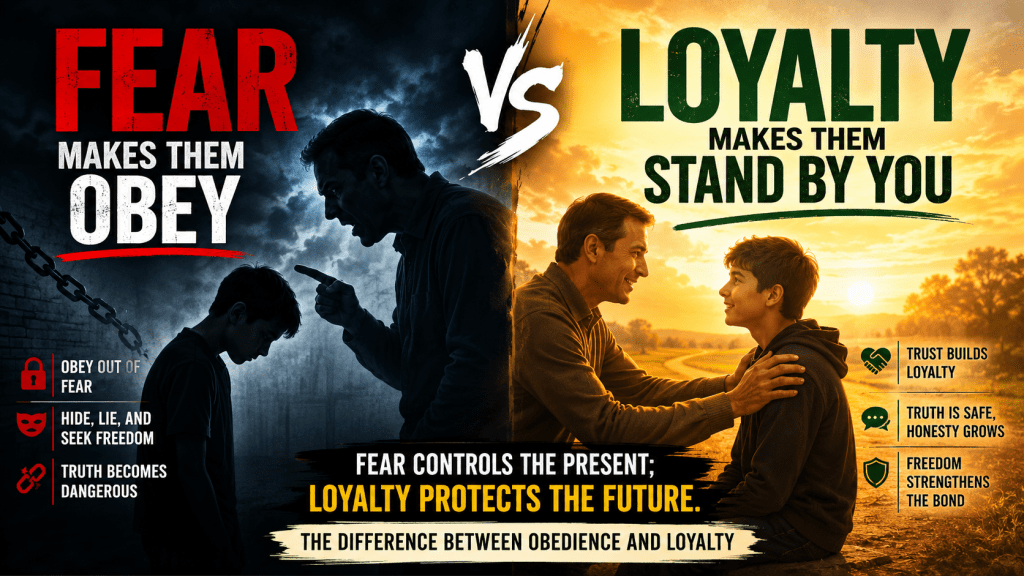
The Difference Between Making Someone Obey You and Making Them Want to Stand With You
There is a profound difference between fear and loyalty.
Fear can make a person obey you.
Loyalty makes a person stand beside you.
From a distance, they may look almost identical. A fearful person follows your instructions. A loyal person follows your wishes. Both may say “yes.” Both may appear disciplined. Both may remain silent when you speak.
But the moment circumstances change, the difference becomes visible.
Fear asks: “What will happen to me if I disobey?”
Loyalty asks: “What can I do to stand by you?”
That difference can determine the fate of a family, a friendship, an organization—or even a nation.
The Child Who Obeys Out of Fear
Imagine a father telling his sixteen-year-old son:
“You are never to ride a motorcycle. If I ever find out that you have, you will be severely punished.”
The boy says, “Yes, Dad.”
The father feels reassured.
But what has actually happened?
The boy has not necessarily accepted his father’s reasoning. He has simply learned that disobedience carries a price.
Now imagine that one day his friends invite him for a motorcycle ride.
He wants to go.
If the relationship is built primarily on fear, his first thought may not be:
“Let me talk to Dad about it.”
It may be:
“How can I make sure Dad doesn’t find out?”
And there begins the journey from obedience to secrecy, and from secrecy to lying.
The father thought he had created obedience.
In reality, he may have created a situation in which the child becomes increasingly skilled at hiding the truth.
Now Change the Relationship
Imagine a different father.
He says:
“I don’t want you riding a motorcycle yet because you’re inexperienced. I know you may want to do it, and I understand that. When you’re old enough, I’ll help you learn properly. Until then, if your friends invite you, talk to me.”
The rule may be exactly the same.
The difference is the relationship.
The first father says:
“Obey me because you fear me.”
The second says:
“Understand me because I care about you.”
The second child may still make mistakes. Children—and adults—will always make mistakes.
But when something goes wrong, there is a greater possibility that he will come home and tell the truth.
Why?
Because truth has not become dangerous.
That is the beginning of loyalty.
Fear Controls the Present; Loyalty Protects the Future
Fear is powerful because it works quickly.
A manager threatens an employee:
“If you make another mistake, you’re out.”
The employee becomes extremely careful.
For a while, productivity may even improve.
But what happens when the employee discovers a serious mistake?
Does he immediately report it?
Perhaps not.
He may hide it.
He may hope nobody notices.
He may manipulate the figures.
He may blame someone else.
Why?
Because the organization has taught him that the truth is more dangerous than the mistake.
Now imagine a different manager:
“Mistakes happen. Tell me quickly when something goes wrong. We will fix the problem first, and then understand how it happened.”
The employee may still make mistakes.
But he is much more likely to bring bad news to the manager.
And that is enormously valuable.
A good leader does not merely create people who perform well when everything is going right.
A good leader creates people who have the courage to bring him bad news when everything is going wrong.
That is loyalty.
The Most Dangerous People in a Fear-Based System
There is an irony in leadership.
A ruler surrounded by people who always say:
“Yes, Sir.”
may believe he is extremely powerful.
But perhaps he is the least informed person in the room.
His subordinates have learned that disagreement is dangerous.
So they agree.
They smile.
They applaud.
They tell him what he wants to hear.
And eventually, the leader begins living inside an illusion created by his own fear.
He thinks:
“Everyone supports me.”
When the reality may be:
“Everyone is afraid of me.”
Those are two completely different things.
A fearful follower asks:
“What does the powerful person want me to say?”
A loyal follower asks:
“What does the powerful person need to know?”
The first protects himself.
The second protects the relationship.
Fear Produces Silence; Loyalty Produces Truth
This may be the most important distinction.
A person who fears you will often hide information that might make you angry.
A person who is loyal to you will sometimes tell you something you don’t want to hear.
That is why loyalty is not the same as agreement.
In fact, the person who always agrees with you may not be your most loyal person.
Your most loyal person may be the one who says:
“I respect you, but I think you’re making a mistake.”
That sentence may be uncomfortable.
But it is priceless.
Because loyalty is not:
“I will always agree with you.”
Loyalty is:
“I care enough about you to tell you the truth, even when the truth is uncomfortable.”
What Happens When Freedom Arrives?
This brings us back to the original saying.
A child grows up.
An employee changes jobs.
A citizen gets the opportunity to oppose a ruler.
A friend becomes independent.
A partner realizes that they no longer have to tolerate control.
Eventually, power changes hands.
And that is when the difference between fear and loyalty becomes visible.
Fear depends upon the continued presence of power.
Remove the power—and fear often disappears.
Loyalty is different.
It can survive distance.
It can survive disagreement.
It can even survive separation.
Because loyalty is not based upon:
“I have no choice.”
It is based upon:
“I could leave, but I choose to stay.”
That is perhaps the purest definition of loyalty.
The Paradox of Control
Here lies one of life’s great paradoxes:
The harder you try to control someone, the more you may teach them how to live without your control.
A controlling parent may raise a child who becomes extremely secretive.
A controlling boss may train employees to conceal problems.
A controlling leader may create people who publicly praise him while privately opposing him.
A controlling partner may eventually create emotional distance.
Control can produce compliance.
But excessive control often destroys the very relationship that makes compliance meaningful.
You cannot command someone to be loyal.
You can demand obedience.
You can demand silence.
You can demand agreement.
But loyalty must be given.
The Motorcycle Is Not Really About the Motorcycle
Return to the child and the motorcycle.
The real question isn’t whether the child should ride it.
The real question is:
What kind of relationship does the parent want to build?
If the objective is:
“I want my child to obey me while I am watching.”
Fear may work.
But if the objective is:
“I want my child to make sensible decisions even when I am not there.”
Then fear is a poor teacher.
The parent ultimately has to transfer responsibility from his authority to the child’s judgment.
That requires explanation.
It requires trust.
It requires consequences.
And above all, it requires communication.
The goal of parenting is not to produce a child who is afraid of making a mistake in front of you.
It is to produce an adult who is capable of making the right decision when you are not there.
Fear Says “Don’t Get Caught”; Loyalty Says “Don’t Let Me Down”
There is another subtle difference.
Fear often produces this internal dialogue:
“Don’t get caught.”
Loyalty produces:
“I don’t want to betray the trust placed in me.”
The behaviour may look identical from outside.
But psychologically, they are worlds apart.
The fearful person behaves properly because someone is watching.
The loyal person behaves properly even when nobody is watching.
That is why loyalty is ultimately stronger than fear.
Fear requires surveillance.
Loyalty carries its own conscience.
The Leadership Lesson
Whether you are a parent, teacher, employer, commander, friend or leader, there is a question worth asking:
Do people obey me because they respect me—or because they are afraid of me?
And perhaps an even more revealing question:
When something goes terribly wrong, will they come to me with the truth—or hide it from me?
The answer tells you what kind of authority you have built.
If people bring you good news and bad news, you have probably built trust.
If they bring you only good news, be careful.
You may not have created loyalty.
You may simply have created fear.
The Ultimate Test of Loyalty
The ultimate test comes when the person has the freedom to walk away.
When there is no punishment for leaving.
No reward for staying.
No surveillance.
No threat.
No obligation.
And yet the person still chooses to stand beside you.
That is loyalty.
Fear says: “I must.”
Loyalty says: “I choose to.”
And perhaps that is the deepest lesson hidden inside the original saying.
We spend much of our lives trying to make people obey us—our children, employees, partners, followers, even our friends.
But perhaps the wiser ambition is different:
Don’t make people afraid to disobey you.
Make them feel safe enough to tell you the truth.
Because one day, they will have the freedom to choose.
And when that day comes, fear may disappear.
But if you have earned their trust, loyalty may remain.
Guchi.


A very insightful and thought-provoking piece! 👏🌿 I particularly appreciated the powerful distinction between obedience born of fear and loyalty born of trust. The examples of the father and the manager make the message simple, practical, and relatable.
LikeLike