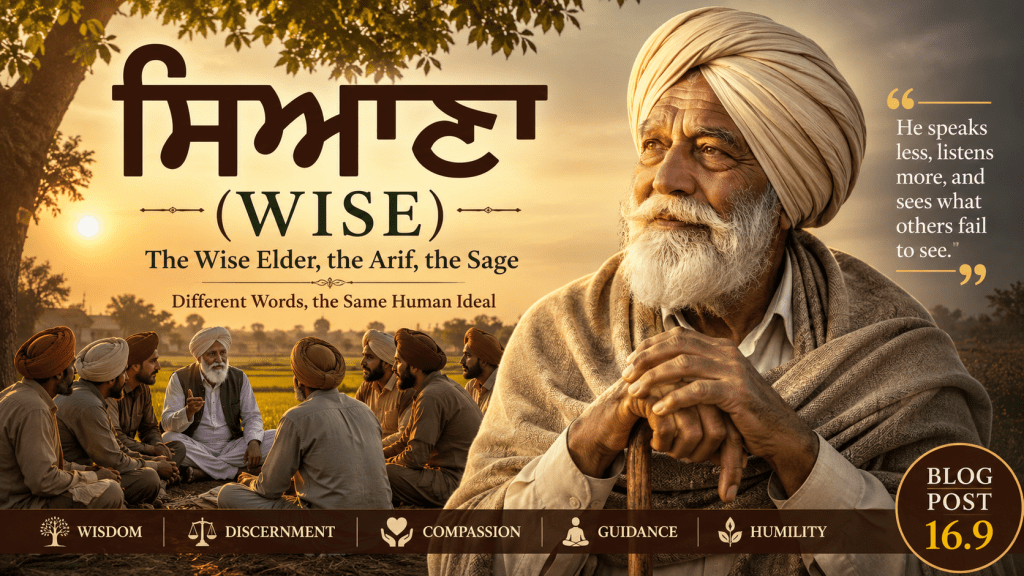
There are words that belong not merely to a language but to an entire civilization.
The Punjabi word ਸਿਆਣਾ is one such word.
The closest English equivalents are Wise Person, Wise Elder, Sage, Person of Sound Judgment, or Counsellor. Yet none fully captures its meaning.
A ਸਿਆਣਾ is not simply intelligent.
He is not merely educated.
He is not necessarily wealthy, powerful, scholarly, or famous.
A ਸਿਆਣਾ is a human being whose presence helps others navigate life.
He possesses the rare ability to understand people, calm conflicts, reduce suffering, and illuminate confusion.
His wisdom is practical rather than theoretical.
His knowledge serves life rather than ego.
And perhaps that is why such people are treasured wherever they are found.
⸻
More Than Intelligence
Modern society often admires intelligence.
A ਸਿਆਣਾ admires understanding.
An intelligent person may solve a mathematical problem.
A ਸਿਆਣਾ solves a human problem.
An intellectual may win an argument.
A ਸਿਆਣਾ preserves a relationship.
An expert may explain a situation.
A ਸਿਆਣਾ helps people live through it.
Knowledge fills the mind.
Wisdom enlarges the heart.
This distinction is ancient and universal.
Throughout history, humanity has respected those rare individuals whose wisdom transcended mere learning.
⸻
The Village Sਿਆਣਾ and Sਿਆਣੀ
Old Punjab possessed many such people.
Every village seemed to have one or two.
Sometimes they were elderly men.
Sometimes they were middle-aged women.
Sometimes they were grandmothers whose wisdom exceeded that of the most educated people around them.
Sometimes they were surprisingly young.
People approached them during family disputes, marriage difficulties, grief, financial troubles, and moments of uncertainty.
These individuals possessed no formal authority.
Yet their words carried weight.
Why?
Because people trusted them.
They listened before speaking.
They understood before judging.
They guided without controlling.
They healed without claiming credit.
Many villages were held together not by officials or institutions but by such quiet individuals.
⸻
Wisdom Is Not Limited by Age
Punjabi culture contains a beautiful saying:
“ਇਸ ਦੇ ਪੇਟ ਵਿੱਚ ਦਾੜ੍ਹੀ ਹੈ।”
“He has a beard in his stomach.”
The phrase refers to a young person who possesses the wisdom normally associated with old age.
His years may be few, but his understanding is deep.
The Sikh tradition offers a magnificent example.
Young Bura impressed Guru Nanak with his remarkable maturity and insight. Recognizing wisdom beyond his years, Guru Nanak affectionately called him Budha.
Thus emerged Baba Budha Ji.
The lesson remains timeless.
Age may produce wrinkles.
Only experience reflected upon produces wisdom.
⸻
The Universal Human Being
Perhaps the most beautiful aspect of a ਸਿਆਣਾ is that he or she belongs to no single religion, race, nationality, or culture.
A ਸਿਆਣਾ may be Sikh.
A ਸਿਆਣਾ may be Hindu.
A ਸਿਆਣਾ may be Muslim.
A ਸਿਆਣਾ may be Christian.
A ਸਿਆਣਾ may be Jewish.
A ਸਿਆਣਾ may be Buddhist.
A ਸਿਆਣਾ may be Jain.
A ਸਿਆਣਾ may belong to no organized religion at all.
Wisdom recognizes no religious monopoly.
Likewise, wisdom recognizes no race.
A ਸਿਆਣਾ may be black.
He may be white.
He may be brown.
He may be yellow.
He may live in Punjab, Africa, Europe, America, China, Japan, Australia, or South America.
Humanity speaks thousands of languages.
Wisdom speaks only one.
Compassion.
Understanding.
Patience.
Discernment.
Humility.
These qualities transcend geography.
⸻
The Great Sਿਆਣੇ of Humanity
Every civilization has produced such individuals.
Socrates
Perhaps the most famous wise man of ancient Greece, Socrates never claimed to possess ultimate knowledge.
His wisdom lay in recognizing the limits of his own understanding.
His famous insight—that true wisdom begins when one acknowledges one’s ignorance—remains profound even today.
Leo Tolstoy
The great Russian writer spent much of his later life searching for moral truth and spiritual understanding.
Despite fame and wealth, he increasingly valued simplicity, humility, and compassion.
Millions continue to seek guidance from his writings because he addressed not merely literature but life itself.
Abraham Lincoln
Lincoln combined humility, patience, humour, compassion, and practical judgment.
Even his opponents respected his fairness.
He possessed the rare ability to see beyond personal grievances and focus on the larger good.
Nelson Mandela
After twenty-seven years in prison, Mandela emerged without hatred.
His commitment to reconciliation rather than revenge demonstrated extraordinary wisdom.
Few individuals have displayed such emotional maturity under such difficult circumstances.
Mahatma Gandhi
Gandhi transformed moral conviction into practical action.
His influence arose not from force but from wisdom, restraint, courage, and understanding of human nature.
⸻
The Great Sਿਆਣੀਆਂ of Humanity
Wisdom has never belonged exclusively to men.
Some of humanity’s greatest teachers have been women.
Mata Khivi
Mata Khivi demonstrated that nurturing and service can themselves be forms of wisdom.
Her compassion and organizational ability strengthened an entire community.
Mata Gujri
Mata Gujri displayed extraordinary spiritual courage and composure during moments of unimaginable hardship.
Her life remains an example of grace under suffering.
Mother Teresa
Her wisdom was expressed through service to the poorest and most neglected members of society.
She understood that human beings require dignity as much as material support.
Eleanor Roosevelt
She combined intelligence with empathy and moral courage.
Her ability to understand both individuals and society made her one of the most respected women of the twentieth century.
Maya Angelou
Her writings reveal deep insight into suffering, resilience, forgiveness, and human dignity.
She transformed personal adversity into wisdom for generations.
Yet beyond these famous names stand countless unnamed women.
Grandmothers.
Mothers.
Teachers.
Widows.
Caregivers.
Women whose wisdom never entered history books but profoundly shaped the lives around them.
My own great-grandmother, I am told, belonged to this category.
She comforted the distressed.
Healed the troubled.
Settled disputes.
Guided the confused.
Her wisdom lived not in books but in human hearts.
⸻
The Characteristics of a True Sਿਆਣਾ
A true ਸਿਆਣਾ can often be recognized by certain qualities.
He speaks less and listens more.
He remains calm during crises.
He is not easily angered.
He is not intoxicated by praise.
He is not wounded by criticism.
He is tactful without being manipulative.
Humble without being weak.
Firm without being harsh.
Compassionate without being sentimental.
He understands that most human problems cannot be solved through force.
They must be understood.
Perhaps his greatest gift is perspective.
When others see chaos, he sees context.
When others see enemies, he sees wounded human beings.
When others seek victory, he seeks resolution.
⸻
Why Are They Becoming Rare?
Modern civilization produces experts.
It produces specialists.
It produces analysts.
It produces influencers.
But it does not always produce wisdom.
The modern world rewards speed.
Wisdom grows slowly.
The modern world rewards visibility.
Wisdom often works quietly.
The modern world rewards certainty.
Wisdom embraces complexity.
Never before has humanity possessed so much information.
Yet many people feel starved for guidance.
The need for wisdom has never been greater.
⸻
A Personal Reflection
As I reflect upon the idea of a ਸਿਆਣਾ, I find myself less interested in identifying such people and more interested in becoming one.
I am still far from that destination.
Life continues to teach me humility.
Every year reveals how much remains to be learned.
Perhaps that realization is itself part of the journey.
The truly wise rarely consider themselves wise.
The arrogant believe they have arrived.
The humble continue travelling.
And perhaps wisdom is not a destination at all.
Perhaps it is a lifelong pilgrimage.
⸻
Conclusion
A ਸਿਆਣਾ (Wise Elder, Sage, Person of Sound Judgment) is among humanity’s rarest treasures.
Such a person may possess little wealth, few qualifications, and no public recognition.
Yet entire communities quietly depend upon people like them.
They reduce suffering.
Heal divisions.
Calm troubled minds.
Restore perspective.
Guide without controlling.
Teach without preaching.
Whether found in a Punjabi village, an African tribe, a Japanese town, an American neighbourhood, a European city, or an ancient monastery, they embody the same timeless qualities.
They belong to no race.
They belong to no religion.
They belong to no nation.
They belong to humanity.
And in a world overflowing with information, perhaps what we need most is not more knowledge.
‘Perhaps we need more ਸਿਆਣੇ.
Guchi.


What a profound and beautifully written reflection. I especially appreciated how you distinguished wisdom from knowledge and highlighted the quiet influence of those who guide, heal, and unite without seeking recognition. The description of a ਸਿਆਣਾ as someone who listens deeply, sees beyond conflict, and offers perspective is both timeless and inspiring. Your concluding thought—that true wisdom belongs to humanity rather than any one culture or creed—resonates deeply. A thoughtful reminder that in a noisy world, wisdom often speaks in a gentle voice. 🙏✨
LikeLike
Thank you so much for your enlightened commentary.
LikeLike