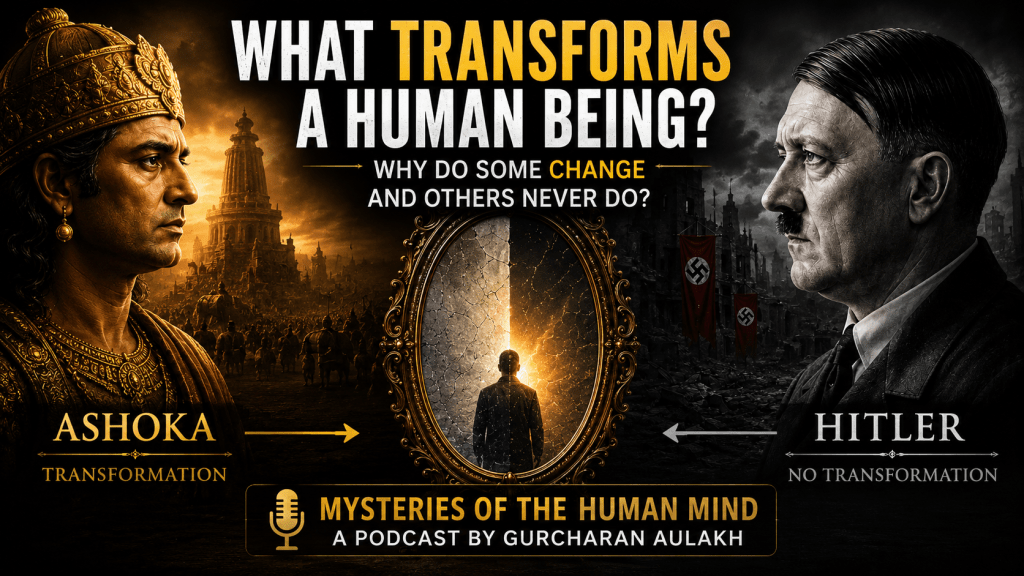
What Transforms a Human Being?
A Reflection on the Mysteries of the Human Mind
Among all the mysteries of life, none fascinates me more than the mystery of the human mind.
What transforms a human being?
History offers extraordinary examples.
A robber becomes a saint.
A murderer becomes a reformer.
A ruthless conqueror becomes a messenger of peace.
Yet history also presents the opposite picture.
Some people never seem to change at all.
Why?
What happens within the human mind that causes one person to transform while another remains exactly as he is?
When we think of transformation, we often think of famous personalities.
Valmiki.
Ashoka.
Sajjan Thug.
But perhaps the real mystery is not what transformed them.
Perhaps the greater mystery is what transforms ordinary people like us.
After all, most of us are neither saints nor villains.
We are not Valmiki before his transformation.
We are ordinary human beings trying to navigate life.
And perhaps that is where the mystery begins.
Most human beings live in shades of grey.
We tell the truth sometimes and lie sometimes.
We are generous one day and selfish the next.
Patient in one situation and angry in another.
We are neither completely good nor completely bad.
We are mixtures.
Within every human being live many versions of the self.
There is a compassionate self and a selfish self.
A courageous self and a fearful self.
A truthful self and a deceptive self.
The battle is not merely between good people and bad people.
The battle exists within each one of us.
The Mahabharata offers a beautiful metaphor.
We often think of Kurukshetra as a battlefield that existed thousands of years ago.
But perhaps the real Kurukshetra exists within us.
Every day.
Every decision.
Every temptation.
Every act of courage.
Every act of weakness.
The battlefield is internal.
The warriors are our own competing desires.
This understanding helps explain why some people undergo dramatic transformations.
Consider Valmiki.
Consider Sajjan Thug.
Consider Ashoka.
Each transformed in a different way.
And each transformation was triggered by a different event.
Valmiki encountered a question from a Rishi.
Sajjan encountered a spiritual teacher Guru Nanak Dev Ji.
Ashoka encountered unimaginable suffering after battle of Kalinga.
Different events.
Yet similar outcomes.
This suggests something profound.
The external event alone cannot explain transformation.
Many people heard Guru Nanak.
Only Sajjan changed.
Many people witnessed suffering.
Only Ashoka transformed so dramatically.
The external event matters.
But something within the person must also be ready.
Ready for what?
Ready to see the truth.
Ready to see oneself honestly.
And perhaps that is one of the most difficult things a human being can do.
Most of us spend our lives protecting our self-image.
We want to believe we are right.
We want to believe our actions are justified.
The ego is a remarkable defense system.
It constantly tells us that the problem lies elsewhere.
With circumstances.
With society.
With other people.
Rarely with ourselves.
And yet genuine transformation often begins the moment responsibility turns inward.
History gives us a fascinating contrast.
Consider Ashoka and Hitler.
Both possessed immense power.
Both shaped history.
Both caused enormous suffering.
Yet their responses were very different.
Ashoka eventually looked at the devastation around him and asked:
“What have I done?”
Hitler, as far as history records, never publicly admitted wrongdoing.
Even as everything collapsed around him, he continued to blame others.
Perhaps the difference lies in the direction of the question.
One question looks inward.
The other looks outward.
Transformation begins when we stop asking:
“What is wrong with them?”
And begin asking:
“What is wrong with me?”
Or perhaps more gently:
“What am I missing?”
This idea reminds us of Socrates.
One of history’s wisest men famously declared:
“I know that I know nothing.”
At first, the statement sounds paradoxical.
But its meaning is profound.
Wisdom begins with humility.
The moment we become absolutely certain of ourselves, learning stops.
The moment we acknowledge our limitations, growth becomes possible.
Plato extended this idea through his famous Allegory of the Cave.
According to Plato, human beings often mistake shadows for reality.
Today, our caves may not be physical caves.
They may be assumptions.
Beliefs.
Prejudices.
Cultural narratives.
Ideas we inherited without questioning.
Transformation may simply be the process of leaving one cave after another.
At twenty, we leave one cave.
At forty, another.
At seventy, perhaps yet another.
Wisdom may not mean reaching the final truth.
Wisdom may mean realizing that there are always more caves to leave.
The older I grow, the less certain I become about many things.
And strangely, I have come to believe that this uncertainty is not weakness.
It is growth.
The young often believe they know everything.
Experience teaches us otherwise.
The mature mind begins to appreciate the vastness of what remains unknown.
And that realization creates humility.
So what ultimately transforms a human being?
Many things contribute.
Love.
Loss.
Success.
Failure.
Friendship.
Illness.
Books.
Nature.
Teachers.
Age.
Experience.
Every one of these can become a turning point.
Yet beneath them all lies one essential ingredient.
The willingness to see oneself honestly.
Without that willingness, even the greatest teacher cannot help us.
With it, even a simple conversation can change a life.
Perhaps saints do not transform people.
Perhaps they simply hold up a mirror.
Perhaps books do not transform people.
Perhaps they too are mirrors.
Perhaps suffering is a mirror.
Perhaps success is a mirror.
Perhaps life itself is one great mirror continuously reflecting us back to ourselves.
The question is not whether the mirror exists.
The question is whether we are willing to look into it.
And perhaps that is why transformation remains such a mystery.
Not because the path is hidden.
But because the path requires courage.
The courage to see ourselves as we truly are.
Not as we wish to be.
Not as others imagine us to be.
But as we actually are.
Only then can genuine change begin.
Perhaps the greatest mystery is not why some people become saints.
Nor why some become tyrants.
Perhaps the greatest mystery is why, at a certain moment, an ordinary human being decides to become a little better than he was yesterday.
A little kinder.
A little wiser.
A little more truthful.
A little less selfish.
A little more understanding.
That small decision may appear insignificant.
Yet repeated day after day, year after year, it can transform an entire life.
Not perfection.
Not sainthood.
Not greatness.
Simply growth.
Perhaps that is the true secret of human transformation.
And perhaps that leaves us with one final question.
A question each of us must answer for ourselves.
What within me is still waiting to be transformed?
Guchi.

