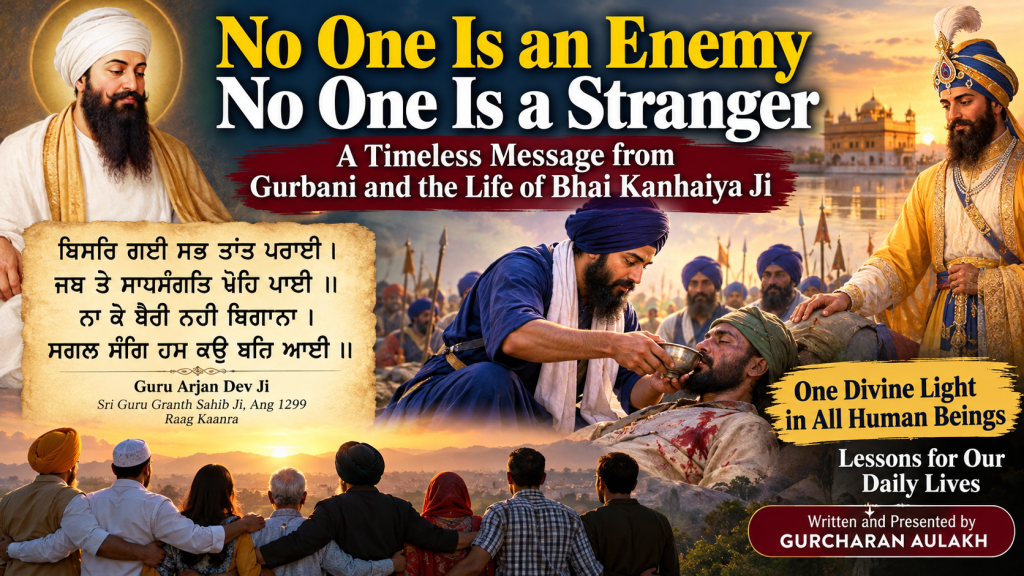
No One Is an Enemy, No One Is a Stranger
A Timeless Message from Gurbani and the Life of Bhai Kanhaiya Ji
A thought that transcends time
Some thoughts arrive without invitation. They emerge quietly during a morning walk, a moment of meditation, or a chance encounter with a line of poetry. Yet, occasionally, one such thought opens a window into the deepest truths of life.
This morning, my mind returned to a beautiful Shabad of Sri Guru Arjan Dev Ji, the Fifth Sikh Guru:
ਬਿਸਰਿ ਗਈ ਸਭ ਤਾਤਿ ਪਰਾਈ ॥
ਜਬ ਤੇ ਸਾਧਸੰਗਤਿ ਮੋਹਿ ਪਾਈ ॥
ਨਾ ਕੋ ਬੈਰੀ ਨਹੀ ਬਿਗਾਨਾ ॥
ਸਗਲ ਸੰਗਿ ਹਮ ਕਉ ਬਨਿ ਆਈ ॥
“No one is my enemy, no one is a stranger; I feel at home with everyone.”
These words, recorded in Sri Guru Granth Sahib Ji, Ang 1299, in Raag Kaanra, express a profound transformation of the human heart. When spiritual understanding deepens, jealousy diminishes, alienation disappears, and the artificial boundaries separating one human being from another begin to fall.
But what does this teaching mean in our daily lives? And is it possible to practise it in a world divided by religion, caste, ethnicity, nationality, ideology and conflict?
Perhaps the answer lies in the extraordinary example of Bhai Kanhaiya Ji.
Bhai Kanhaiya Ji: When compassion rises above conflict
During the battles associated with Guru Gobind Singh Ji, Bhai Kanhaiya Ji became known for providing water to wounded soldiers, including those belonging to the opposing forces.
Some fellow Sikhs questioned his conduct. Why was he serving the enemy?
According to the traditional Sikh account, Guru Gobind Singh Ji asked Bhai Kanhaiya Ji to explain his actions.
His answer expressed a remarkable spiritual vision: he saw the Divine Light in everyone. When he looked at a wounded soldier, he did not see a Sikh or a Muslim, a friend or an enemy. He saw a human being in pain who needed water.
Guru Gobind Singh Ji appreciated his explanation and provided him with ointment and bandages so that he could also tend to the wounded.
Consider the moral courage behind this act.
Bhai Kanhaiya Ji was living in a time of armed conflict. He understood that opposing armies were fighting one another. Yet he refused to let the divisions of war extinguish his compassion.
He recognised a truth that hatred often conceals: the uniform may identify the combatant, but it cannot erase the humanity of the wounded person beneath it.
Centuries later, international humanitarian law would establish formal obligations for the humane treatment of wounded combatants and prisoners of war.
Bhai Kanhaiya Ji’s example reminds us that the spirit of humanity must survive even when peace fails.
The invisible walls we build
We may never find ourselves on a battlefield, but we encounter smaller battlefields every day.
They exist in our homes, offices, neighbourhoods, social circles and public conversations.
We divide people into categories. We trust those who resemble us and remain suspicious of those who do not. We sometimes judge a person before discovering their character, simply because they belong to a different religion, caste, nationality or political group.
We may even teach these prejudices to our children without realising it.
But the Shabad invites us to pause and ask ourselves: what truly makes another person a stranger?
Is it their language? Their dress? Their religious beliefs? Their place of birth?
Or have we simply allowed inherited prejudices and social conditioning to determine whom we consider worthy of our affection and respect?
We do not have to abandon our own identities, traditions or convictions to recognise the dignity of others. We can love our country without hating another nation. We can remain devoted to our faith without belittling another person’s faith.
The challenge is to retain our convictions without turning them into instruments of discrimination.
No enemy does not mean no opposition to wrongdoing
A natural question arises: if we have no enemies, how should we respond to injustice, aggression, dishonesty or cruelty?
Does universal compassion mean accepting everything?
Certainly not.
There is an important difference between opposing someone’s wrongful actions and declaring that person our permanent enemy.
We must protect the vulnerable, defend what is right, hold wrongdoers accountable and establish appropriate boundaries. Forgiveness does not require us to expose ourselves repeatedly to harm. Compassion does not demand passivity.
The real challenge is to oppose wrongdoing without becoming unjust ourselves.
We can disagree without humiliating another person. We can seek justice without allowing revenge to govern our lives. We can defend our principles without dehumanising those who challenge them.
This is not weakness. It is discipline of the highest order.
Bhai Kanhaiya Ji did not deny the reality of the battlefield. He demonstrated that even on a battlefield, compassion need not surrender to hatred.
What this teaching means in everyday life
The philosophy of universal brotherhood becomes meaningful only when it influences our conduct.
First, see the person before the label.
Give people an opportunity to reveal their character before judging them by their religion, caste, colour, ethnicity or nationality.
Second, help without discrimination.
If someone is hungry, help them find food. If someone is ill, offer assistance where possible. If someone is lonely, give them a little of your time. Their humanity is reason enough.
Third, disagree without hostility.
Not every argument needs a winner and a loser. Sometimes, the most mature response is to listen respectfully and accept that another person may see the world differently.
Fourth, free yourself from resentment.
Old grievances can become invisible burdens. Forgive where you can, seek justice where necessary, and establish boundaries where appropriate. But do not allow hatred to occupy your mind indefinitely.
Fifth, teach the next generation by example.
Children observe how adults speak about people who are different from them. If we want a more peaceful world, we must demonstrate fairness and respect in our own homes.
Finally, examine yourself each evening.
Ask yourself: Did I judge anyone unfairly today? Did envy influence my behaviour? Did I hurt someone unnecessarily? Did I withhold kindness because that person belonged to a different group?
Such questions may appear small, but honest self-examination is often the beginning of meaningful change.
One humanity, many identities
Imagine a world in which people retained their diverse religions, cultures, languages and national identities, yet refused to treat those differences as reasons for hatred.
Imagine nations that defended their security while respecting the dignity of other peoples.
Imagine communities that celebrated their own traditions without denigrating those of their neighbours.
Imagine families in which disagreements did not destroy affection, and societies in which another person’s success was a reason for appreciation rather than envy.
Such a world would not be free from every conflict. Human beings would continue to disagree, compete and make mistakes.
But perhaps we would learn to disagree without hatred and compete without contempt.
The world does not need everyone to think alike. It needs people who can respect one another despite their differences.
The greatest victory is over our own hatred
We often measure victory by what we achieve, what we acquire, whom we defeat or how successfully we defend our position.
Yet there is another kind of victory: the victory over our own prejudices, jealousy, anger and desire for revenge.
When we stop treating every disagreement as a personal battle, we recover our peace of mind. When we stop envying another person’s good fortune, we make room for gratitude. When we stop defining people by their differences, we discover possibilities for friendship and cooperation that we had previously overlooked.
Perhaps this is one of the deeper meanings of finding the company of the spiritually wise, as expressed in Guru Arjan Dev Ji’s Shabad. True wisdom changes not merely what we believe, but how we see and treat others.
Bhai Kanhaiya Ji did not simply understand the principle of universal humanity. He acted upon it when the circumstances made it difficult.
That is the difference between knowing a teaching and living it.
My morning resolution
Today, I would like to carry one simple resolution into my daily life:
I shall try not to hate anyone merely because they are different from me.
I shall judge people by their conduct rather than their community.
I shall stand against injustice without allowing hatred to consume me.
I shall offer kindness wherever I can, without expecting the recipient to share my beliefs or identity.
And I shall remember that every human being has hopes, fears, loved ones and a desire to live with dignity.
I may not be able to change the thinking of the entire world. I cannot prevent every conflict or remove every injustice.
But I can decide whether I add to the world’s bitterness or contribute, however modestly, to its understanding.
Perhaps that is where the journey towards a more humane world begins.
No one is an enemy. No one is a stranger.
Let these words be more than a beautiful line of Gurbani. Let them become a way of living.
May our presence bring comfort, our words bring understanding, and our actions reflect the humanity we wish to see in others.
Gurcharan Aulakh

