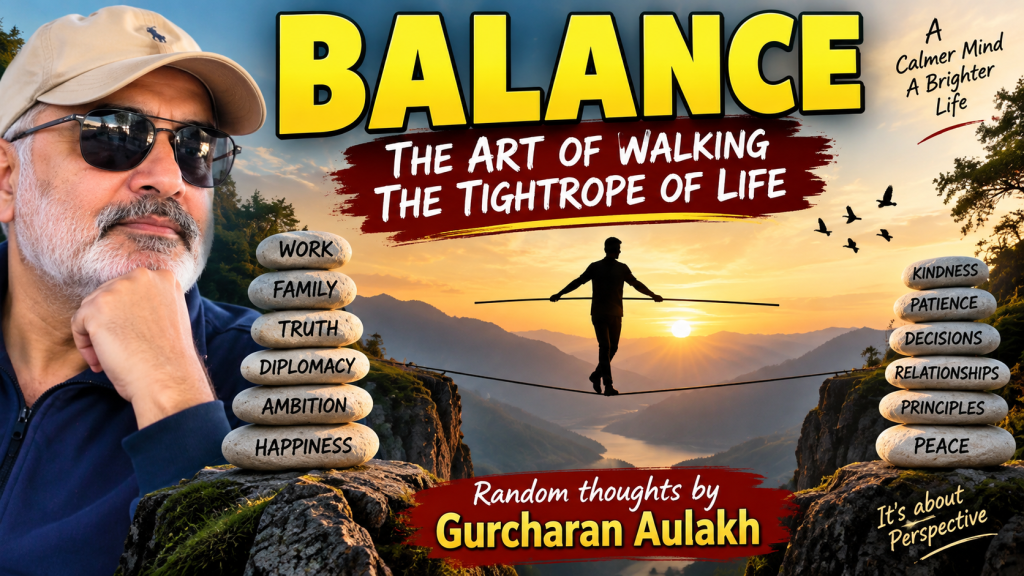
Balance.
A simple word, but perhaps one of the most difficult things to achieve in life.
We speak about balance as though it were a formula: balance work and family, truth and diplomacy, firmness and kindness, ambition and contentment. But real life rarely gives us such neat choices.
Relationships demand balance.
Work demands balance.
Family demands balance.
Even our principles sometimes demand balance.
And as we grow older, we perhaps discover that maturity is not always about knowing what to say—it is also knowing what not to say, when to say it, and how to say it.
“Very difficult to keep. In relationships, in work, in everything in life.”
Truth is important—but so is the way we deliver it
We are often told that we should always speak the truth.
I agree—with one qualification.
Truth without sensitivity can become cruelty.
There are truths that need to be spoken, but perhaps not in their rawest form. Sometimes an unpalatable truth has to be softened. Sometimes a statement has to be carefully framed so that the listener can hear what we are actually trying to say.
This is not necessarily dishonesty.
There is a difference between deceiving someone and exercising discretion.
A mature person understands that the same truth may need to be communicated differently to different people.
What we say to a grieving friend may be different from what we say to a colleague.
What we say to a child may be different from what we say to an elderly parent.
The truth remains the truth. The packaging changes.
Even in families, everything cannot always be said
Family relationships perhaps require the greatest diplomacy.
There are occasions when something has to be modified, suppressed, amplified or filtered—not because we want to manipulate someone, but because relationships are delicate.
A perfectly honest sentence can sometimes destroy a relationship, while a carefully chosen sentence can preserve it.
Does that mean we should live a life of pretence?
No.
It means we should develop the wisdom to distinguish between being truthful and being brutally truthful.
Not every thought deserves to become a spoken sentence.
That, perhaps, is one of the marks of maturity.
The workplace is another balancing act
Work brings its own complications.
There are times when we have to be firm.
There are times when we have to compromise.
There are times when we have to speak.
And there are times when silence is the wiser response.
Sometimes we play the good cop; sometimes circumstances require the bad cop.
Neither role necessarily defines who we are.
The situation does.
Leadership is not about behaving identically in every circumstance. It is about understanding the circumstance and responding appropriately.
A good leader may have to be tough today and reassuring tomorrow.
Firmness has to be conveyed with politeness, grace and tact—keeping in mind the taste and sensibilities of the person listening.
Sometimes, swallow the insult
This is perhaps one of the hardest lessons.
Our ego wants an immediate response.
Someone insults us—we want to answer.
Someone challenges us—we want to prove ourselves.
Someone humiliates us—we want the last word.
But life teaches us that winning every argument is not the same as winning at life.
Sometimes the wisest response is to remain silent.
Sometimes we have to swallow an insult.
Sometimes we have to retreat—not because we are weak, but because the battle is not worth fighting at that particular moment.
There is an old strategic wisdom behind the idea of retreating today in order to fight another day.
It is not cowardice.
It can be strategy.
The wisdom of Chanakya
Indian thought has long recognised that life is not governed by a single rule applicable to every situation.
The wisdom associated with Chanakya Niti often emphasises prudence, strategy, timing and understanding human nature.
Whatever one’s interpretation of Chanakya may be, there is a practical lesson here:
Life requires situational intelligence.
The same action that is appropriate in one situation may be completely wrong in another.
There are times to confront.
There are times to negotiate.
There are times to compromise.
There are times to walk away.
And there are times when we simply have to wait.
Walking the tightrope
I sometimes think of balance as walking on a tightrope.
Lean too far toward honesty without compassion—and we may hurt people.
Lean too far toward diplomacy—and we may lose our integrity.
Be too soft—and people may take advantage of us.
Be too rigid—and we may lose relationships.
Work too much—and family suffers.
Focus entirely on family—and professional responsibilities may suffer.
Think only about tomorrow—and we may forget to live today.
Think only about today—and tomorrow may become difficult.
That is why balance is not a destination.
It is a continuous adjustment.
Like a person walking a tightrope, we constantly make tiny corrections.
Balance does not mean pleasing everyone
Perhaps this is an important distinction.
Balance does not mean keeping everybody happy.
That is impossible.
Nor does it mean constantly compromising one’s principles.
Sometimes balance requires us to say no.
Sometimes it requires us to stand firm.
But even firmness can have grace.
You can disagree without humiliating.
You can refuse without insulting.
You can correct without belittling.
You can walk away without creating an enemy.
That is where tact becomes strength rather than weakness.
The older I get, the more I understand
When we are young, we often see the world in black and white.
Right is right.
Wrong is wrong.
Speak the truth.
Fight injustice.
Never compromise.
But with experience, the colours become more nuanced.
We begin to understand circumstances.
We understand human weaknesses.
We recognise that people carry their own fears, insecurities and pressures.
And perhaps we become less interested in proving that we are right and more interested in asking:
What is the right thing to do in this particular situation?
That is a very different question.
My random thought
Perhaps the real art of living is not choosing between truth and diplomacy, firmness and kindness, courage and caution.
It is learning when each is required.
Sometimes speak.
Sometimes listen.
Sometimes confront.
Sometimes retreat.
Sometimes explain.
Sometimes let it go.
Sometimes be firm.
Sometimes be gentle.
And occasionally, perhaps, simply say nothing.
Because balance is not weakness.
It is the wisdom to know how much is enough.
It is the maturity to understand that every situation cannot be handled with the same rule.
And it is the grace to remain true to yourself while respecting the sensitivities of others.
Life is a tightrope.
We cannot always control the wind.
But we can learn to keep our balance.
Guchi.
(Gurcharan Aulakh}


This is such a thoughtful reflection on one of the most difficult lessons in life—the art of balance. I particularly agree with your point that truth is important, but the way we communicate that truth matters just as much.
The distinction between being truthful and being brutally truthful is beautifully expressed. Sometimes a harshly delivered truth may satisfy our need to be right, but a thoughtfully expressed truth can protect both honesty and the relationship. As you rightly say, the truth remains the truth; the packaging changes.
LikeLike