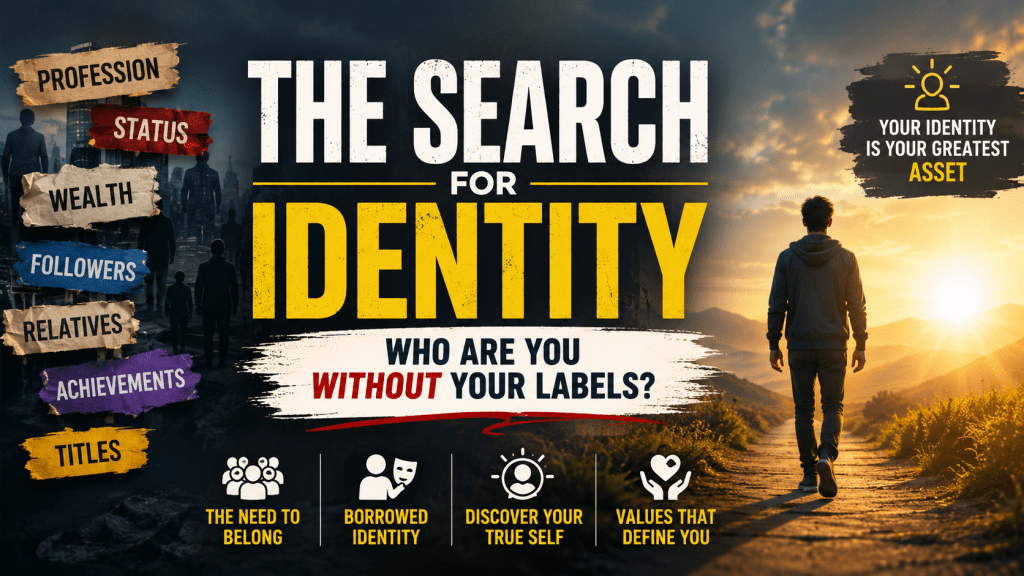
From the moment we are born until our last breath, every human being is searching for one thing—identity.
It is one of our deepest psychological needs: the desire to be recognized, accepted, appreciated, and valued. We all want to answer the same silent question:
“Who am I, and where do I belong?”
This search begins surprisingly early. A child proudly shows a drawing to a parent, not because it is a masterpiece, but because the child longs to hear, “Well done!” A teenager carefully chooses clothes, music, or friends, trying to fit into a group. An adult works tirelessly to earn promotions, awards, or respect. Even in old age, people love to tell stories of their achievements because they wish to know that their lives mattered.
The need for identity never leaves us—it simply changes its form.
The Many Masks We Wear
Some people identify themselves by their profession.
“I am a doctor.”
“I am a soldier.”
“I am a teacher.”
Others define themselves through relationships.
“I am a father.”
“I am a mother.”
“I am someone’s friend.”
Some seek identity through wealth and possessions.
“My house…”
“My luxury car…”
“My designer clothes…”
Others chase identity through fame. Social media has amplified this desire. A photograph receiving thousands of likes can produce a temporary feeling of importance. Yet when the attention fades, many feel strangely empty again.
The search continues.
Why Do We Need Recognition?
Imagine attending a party where everyone ignores you. Nobody greets you. Nobody remembers your name. You stand in a room full of people, yet feel completely invisible.
Now imagine entering another gathering where people smile, welcome you warmly, remember your achievements, and genuinely enjoy your company.
The difference has nothing to do with money.
It has everything to do with recognition.
Human beings are social creatures. We thrive when we feel seen and appreciated. Recognition reassures us that our existence has meaning.
The Desire to Belong
Throughout history, people have formed tribes, villages, religions, nations, clubs, sports teams, and online communities.
Why?
Because belonging gives us identity.
A fan proudly wears the jersey of a cricket team.
A soldier wears a uniform with pride.
A Sikh ties a turban.
A monk wears simple robes.
A graduate treasures a university badge.
These symbols are far more than pieces of cloth or metal. They represent membership, purpose, and shared values.
People often defend these identities passionately because they become part of how they see themselves.
Standing Out or Fitting In?
Interestingly, not everyone seeks identity in the same way.
Some desperately want to fit in.
They dress like everyone else, follow trends, and avoid being different.
Others crave uniqueness.
Artists, entrepreneurs, inventors, and explorers often challenge accepted norms because they want to leave their own mark on the world.
One seeks acceptance.
The other seeks distinction.
Yet both are driven by the same human need—to know who they are.
When Identity Becomes a Trap
The search for identity is healthy—until we mistake our roles for our true selves.
A successful executive retires and suddenly feels lost because the title that defined him has disappeared.
An athlete suffers an injury and wonders who they are without the sport.
A celebrity fades from public attention and struggles with loneliness.
A wealthy businessman loses his fortune and feels he has lost himself.
If our identity depends entirely on external labels, it becomes fragile.
Titles change.
Relationships change.
Possessions disappear.
Even our physical appearance changes with time.
If everything we identify with can be taken away, who are we then?
The Deeper Identity
Many philosophers and spiritual teachers suggest that our deepest identity lies beyond our profession, nationality, religion, or social status.
A king and a beggar both laugh, cry, love, and fear.
A billionaire and a labourer both seek happiness.
Behind every label is simply a human being longing to love and be loved.
When we discover values such as compassion, honesty, courage, kindness, and wisdom, our identity becomes more stable because these qualities cannot be stolen by circumstances.
The Lifelong Journey
Identity is not something we find once and keep forever.
It evolves.
A young student becomes a professional.
A professional becomes a parent.
A parent becomes a mentor.
A mentor becomes a source of wisdom.
Every stage of life asks us a new question:
“Who are you now?”
The answer keeps changing as we grow.
The Final Reflection
The search for identity is one of life’s greatest adventures. We all seek acceptance, respect, and belonging. We all want our lives to matter.
But perhaps the greatest freedom comes when we realize that our true worth is not determined by applause, titles, wealth, or popularity.
These may describe what we do.
They do not define who we are.
When we discover our authentic self—grounded in character rather than labels—we no longer need constant approval from the world. Recognition becomes a pleasant bonus, not a necessity.
The journey of identity is, in the end, a journey of self-discovery.
The more honestly we understand ourselves, the less desperately we seek validation from others.
‘And that may be the most meaningful identity of all.
Guchi.

