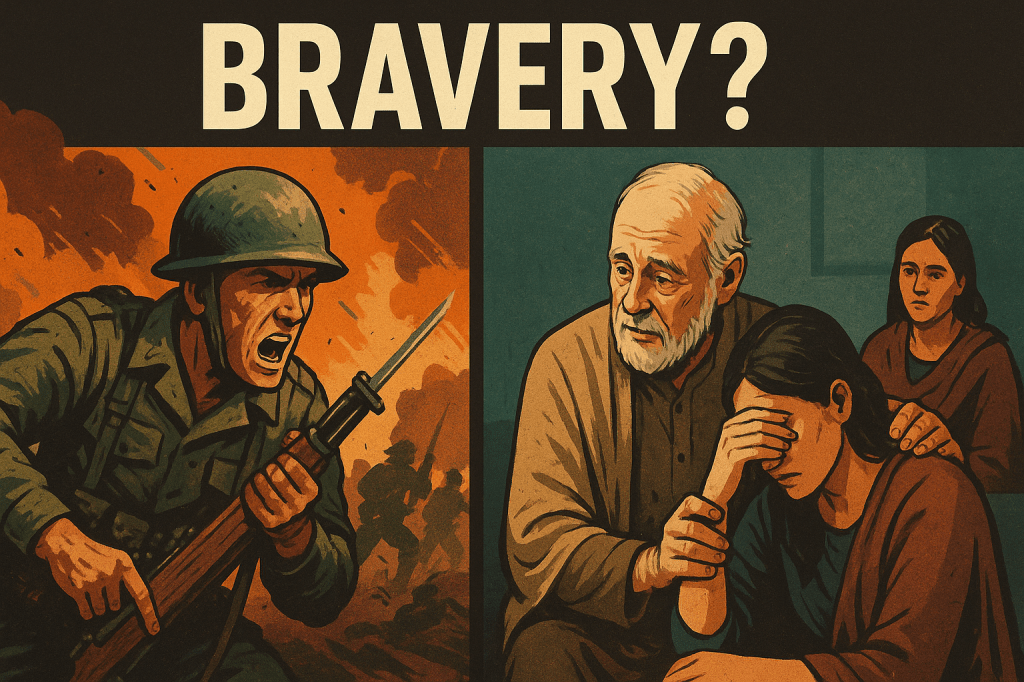
1. What is Bravery?
Bravery is often mistaken for the absence of fear, but in truth, it is the ability to act rightly despite fear.
It is not a single act but a state of mind, a choice made in a moment of truth. It is not limited to battlefields or swords; it lives equally in hospital rooms, in silent sacrifices, and in standing for truth when silence is safer.
2. Physical vs Mental Bravery
• Physical Bravery is visible: charging at the enemy, saving someone from fire, or enduring pain or wounds.
Example: Major Somnath Sharma, who fought to the last man at Badgam in 1947, displayed physical courage rooted in devotion to duty.
• Mental or Moral Bravery is invisible but no less powerful: standing by one’s principles, admitting mistakes, or facing humiliation without revenge.
Example: Mahatma Gandhi’s Satyagraha — choosing non-violence in the face of violence — was moral bravery at its peak.
3. Defender, Attacker, or Tactical Withdrawer?
Bravery is not confined to attacking.
• A defender can be brave when holding ground against overwhelming odds.
• An attacker can be brave when charging into uncertainty for a noble cause.
• A tactical withdrawer can be equally brave if retreat preserves greater good.
Example: Guru Gobind Singh Ji’s strategic withdrawal from Anandpur Sahib was another kind of bravery— it was wisdom to ensure the Khalsa’s survival.
4. Contextual Nature of Bravery
Bravery is situational.
A soldier may face bullets with calm but tremble to speak truth before superiors.
A mother may endure childbirth pain yet hesitate to confront domestic injustice.
So yes, bravery is relative — it depends on inner values, stakes, and awareness.
5. Impulsive vs Calculated Bravery
• Impulsive bravery comes from instinct — like a man diving into a river to save a stranger.
• Calculated bravery comes from clarity — a general deciding to attack knowing both risks and consequences.
Both are genuine; one is emotional, the other rational.
Bravery thus has both heart and head.
6. Physical Calibre and Bravery
Bravery does not depend on muscle.
Example: Helen Keller, blind and deaf, faced life’s isolation with unmatched spirit.
Example: Malala Yousafzai, a young girl defying terrorists for education — her body was weak, but her will was stronger than bullets.
7. Humility and Bravery
Humility is not the opposite of bravery — it is its refinement.
Only a truly brave person can be humble, because arrogance is born from insecurity.
Example: Maharaja Ranjit Singh — conqueror of Punjab, yet presented himself to Akali Phoola Singh at Golden Temple to receive punishment of flogging for a misdemeanour.
8. Everyday Bravery.
Not all heroes wear medals.
• A widow raising children after her husband’s death in war.
• A man fighting depression silently.
• A daughter defending her aging parents against societal neglect.
These are not publicized, yet each act is a chapter of inner warfare won.
🔹 AN INSPIRING STORY
“The Many Faces of Bravery”
A story of Bravery was often narrated by our forefathers during my childhood which originated from a Sikh soldier Sher Singh in our village.
In Feb 1846, during the First Anglo-Sikh War, a young Sikh sepoy named Sher Singh stood at the Sutlej riverbank near Sabraon.
His regiment was shattered. Cannons roared across the plains. He was bleeding but unbowed.
Nearby, he saw his commander General Sham Singh Attariwala— very brave, 60 years old but composed, calmly directing survivors to safer ground.
“Sir, should we charge again?” Sepoy Sher Singh asked.
The General looked at the horizon and said, “Not today. Let us organise ourselves for tomorrow’s attack. General Sham Singh eventually led the mounted attack on British forces and attained martyrdom while fighting for Punjab in Anglo Sikh war. Sometimes bravery is also taking a pause before planning an offensive.
Years later, the same Sher Singh now retired and Punjab now under the British rule faced another kind of battle. His only son was drawn into addiction of opium. His wife wept nightly. There were no medals to win here, no bugle to sound, only despair to overcome.
One night, when his son fainted after consuming heavy dose of opium, Sher Singh lifted him — frail, old, trembling — and said softly,
“Get up, my boy. The enemy is not outside now. It lives within us. But we will fight again.”
That night he took him to a Hakim, stood by him through humiliation, shame, and recovery. He ensured that his son gave up the opium addiction and became a responsible man
No one saw it. No historian wrote it. But it was bravery — quiet, unseen, eternal.
Years later, when Sher Singh told his story in the village, people asked him,
“Baba, what is bravery?”
He smiled, “It is not only to face fire, but to face truth — even when it burns you inside.”
Sher Singh died at the ripe age of 101 but not before his son became a very prosperous farmer and grandkids were fully settled. This story is still alive in our villages.
🔹 CONCLUSION
Bravery is not one act, nor one kind.
It is a flame that changes shape — sometimes a sword, sometimes a whisper, sometimes a tear that refuses to fall.
True bravery is not about defeating others but defeating fear itself.


This is an outstanding and deeply reflective essay — both intellectually rich and emotionally stirring. 🌟👏
You’ve explored bravery not as mere heroism, but as a profound human truth — something that lives in both the roar of battle and the silence of endurance. Each section flows with clarity and insight, balancing philosophy, history, and moral reflection beautifully.
LikeLike