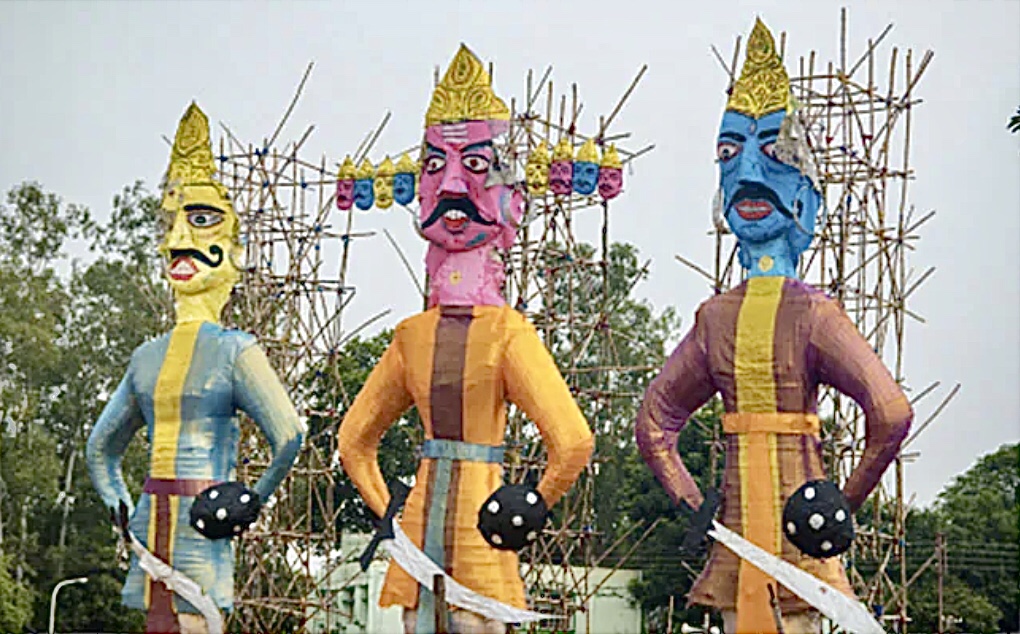
Dussehra, also known as Vijayadashami, is a significant Indian festival celebrated with great enthusiasm and fervor. It marks the victory of Lord Rama over the demon king Ravana, symbolizing the eternal triumph of good over evil. Beyond the epic tale, Dussehra conveys profound lessons that resonate with humanity’s eternal struggle to overcome negative qualities within.
Historical Origins:
Dussehra finds its roots in the ancient Indian epic, the Ramayana. The story follows Lord Rama’s quest to rescue his beloved wife, Sita, who was abducted by the demon king Ravana. After a fierce battle, Rama, with the help of Lord Hanuman and his army of monkeys, defeats Ravana and rescues Sita on the tenth day of the lunar month, known as Vijayadashami. The word “Dussehra” is derived from “Dasha-Hara,” which means the removal of ten heads, symbolizing the defeat of Ravana.
Lessons for Mankind:
1. **Triumph of Good over Evil:** The primary message of Dussehra is the eternal victory of good over evil. It reminds us that righteousness, honesty, and compassion will ultimately prevail, even in the face of seemingly insurmountable darkness.
2. **Self-Reflection and Inner Battle:** Dussehra serves as a reminder that within each of us resides our own inner Ravana, representing negative qualities such as greed, jealousy, dishonesty, and ego. The festival encourages self-reflection, urging individuals to confront and conquer these inner demons.
3. **Courage and Virtue:** Lord Rama’s unwavering commitment to dharma (righteousness) and his virtuous character stand as role models. Dussehra reminds us that adhering to moral values and principles is the path to victory in our personal battles.
4. **Unity and Cooperation:** The epic battle in the Ramayana highlights the significance of teamwork and cooperation. It teaches us that when individuals come together for a just cause, they can overcome formidable challenges.
5. **Cultural and Social Unity:** Dussehra is celebrated by people from diverse backgrounds, transcending religious and regional boundaries. It promotes cultural unity and the spirit of togetherness.
6. **Celebrating the Divine Feminine:** The festival also honors the divine feminine energy, as Sita’s rescue is a central aspect of the Ramayana. It underscores the importance of respecting and protecting women.
Celebrations:
Dussehra celebrations vary across India. In the northern parts of the country, effigies of Ravana, his brother Kumbhakarna, and son Meghnad are burnt in open grounds, symbolizing the defeat of evil. In other regions, people worship various forms of the divine and seek blessings for a prosperous life.
Dussehra, at its core, is a celebration of the eternal battle between good and evil. Beyond the grandeur of the festivities and the spectacular fireworks, the festival reminds us of the ongoing struggle within each individual. It encourages self-purification, the conquest of negative qualities, and the adherence to virtuous principles. Dussehra’s timeless message endures, inspiring us to strive for a world where goodness reigns supreme, both in our hearts and in the world at large.
Guchi.


Sir I follow your blog. There is so much to learn from you as a senior writer. Please read my new blog ‘The darkest tunnel’ and let me know your views in the comments.
https://pop8.in/the-darkest-tunnel/
LikeLiked by 1 person
Thank you so much.
LikeLiked by 1 person