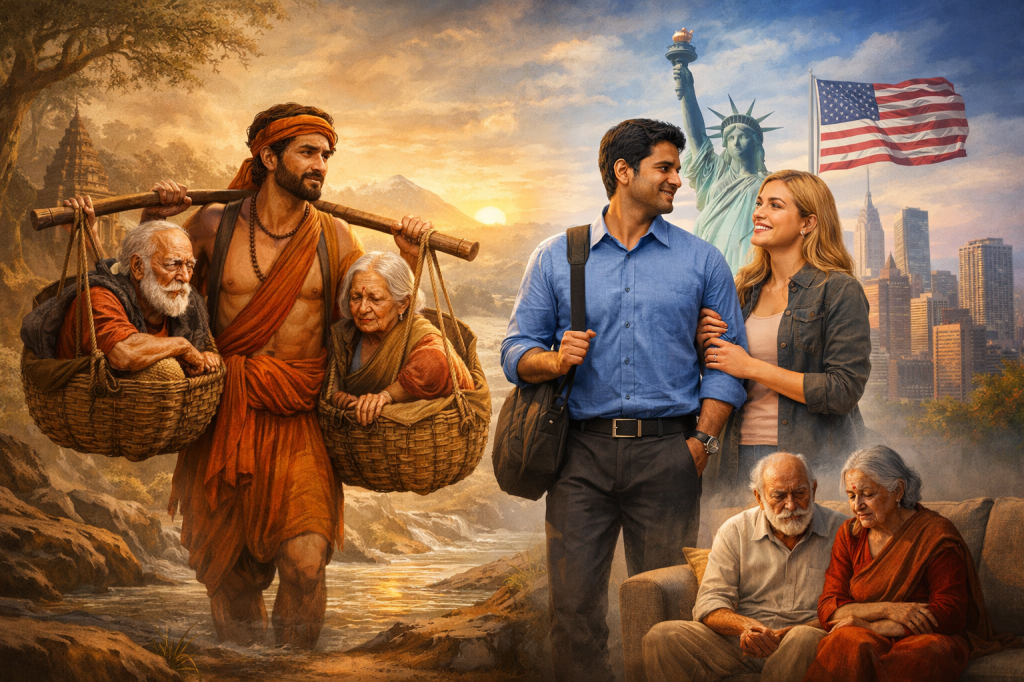
Long before immigration counters and social security numbers, there lived a boy named Sharwan Kumar.
History remembers him walking barefoot through forests, carrying his blind parents on his shoulders—two fragile lives balanced on one devoted soul. When an arrow struck him by mistake, his final concern was not pain, nor death, but his parents’ future.
That story became scripture.
A benchmark of devotion.
Centuries passed.
Rebirth in a New India
Sharwan Kumar was born again in modern India—middle-class, educated, gentle. His parents were aging but dignified, their lives quietly orbiting around their only son.
Sharwan was once again the ideal son.
He took his father to hospitals, massaged his mother’s aching knees, skipped parties to sit beside them in the evenings. Neighbors whispered with admiration.
“ऐसा बेटा किस्मत वालों को मिलता है।”
And then came America.
The First Crossing
The H1B visa arrived like a blessing disguised as temptation.
A software job.
A future too bright to refuse.
Sharwan promised to return, to care, to remain unchanged. His parents smiled, hiding their fear behind pride.
America welcomed him politely—no emotion, just opportunity.
He worked hard. He adapted faster than expected.
And somewhere between deadlines and promotions, he fell in love.
The Marriage
She was American. White. Independent. Kind in her own way.
She admired Sharwan’s discipline, his values, his ambition.
Sharwan admired her freedom, her clarity, her uncomplicated life.
They married quietly—court wedding, simple vows, smiles captured in photographs.
When Sharwan told his parents, his mother cried—half joy, half uncertainty.
“She is good,” Sharwan said.
“She will understand.”
But understanding is not automatic—it grows from shared soil.
When Parents Arrived
Years later, when Sharwan brought his parents to America, the house changed.
His wife was polite.
Always polite.
She smiled.
She nodded.
She maintained distance.
She did not understand why parents needed to live with them.
Why they expected conversation.
Why silence felt like abandonment to them.
To her, independence was respect.
To them, distance was neglect.
She did not stop Sharwan from caring for his parents—
She simply did not participate.
And slowly, Sharwan adjusted—not consciously, but conveniently.
A New Normal
His wife preferred weekends out.
His parents preferred evenings together.
He chose balance.
Which often meant absence.
His mother stopped asking questions.
His father stopped telling stories.
They learned to live quietly in a foreign land—
No language.
No friends.
No familiar rituals.
Even food became a negotiation.
“Please don’t cook every day,” his wife would say gently.
“The smell lingers.”
So his mother cooked less.
And then stopped altogether.
The Invisible Drift
Sharwan never stopped providing.
Bills were paid.
Medicines ordered.
Insurance secured.
But love had changed its form—from presence to logistics.
When his wife asked,
“Why don’t they go back to India for a while?”
Sharwan hesitated.
He knew the truth:
They could not go back alone.
They had nowhere to belong without him.
But he said nothing.
The Breaking Point
One winter night, his father slipped in the bathroom.
Hospital lights.
Machines.
Silence.
The doctor asked,
“Do they have support?”
Sharwan looked around.
His wife was there—concerned, composed.
But she stood slightly apart.
And for the first time, Sharwan felt something tear inside him.
His father, half-conscious, whispered:
“तू खुश है न बेटा?”
That was all.
Realization Without Villains
No one was cruel.
The wife was not heartless—
She was raised differently.
America was not evil—
It rewarded efficiency, not emotion.
Sharwan was not wicked—
He simply adapted too well.
And that is how devotion died—not by violence, but by adjustment.
Epilogue
In ancient times, Sharwan Kumar died protecting his parents.
In modern times, he lived long enough to outgrow them.
The tragedy is not that he married outside his culture.
The tragedy is that he forgot that love requires translation, effort, and courage.
Sharwan Kumar went to America.
But somewhere between love, success, and assimilation,
he forgot which shoulders once carried the world for him.
Guchi.
 Improve Your Life
This is a powerful, quietly devastating piece. It captures how love can erode not through cruelty, but through adaptation and silence. The modern retelling of Shravan Kumar is nuanced, compassionate, and painfully real—no villains, only shifting values and unintended loss. Deeply moving and thoughtfully written.
LikeLike
Thank you, reality of the day.
LikeLiked by 1 person
Eloquently captured.
LikeLike