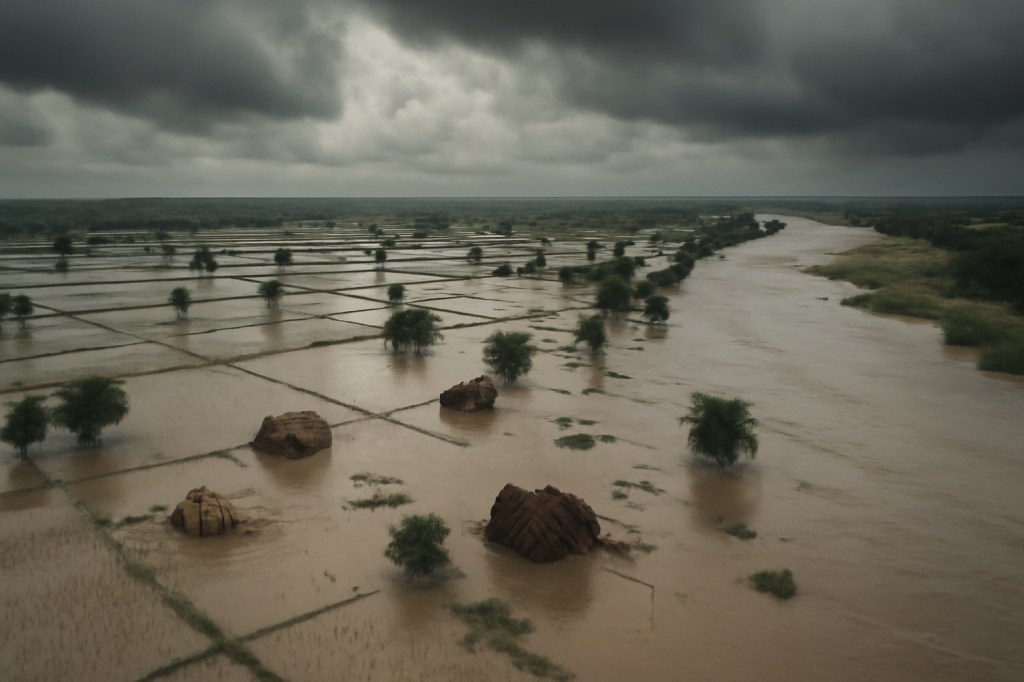
The rain had been falling relentlessly for days. It wasn’t the gentle monsoon drizzle that Punjab’s farmers awaited for their crops. This was different—angry clouds had burst their fury, and the Sutlej and Beas swelled beyond their banks. Smaller streams like Ghagar turned into raging torrents. Eleven districts were submerged, the fertile paddy fields that once promised grain to millions now lay under a sheet of muddy water.
In Mohali, Derabassi, and parts of Chandigarh, water seeped into colonies, drowning homes and leaving behind the stench of despair. Along the Ravi, villages that touched the border with Pakistan were cut off—fields became lakes, huts were reduced to splinters, and men stood helpless, their livelihoods washed away. Over 300 souls had been claimed by the floodwaters, their names whispered in grief by families clinging to hope.
Amid this devastation, stories of compassion quietly bloomed.
The Carpenter and the Child
Raghbir, a day laborer and carpenter from a village near Ropar, had lost his hut to the flood. His tools were gone, and with them, his daily wages. But when he heard the cries of a child stranded on a rooftop, he didn’t hesitate. With nothing but an old plastic drum and a bamboo pole, he waded through chest-deep water. The currents pulled hard, debris scraped his legs, but he pushed on.
The child, barely six, clung to him like a terrified bird. Raghbir brought him to safety, even though his own family was still missing. When asked why he risked his life, his voice cracked:
“If this child lives, perhaps God will send someone to save mine.”
Langar in the Floodwaters
In a Gurudwara near Fatehgarh Sahib, the flood had entered the ground floor. Instead of despair, volunteers carried the Guru Granth Sahib to higher ground and set up makeshift kitchens on the roof. Langar fires were lit using dry wood salvaged from collapsing homes. Soon, hot dal and roti were being distributed in boats and tractors, handed over to villagers marooned on rooftops.
Not just Sikhs, but Hindu youths from neighboring towns joined them. Together they made food packets, sometimes tying them to floating logs and pushing them across currents where boats couldn’t reach. A Muslim truck driver, stuck while on his way to Ludhiana, opened his vehicle filled with sacks of rice and said:
“Khuda ka diya hai, insaan ke kaam aana chahiye.”
(What God has given must serve humanity.)
The Silent Hero
In Derabassi, Harpreet Kaur, a schoolteacher, turned her half-flooded home into a shelter. She placed benches and cots on bricks and welcomed whoever came—Hindu, Sikh, or migrant laborer. For three nights, over forty people slept in her small house. She used her savings to buy milk for the children.
When asked how long she could continue, she replied simply:
“As long as I have breath, this roof will protect more than me.”
The Elder’s Words
In one relief camp, an old man sat weeping. His paddy crop was gone, his buffaloes drowned, his son missing. A volunteer tried to console him, saying, “Baba ji, sab theek ho jaayega.”
The old man shook his head and replied, “Beta, fasal toh dobara ug jaayegi, makaan bhi ban jaayega. Lekin jis tarah aaj Hindu-Sikh-Musalmaan ek-dusre ko bacha rahe hain, yeh nazaara dubara kab dekh paayenge?”
(Son, crops will grow again, houses will be rebuilt. But this sight—of Hindus, Sikhs, and Muslims saving one another—when will we see it again?)
Soft Compassion Amid Hard Rain
The government’s response was slow, often invisible. Relief trucks were late, bureaucracy heavier than the floods themselves. But humanity refused to drown. Across Punjab, ordinary people became extraordinary—villagers turning their tractors into lifeboats, women cooking in knee-deep water, youths risking their lives to rescue strangers.
The rain was hard, merciless, unrelenting. But amidst the roaring rivers and submerged lands, there flowed a softer, stronger current—of compassion, unity, and love.
In the days when Punjab wept, it was not only rain that fell—it was kindness, too, falling gently into every broken heart.
Guchi.
 Improve Your Life