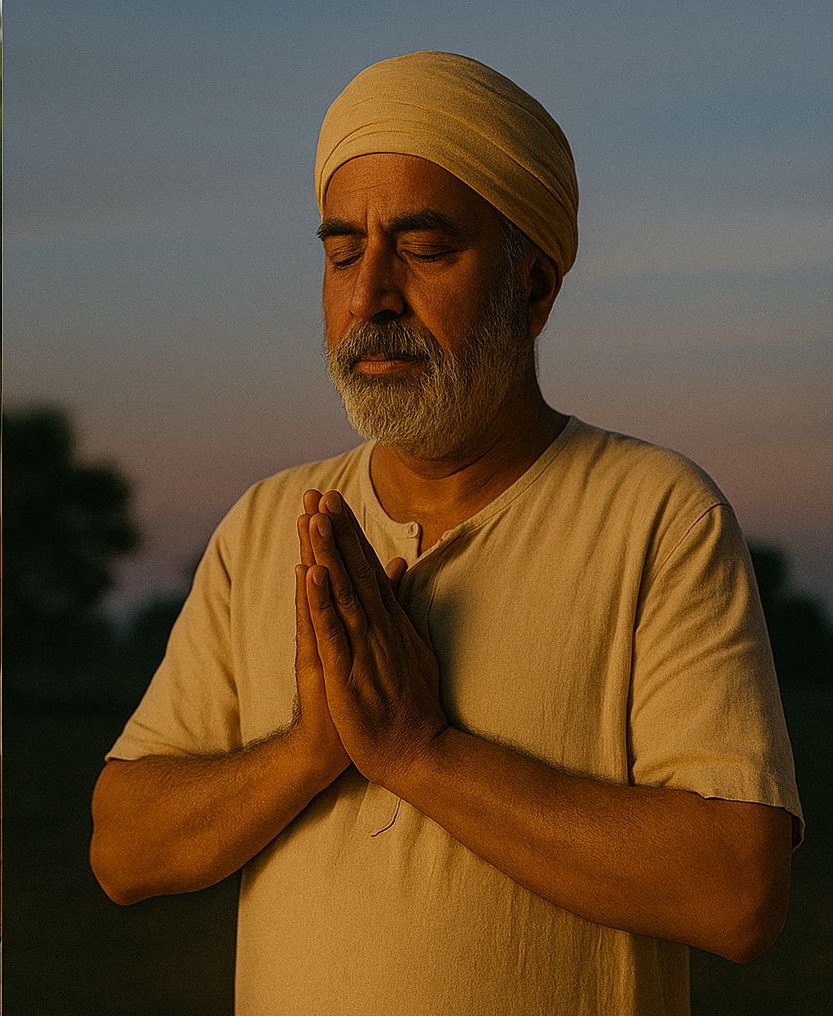
Before closing my eyes each night, I follow a small, deeply personal ritual. It is simple, private, and almost childlike in its innocence—but it brings me peace. I offer four prayers: one each for my daughters, one for my son, and finally one for all creatures on this Earth. Each prayer I repeat eleven times, almost like weaving a protective thread around those I love and around the world at large. And then, with a quiet heart, I sleep soundly.
Yet, sometimes a question rises within me: “Why four prayers? Why not just one universal prayer?” Couldn’t a prayer for all beings include my children as well? Why this separation? Does this betray my selfishness as a human being—placing my own family first before humanity, nature, and all creation?
I have wrestled with this paradox many times, and over the years, I have come to see it less as a contradiction and more as a mirror of my human condition.
The Universal Prayer: Sarbat da Bhala
In Sikh philosophy, there is a profound prayer: Sarbat da Bhala—the welfare of all. On the surface, it means that we wish goodness for everyone, but embedded within it are layers of wisdom that humanity as a whole still struggles to achieve. Sarbat da Bhala extends beyond individuals and tribes. It envisions:
• Peace among all communities
• Health for all beings
• Food, clothing, and livelihood for every person
• Relationships built upon mutual respect rather than envy or rivalry
• A world without hatred, prejudice, or divisions of religion, tribe, class or caste
• Justice and fairness as guiding principles of society
If I truly believed in the completeness of this prayer, my nightly ritual would not need four parts. One single invocation of Sarbat da Bhala should suffice. Yet, in my weakness, I still begin with prayers specific to my children before widening the circle outward. Why?
The Role of a Parent
Perhaps the answer lies in my role as a parent and an elder of my family. In the drama of life, each of us plays a part. My role carries within it the instinct to care first for my children—the natural bond of Moh (attachment) that ties me to them.
I do not pray that they become wealthy, powerful, or famous. Instead, I pray they overcome their own fault lines, their inner battles, their moral weaknesses. I pray they become kind, compassionate, and strong human beings. Because these are things I cannot command or enforce as a father. Each child must walk their own path. All I can do is place their names gently before the Divine and ask that they be guided toward light.
It is not selfishness in its crude form, but perhaps it is still partiality—the prioritization of my circle first before expanding the embrace to the whole human family. And I accept that about myself. It is my humanness.
From Family to Universe
After prayers for my children, I step outward into the larger prayer for the world. Because ultimately, my children’s well-being is intertwined with it. My daughters and son cannot truly thrive in a world sick with hatred or injustice. Their individual lives bloom only if humanity itself blossoms. If society becomes more just, more peaceful, more compassionate, then my family as well as every family benefits.
Thus, the universal prayer completes the circle. What begins with family finds its true fulfillment in inclusivity. In that sense, the four prayers are not a conflict but a progression:
From my children → to my family → to my community → to all of existence.
Reconciling the Human with the Divine
So I no longer feel guilty for praying in four steps. My prayers reflect the limitations of being human, but also the sincerity of being human. They combine weakness and wisdom. They remind me of my attachment, but they also push me beyond it.
Maybe this is how life is meant to be lived. Not in perfection, but in honest struggle between our small attachments and our larger ideals. Perhaps God smiles not at the person who utters the most grandiose universal prayers but at the one who speaks authentically—from the narrow concerns of the heart to the infinite vision of the soul.
So I will continue with my little ritual: three prayers with names, one without. Four whispers in the night. Four bridges from love of kin to love of all. And then, with my conscience at ease, I surrender myself to sleep.
Closing Reflection
The truth is, prayer is less about words and more about intentions. Each repetition, each whisper of longing, reorients the heart. My four prayers may seem redundant, but for me, they are essential stepping-stones toward that one ultimate prayer:
That all beings may live in peace.
That justice may prevail.
That compassion may triumph.
That we may recognize one another not as rivals, but as fellow travelers.
Until then, I will keep repeating my ritual. Eleven times for each intention. Night after night. Step by step, heart by heart.
Guchi.
 Improve Your Life