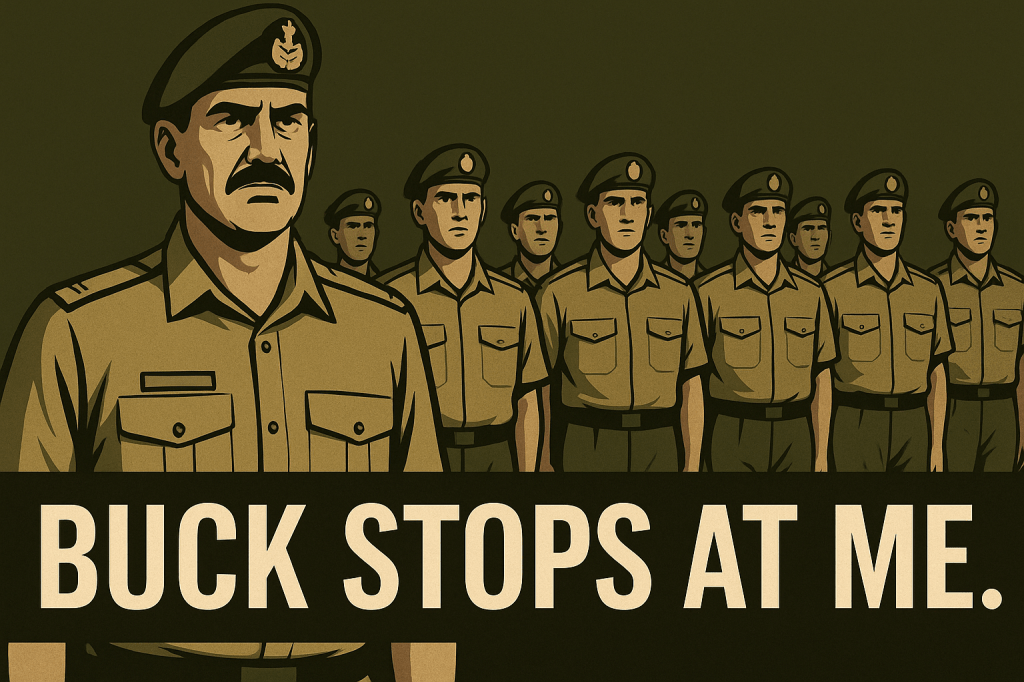
Leadership and the Burden of Command: A Lesson from the Parade Ground to the Boardroom!
During my time in the Indian Army, one defining moment etched itself deeply into my conscience—a piece of advice, simple yet profound, given by a senior officer as I was being promoted to Commanding Officer of my regiment. He looked me in the eye and said, “Whenever you get praise for the achievement of your unit from a superior officer, always reply that it is due to the effort of your team—your officers and your men. And whenever your organisation gets a reprimand for something going wrong, own the responsibility and say, ‘Sir, it is entirely my fault and not of my team.’ A true military leader does not find scapegoats for the failure of his organisation. The buck stops at him.”
At that time, I appreciated the wisdom in those words, but only over years of leading men, making difficult decisions, and facing the ultimate crucibles of leadership did I realise how those words would shape not just my actions—but my identity.
I carried this leadership philosophy throughout my career all the way to the rank of Major General, and I believe the truth it holds is as relevant to CEOs and Prime Ministers as it is to Commanding Officers in the field.
Leadership Isn’t About Glory—It’s About Ownership.
In a world increasingly driven by optics, image, and self-promotion, it is tempting to step into the limelight when things go well, and equally tempting to fade into the background or place blame when things go awry. But true leadership—really *true* leadership—is about ownership.
Take the example of General Sam Manekshaw, one of India’s most revered military leaders. During the 1971 Indo-Pak war, when asked by Prime Minister Indira Gandhi whether the Indian Army was ready for war in April that year, he candidly replied, “I guarantee victory, but my troops need more time to prepare.” Had he capitulated under pressure or sought easy glory, the course of the war could have been very different. But his foresight and his honesty saved thousands of lives. Later, after India emerged victorious, Manekshaw gave due credit not to himself—but to his soldiers, his officers, and his staff. That, to me, is the gold standard of honourable leadership.
On the contrary, across various domains—be it politics, corporate boardrooms, or NGOs—leaders are often seen rushing to take credit when teams succeed, and just as swiftly shifting blame when they stumble. This is a betrayal—not just of their people, but of the very ethic of leadership.
When the Buck Really Stops: A Case Study from Corporate India.
Let’s look at a contrasting but equally powerful example from the corporate world.
In 2017, when Tata Group was going through one of its most turbulent times, Natarajan Chandrasekaran stepped in as Chairman amidst boardroom tumult and media frenzies. Despite the storm he inherited, he made no excuses, never blamed his predecessors or colleagues. Instead, he owned the responsibility for restoring the Tata brand’s dignity. Under his leadership, the group found its bearings again—reviving stalled projects, fostering trust with shareholders, and aligning the conglomerate with a long-term vision. His cornerstone belief: If a leader shields his team in failure and shares every inch of the success, loyalty and excellence follow naturally.
Contrast this with other corporate collapses—like Enron or Satyam—where top executives were quick to deny wrongdoing and throw their juniors under the proverbial bus. The consequences? Loss of trust, imploded organisations, and lives affected irreparably. Leadership abandoned them long before the auditors did.
Own the Fall, Share the Rise.
Globally, history is replete with examples where the strength of an organisation mirrors the moral core of its leader. During World War II, when things started to go wrong in North Africa, General Dwight D. Eisenhower, the Supreme Allied Commander, would repeatedly say, “The losses are mine, the mistakes are mine.” Later, when the D-Day invasion proved a success, he ensured the press highlighted the bravery of junior officers, the meticulous planning of his generals, and the determination of allied troops.
Now let’s pull that thread further—to our times. In 2020, during the COVID-19 pandemic, New Zealand’s Prime Minister Jacinda Ardern displayed similar qualities. When her government faced criticism over quarantine slipups, she publicly apologised, saying, “The blame ultimately rests with me.” Her approval ratings soared not because she was infallible, but because she was accountable. The world noticed. Because people understand that someone willing to protect their people in failure is someone worth following.
Leadership in Everyday Life.
Even today, when young professionals ask me for advice, I recount that moment during my promotion—a time when a senior taught me what truly wearing the stars on your shoulder meant. It was not about salutes or parades or medals, but about carrying not just responsibility, but your people’s trust.
I’ve seen young Captains dealing with combat stress bear the faults of their company with grace, and I’ve seen bureaucrats fumble for excuses. The difference lies not in hierarchy, but in character.
And this philosophy isn’t limited to drill grounds or C-suites. It applies in social and family life too.
Even as the head of the family, you must praise your family members for their achievements, however small. But should any member default, stumble, or fail in their conduct—it is the leader of the family who must bear the brunt. Perhaps their upbringing lacked a lesson, or their grooming could have been better. Taking responsibility, not deflecting it, is what keeps a family united and respectful. The family’s honour lies in the humility and courage of its leader.
It also applies to a school principal defending her teachers, a social reformer defending his volunteers, or even a cricket captain speaking after a loss. Watch MS Dhoni a man who never credited himself after a win, but always protected his players when India lost. That’s why his team trusted him. That’s why a billion fans did.
In Conclusion: The Legacy of Leadership.
In my life as a soldier and later as a General, I learned that medals may glitter, but integrity shines.
A leader’s real legacy is built in the quiet moments—when they take the fall so their team can rise, when they deflect credit but absorb the blame, and when they remember that to lead is not to command prestige, but to carry responsibility.
So whether you’re commanding a battalion, running a startup, managing a classroom, or leading a community, remember:
True leaders don’t ask where the blame lies. They make sure the Buck stops at them.
And if they truly do that, the respect of their team follows—not in words, but in loyalty. And that’s a currency no title can ever buy.
Guchi.
 Improve Your Life