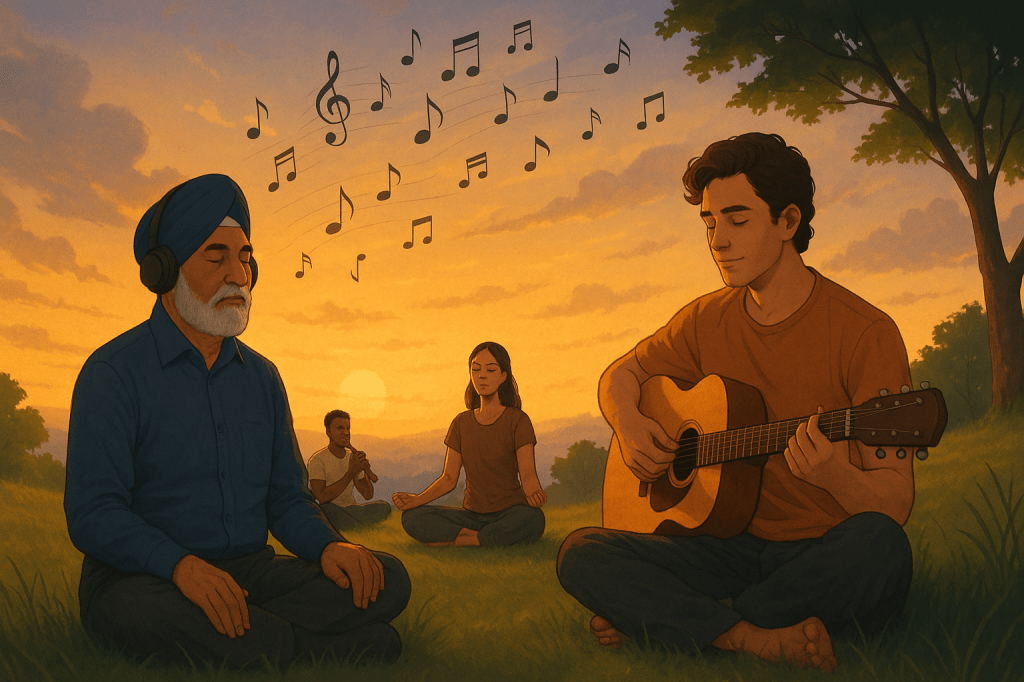
Introduction: A Universal Need Beyond Belief
Meditation has long been associated with religion — sacred chants, scripture reading, prayer rituals, or visualizing a divine form. But what about those who don’t identify with a religion? Or those who believe in a higher power but don’t follow rituals or scriptures strictly?
I asked myself this question, as someone who belongs to the Sikh faith but is not ritualistic. I find myself deeply moved by music — sometimes classical, sometimes even a Bollywood melody. Often, it feels more sacred than a verse from scripture. And it led me to wonder:
What stirs the soul of an atheist or agnostic? Can music become their meditation?
1. Meditation: A Human Practice, Not Just a Religious One
At its essence, meditation is the practice of stillness, awareness, and inner observation. While religions offer tools like mantra, prayer beads, or divine imagery, meditation does not belong to any one path.
Even those who do not believe in God — atheists, agnostics, rationalists — feel anxiety, stress, or existential curiosity. They too seek:
• Calmness of mind
• Clarity of thought
• Emotional healing
• Purpose and meaning
Thus, meditation — in its purest form — is not about religion. It’s about being fully present, fully alive.
2. Music: The Atheist’s Mantra, The Agnostic’s Scripture
Music is a universal language. It bypasses intellect and belief, touching the human heart in a way few other mediums can.
A religious devotee might meditate on God’s name.
An atheist may listen to a soft piano piece and enter the same inner silence.
• A sad raga can help release grief.
• A soulful ghazal can stir forgotten emotions.
• A Sufi qawwali can generate awe, even if one doesn’t believe in divine forms.
• Even pop or electronic music can transport someone into a trance-like flow.
As Mozart’s peers once said: “Music is the voice of God.”
Even for those who don’t believe in God, music becomes something sacred, transcendent, and transformative.
3. Self-Discovery Without Religion: Atheism and the Inner Journey
Many non-believers still ask the same questions that saints and sages have pondered:
• Who am I?
• What is the purpose of life?
• How can I be more aware, more present, more authentic?
They might not use words like soul, karma, or God, but they explore:
• Consciousness
• Mindfulness
• Ethical living
• Emotional balance
• Universal oneness through nature, music, or art
Meditation for them may come through:
• Watching the stars,
• Listening to ocean waves,
• Feeling goosebumps while hearing a violin solo,
• Or simply focusing on the breath.
These too are doorways to the divine — even if unnamed.
4. The Science of Vibration and the Abstract Divine
You don’t need religion to appreciate that everything is energy.
Modern science agrees — all matter is vibration.
So, when one is moved by a sound, a melody, or a musical note, they are resonating with something fundamental.
Whether we call it “God,” “Source,” “Light,” “the Universe,” or “Nature’s rhythm,” — it’s the same inner experience of awe, peace, and unity.
Einstein once said:
“The most beautiful thing we can experience is the mysterious. It is the source of all true art and all science.”
5. Music as Meditation for All
• For a Sikh, Kirtan can be meditation.
• For a Buddhist, chanting may open the heart.
• For an atheist, a cello composition may bring the same serenity.
• For a spiritual seeker, nature sounds may act as divine whisper.
Each soul finds its own frequency.
And music is the bridge that carries us across differences — toward self-awareness, silence, and sometimes, bliss.
Conclusion: One Soul, Many Pathways
You don’t have to follow a scripture to feel the sacred.
You don’t need to bow before a form to touch divinity.
You just need to be moved — by music, nature, poetry, or breath.
So yes, even atheists can meditate.
Even the non-religious can experience transcendence.
The medium may differ, but the yearning is the same.
In the end, we’re all seeking the same silence —
The same light —
The same peace.
And sometimes… a single piece of music becomes that sacred silence.
Guchi.
 Improve Your Life