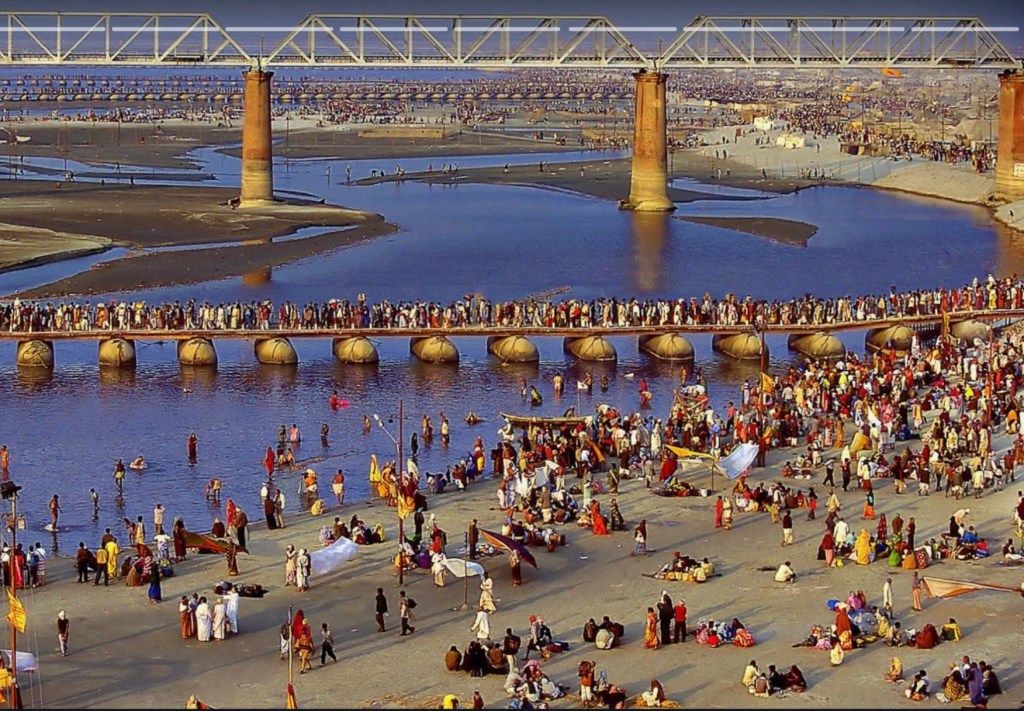
The Maha Kumbh Mela, currently underway in Prayagraj, Uttar Pradesh, is the world’s largest religious gathering, drawing millions of Hindu devotees. This grand event, spanning from January 13 to February 26, 2025, holds profound spiritual significance and is deeply rooted in Hindu mythology and traditions.
Origins and Mythological Significance
The Kumbh Mela finds its origins in the ancient Hindu legend of the Samudra Manthan, or the churning of the ocean of milk. According to mythology, the Devas (gods) and Asuras (demons) collaborated to extract Amrit, the nectar of immortality. In the ensuing struggle for possession, a few drops of this divine nectar fell at four locations—Prayagraj, Haridwar, Nashik, and Ujjain—making them sacred pilgrimage sites where the Kumbh Mela is held in rotation.
Astrological Alignments and Timing
The Maha Kumbh Mela is organized based on specific planetary alignments. It occurs when Jupiter (Brihaspati) enters Aquarius (Kumbh Rashi) and the Sun enters Aries (Mesha Rashi). The 2025 Maha Kumbh Mela is particularly significant due to a unique planetary alignment that happens once every 144 years, adding to its spiritual importance.
Rituals and Traditions
Shahi Snan (Royal Bath) at Triveni Sangam
The most sacred ritual of the Kumbh Mela is the Shahi Snan, or royal bath, at the Triveni Sangam—the confluence of the holy Ganga, Yamuna, and the mythical Saraswati rivers. Devotees believe that bathing in these waters during the auspicious periods of the Mela purifies the soul and aids in attaining Moksha (liberation from the cycle of birth and death).
Akhadas and the Naga Sadhus
A unique aspect of the Kumbh Mela is the participation of various Akhadas—monastic orders of Hindu ascetics. These sects, such as the Juna, Mahanirvani, and Niranjani Akhadas, play a vital role in the festival’s religious proceedings. Among the most fascinating figures are the Naga Sadhus—renunciates known for their complete detachment from material possessions, including clothing. Smeared in ash and often engaged in deep meditation, they symbolize the highest form of renunciation in Hinduism. Their processions, led by revered Mahamandaleshwars, are a major highlight of the Shahi Snan.
Cultural Significance and Societal Impact
Beyond its religious aspects, the Maha Kumbh Mela is a grand cultural phenomenon. It serves as a platform for spiritual discourses, religious debates, and cultural performances. The event significantly impacts the local economy, with the 2025 Mela expected to generate substantial revenue for Uttar Pradesh through tourism and religious tourism-based businesses. However, the sheer scale of the gathering also presents logistical challenges such as crowd management, sanitation, and public safety.
Personal Spiritual Journey at Maha Kumbh
Reflections from a Veteran of the Indian Army, Colonel (Retd) Sujit Lala
From the site of Maha Kumbh 2025.
“The Maha Kumbh Mela is not just a religious gathering; it is a testament to the unwavering faith and spiritual resilience of millions. Walking among the ascetics, saints, and pilgrims, one cannot help but feel the pulse of India’s ancient spiritual heritage. The disciplined processions of the Akhadas, the devotional chants echoing across the ghats, and the collective faith of millions create an atmosphere unlike any other. As a veteran of the Indian Army, I have witnessed the spirit of unity in the forces, but here, at the Maha Kumbh, I witnessed another kind of unity—the unity of faith, devotion, and the eternal pursuit of truth. The experience was humbling, profound, and deeply transformative.”
Since February 1st, I have been immersed in the divine ambiance of the Maha Kumbh, where spirituality fills the air and devotion resonates in every soul. Each morning begins with the Prabhat Pheri, echoing with the sacred sounds of conch shells and the soulful chanting of “Joy Guru,” setting the tone for a day of deep spiritual connection.
At the auspicious Brahma Muhurta, I take a holy dip in the sacred waters under the guidance of our revered Guruji, purifying both body and soul. The days are spent visiting the Akhadas of the Naga Sadhus, receiving their divine blessings, and absorbing the wisdom of ancient traditions. In the serene atmosphere of the Kriya Yoga camp, nestled on the sacred banks of the Ganga, we engage in Kriya Yoga Sadhana, uplifted by the august presence of Guruji Swami Priyaganandaji Maharaj, followed by satsangs that illuminate the path of self-realization.
These past four days have been nothing short of a divine odyssey, steeped in spiritual bliss. Today was especially significant, as we took a holy dip at the sacred Triveni Sangam in the early hours of dawn, where the holy Ganga, Yamuna, and the mystical Saraswati converge. The distinct hues of the Ganga’s crystal clarity and Yamuna’s deeper tones were mesmerizing, while the unseen Saraswati flowed beneath, adding an ethereal mystery to the sacred confluence.
As the golden sun rose, bathing the waters in a celestial glow, countless seagulls soared above, adding to the divine spectacle. The entire experience felt timeless—a sacred moment of surrender and awakening in the holiest of pilgrimages.
Guchi.
 Improve Your Life