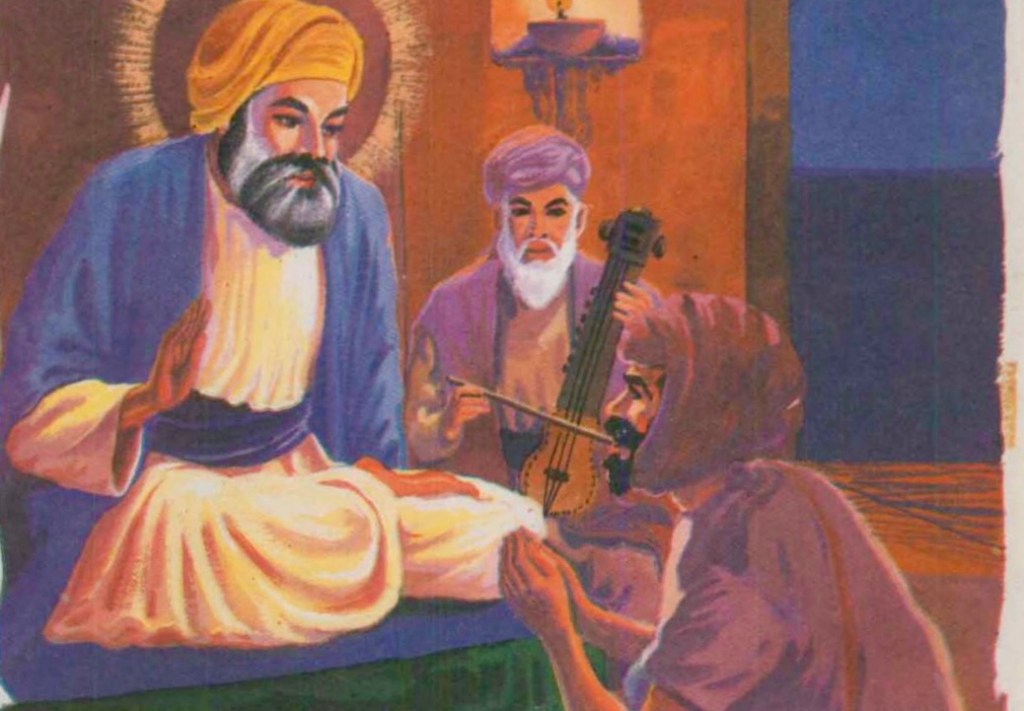
Story of Guru Nanak and Sajjan Thug: A Tale of Transformation
The Encounter:
During his travels spreading the divine message, Guru Nanak, accompanied by his companion Bhai Mardana, arrived at Tulamba (modern-day Pakistan). They stayed at an inn run by Sajjan, a man outwardly known for his hospitality but secretly a ruthless thug. Sajjan had built a reputation as a “friend” to travelers, but in reality, he murdered his guests to rob them and buried their bodies near the inn .
Guru Nanak’s Wisdom:
Recognizing Sajjan’s malicious intent, Guru Nanak chose a compassionate approach to reform him. After being offered comfort and rest, Guru Nanak sang a hymn (Shabad) with Bhai Mardana playing the rabab. The hymn conveyed that outward appearances or good deeds mean little if the heart is impure. It drew parallels between seemingly clean objects and corrupt actions, highlighting that true goodness arises from inner purity and righteous deeds .
Sajjan, deeply moved, saw the truth of his actions. The Shabad pierced his conscience, and he realized the harm he had inflicted on innocent travelers. He confessed to Guru Nanak, expressing regret for his deeds and pleading for guidance .
The Transformation:
Guru Nanak advised Sajjan to return his ill-gotten wealth to the needy and lead an honest life of service. Sajjan followed the Guru’s counsel, converted his inn into a place of genuine hospitality, and dedicated his life to helping others. Over time, he became a devout disciple and an example of sincere repentance and reform .
Lessons from the Story
1. The Power of Compassionate Communication:
Guru Nanak did not confront Sajjan with anger or judgment. Instead, he used spiritual wisdom to awaken Sajjan’s conscience. This demonstrates the importance of addressing wrongdoing with empathy to inspire transformation.
2. Inner Purity Over Outer Appearance:
The story emphasizes that true goodness stems from one’s intentions and actions, not outward shows of piety or generosity.
3. Repentance and Redemption:
Sajjan’s transformation illustrates that it is never too late to change. Sincere repentance can pave the way for a new, righteous life.
4. Guidance and Mentorship:
The role of a wise mentor, like Guru Nanak, is pivotal in helping individuals realize their potential for goodness and redirecting them towards a meaningful life.
5. Impact of Selfless Service:
Sajjan’s reformation into a man of service shows that helping others can be a path to inner peace and redemption.
This story of redemption remains a timeless example of how spiritual wisdom and compassion can transform even the darkest hearts into beacons of light.
Guchi.
 Improve Your Life