Guru Nanak’s Tale: Bhai Lalo and Malik Bhago
The story of Guru Nanak Dev Ji’s encounter with Bhai Lalo and Malik Bhago is a profound tale that illustrates the principles of honesty, humility, and justice.
The Story
During one of Guru Nanak’s journeys, he visited Saidpur (now Eminabad, Pakistan) and stayed with Bhai Lalo, a poor carpenter known for his honesty and humility. Bhai Lalo lived a simple life, earning his livelihood through hard work and serving others selflessly. Despite his modest means, he welcomed Guru Nanak with great warmth and offered him simple but lovingly prepared food. Guru Nanak blessed Bhai Lalo for his sincerity.
Meanwhile, Malik Bhago, a wealthy but arrogant landlord, invited Guru Nanak to a grand feast he was hosting. Malik Bhago was infamous for exploiting poor farmers and amassing wealth through corrupt means. Guru Nanak declined his invitation, preferring to dine with Bhai Lalo.
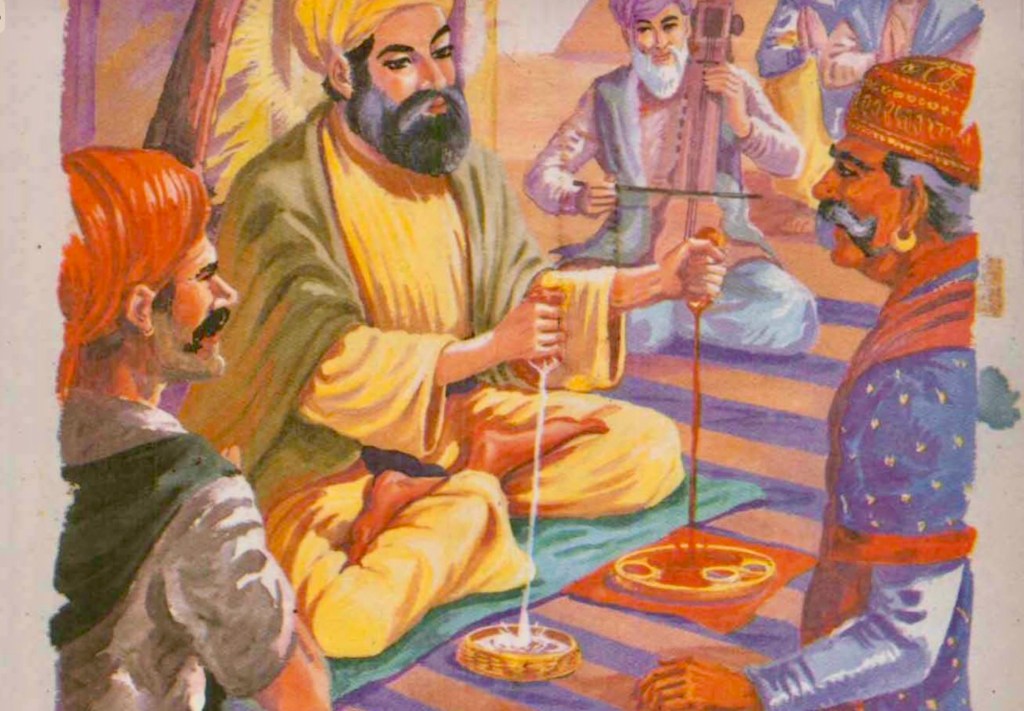
When Malik Bhago confronted Guru Nanak, questioning why he had refused his lavish feast, Guru Nanak took a profound approach to explain his decision. He asked for food from both Bhai Lalo and Malik Bhago. Holding Bhai Lalo’s simple food in one hand and Malik Bhago’s rich offerings in the other, Guru Nanak squeezed both. From Bhai Lalo’s food, milk flowed, symbolizing purity and honest labor, while Malik Bhago’s food oozed blood, signifying the suffering of those he had exploited.
Guru Nanak then said, “Malik Bhago, your wealth is stained with the blood of the poor. I cannot consume what is born out of greed and exploitation.”
Lessons from the Tale
1. Dignity of Labor
Guru Nanak emphasized the value of honest work (kirat karna). Bhai Lalo’s simple but honestly earned food was more respectable than Malik Bhago’s ill-gotten riches. This teaches us to respect all forms of labor and strive for fairness in our own pursuits.
2. Integrity Over Wealth
The story highlights that wealth gained through unfair means cannot bring true happiness or respect. Integrity and ethical conduct are far more valuable than material riches.
3. Equality and Humility
Guru Nanak’s choice to dine with Bhai Lalo reflects his belief in equality. He saw no difference between rich and poor, only between good and bad deeds. This underscores the need for humility and inclusivity in our relationships.
4. Social Responsibility
Malik Bhago’s wealth symbolized the exploitation of the less fortunate. Guru Nanak’s rejection of his feast serves as a reminder that we must be socially responsible, ensuring our actions uplift others rather than cause harm.
Applicability in Today’s Era
1. Corporate Responsibility
In a world where corporate greed often leads to exploitation, the tale reminds us of the importance of ethical practices and fair treatment of workers. Businesses should prioritize social responsibility over profit.
2. Respect for Honest Workers
With widening economic disparities, society must learn to value and support those who work hard but may not be materially affluent, like farmers, laborers, and small business owners.
3. Minimalism and Sustainability
Bhai Lalo’s simple life teaches us to embrace minimalism and sustainable living, focusing on what we truly need rather than indulging in excess.
4. Combatting Corruption
Just as Guru Nanak rejected Malik Bhago’s wealth, we too should reject corruption and unethical practices. Standing up for integrity and justice can lead to a more equitable society.
5. Spiritual Perspective on Wealth
In an age driven by materialism, Guru Nanak’s lesson reminds us that true richness lies in virtue and spirituality, not in possessions.
Conclusion
The story of Bhai Lalo and Malik Bhago is timeless. Guru Nanak’s teachings resonate deeply with the challenges of modern society, urging us to uphold honesty, humility, and equality. By integrating these values into our lives, we can create a world that thrives on fairness, compassion, and shared prosperity.
Guchi.
 Improve Your Life