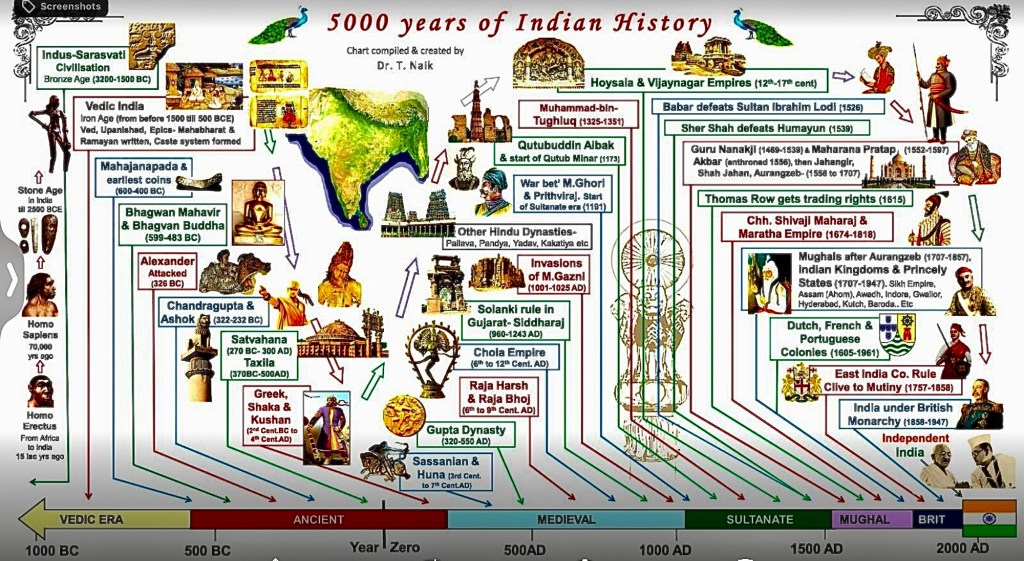
India is one of the world’s oldest and most continuous civilizations, tracing its roots back to the Indus-Sarasvati civilization around 3200 BC. Over the millennia, it has adapted and thrived through various epochs, from the early Vedic period to the rise of powerful empires and the challenges of foreign invasions. India’s uniqueness lies in its ability to absorb and integrate diverse cultural, religious, and philosophical influences. This is evident in its rich spiritual and intellectual heritage, including traditions like Hinduism, Buddhism, Jainism, and Sikhism.
Throughout history, great saints and reformers have left a profound mark on Indian society, guiding its evolution. Saints like Guru Nanak, Kabir, and Farid—spiritual figures from the Bhakti and Sufi movements—rejected rigid orthodoxy, caste-based discrimination, and religious divides, emphasizing the oneness of humanity and devotion to a higher truth. These movements, particularly the Bhakti movement during the 14th and 15th centuries, brought together people from all walks of life, transcending social and religious boundaries. Their teachings of love, unity, and devotion played a crucial role in shaping Indian spirituality and culture, continuing to resonate across centuries.
The Historical Timeline of India:
1. Ancient Period (3200 BC – 500 AD)
India’s history begins with the Indus-Sarasvati Civilization (3200-1500 BC), known for its advanced urban planning, architecture, and trade networks. This Bronze Age civilization laid the foundation for Indian culture, seen in the earliest forms of spirituality and communal organization.
The Vedic Era (1500-500 BC) followed, characterized by the composition of the Vedas, Upanishads, and epics like the Mahabharata and Ramayana. It was during this time that the caste system began to take root, shaping the social fabric of the subcontinent. The later Vedic period saw the rise of the Mahajanapadas (600-400 BC), early Indian republics that set the stage for future empires.
Spiritual leaders such as Bhagwan Mahavira (the founder of Jainism) and Bhagwan Buddha (the founder of Buddhism) emerged between the 6th and 5th centuries BC, advocating paths of renunciation, non-violence, and enlightenment. Their teachings spread widely across India and beyond, influencing not just spirituality but also governance and ethics.
India’s first major unification under a single ruler occurred with Chandragupta Maurya (322-298 BC), who founded the Maurya Empire after Alexander the Great’s invasion in 326 BC. His grandson, Ashoka the Great (273-232 BC), further expanded the empire and became a patron of Buddhism after the Kalinga war. Ashoka’s reign is remembered for promoting non-violence, social welfare, and religious tolerance, marking one of the most enlightened periods in Indian history.
After the decline of the Mauryas, the Satavahana dynasty (270 BC-300 AD) emerged in southern India, and the Gupta Dynasty (320-550 AD) in the north. The Gupta period is often regarded as the Golden Age of India, a time when arts, science, literature, and mathematics flourished. The famous mathematician Aryabhata and other scholars contributed to astronomy and the concept of zero.
2. Medieval Period (500 AD – 1500 AD)
The medieval period saw the rise of powerful Hindu kingdoms and the arrival of Islamic rule. In the south, the Chola Empire (6th-12th centuries) reached its zenith, renowned for its naval strength, temple architecture, and the flourishing of art and literature. Similarly, the Rajput kingdoms in the north demonstrated valor and military prowess, particularly during the early Islamic invasions.
Muhammad Ghori’s invasion in 1191 marked the beginning of the Sultanate period, with Qutubuddin Aibak establishing the Delhi Sultanate (1206 AD), which would rule large parts of India for over three centuries. During this era, other powerful Hindu dynasties like the Solanki, Yadava, Pallava, and Pandya coexisted, defending their territories against invading forces.
The 12th to 17th centuries witnessed the rise of the Hoysala and Vijayanagar Empires in South India, both known for their contributions to culture, arts, and religion. The famous temples of Hampi stand as a testament to the architectural achievements of this period.
Simultaneously, the Bhakti movement flourished during the 14th and 15th centuries, with saints like Kabir, Guru Nanak, Mirabai, Chaitanya Mahaprabhu, and Ravidas playing vital roles in shaping a syncretic spiritual tradition that transcended the confines of caste and creed.
3. The Mughal Period (1526 AD – 1707 AD)
The Mughal Empire began with Babar’s victory over Ibrahim Lodi at the Battle of Panipat in 1526. The empire reached its peak under Akbar the Great (1542-1605), who consolidated vast territories and fostered a policy of religious tolerance, incorporating Hindu, Sikh, and Islamic elements into his court. Jahangir, Shah Jahan, and Aurangzeb followed, with Shah Jahan known for building the magnificent Taj Mahal.
However, Aurangzeb’s expansionist policies alienated many of India’s regional powers, leading to rebellions, most notably by the Marathas and Rajputs.
4. The Rise of the Marathas, Sikh Empire, and Maharaja Ranjit Singh (1707 AD – 1857 AD)
As Mughal power waned after the death of Aurangzeb in 1707, the Maratha Empire, under the leadership of Chhatrapati Shivaji Maharaj, rose to prominence, establishing a powerful Hindu kingdom in western India. Shivaji’s military strategies and governance reforms laid the foundation for a powerful confederation that resisted Mughal dominance.
In the northwestern region of Punjab, the Sikh warrior Maharaja Ranjit Singh (1780-1839) established the Sikh Empire, a sovereign state that resisted British expansion. Known as the Lion of Punjab, Ranjit Singh unified the Sikh misls (clans) and created a modern army, protecting Punjab from foreign invasions. His secular rule, inclusivity of Hindus and Muslims in governance, and patronage of the arts stand as remarkable achievements of this period.
5. Colonial and Modern India (1857 AD – Present)
The decline of both the Maratha and Sikh Empires coincided with the rise of British power in India. Following the failed India’s First War of Independence (1857), India came under the direct rule of the British Crown in 1858. The exploitation of Indian resources and the suppression of its people during colonial rule spurred the Indian Independence Movement, led by figures like Mahatma Gandhi, Jawaharlal Nehru, and Subhas Chandra Bose.
India finally gained independence from British rule in 1947, marking the birth of the world’s largest democracy. The spiritual and cultural legacy of India continues to shape its identity, with the teachings of saints like Guru Nanak, Kabir, and others still resonating today.
Conclusion
India’s journey from the Indus-Sarasvati civilization to modern-day democracy is a testament to its resilience, adaptability, and profound cultural heritage. Despite periods of invasions and foreign rule, the spirit of India, embodied in its saints, warriors, and scholars, has persevered. Its 5000-year history of philosophical thought, spirituality, and innovation stands as a beacon of continuity in an ever-changing world.
(Compilation from various web resources)
Guchi.
 Improve Your Life