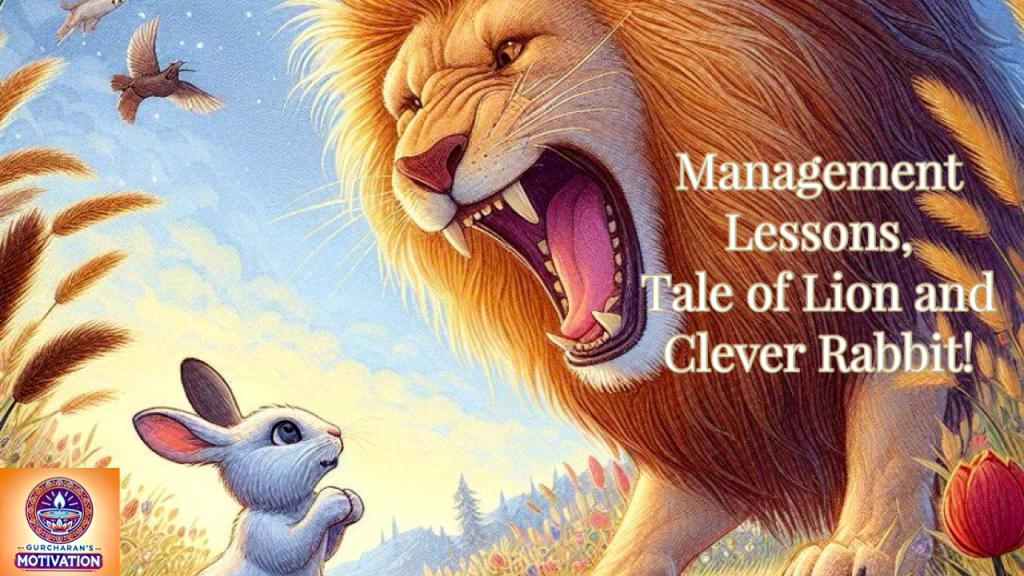
The Panchatantra tale of the *Lion and the Clever Rabbit* offers valuable management lessons, particularly in areas such as leadership, strategy, problem-solving, and resource management. The story revolves around a fierce lion that terrorizes the jungle, killing animals indiscriminately. To prevent further bloodshed, the animals propose sending one animal daily as food. The clever rabbit, upon being selected, tricks the lion into its own demise by luring it to a well, where the lion drowns after attacking its own reflection.
Here are the key management lessons derived from the tale:
1. Strategic Thinking and Planning
-**Lesson**: The rabbit’s approach to handling the lion showcases the importance of strategic thinking and planning.
– **Explanation**: The rabbit understands that a direct confrontation with the lion would lead to certain death, so it devises a strategy to defeat the lion without using force. In management, strategy is essential for tackling complex challenges, especially when direct solutions are not feasible. Effective leaders must think ahead, anticipate obstacles, and develop smart alternatives to solve problems.
2. **Leadership and Delegation**
– **Lesson**: The delegation of responsibility and trust in the rabbit reflects the importance of choosing the right leaders and trusting them to execute a plan.
– **Explanation**: The animals wisely delegate the task to the clever rabbit, recognizing its intelligence and strategic thinking. Similarly, in management, leadership involves identifying capable individuals within a team, empowering them with responsibility, and trusting their judgment. Good leaders recognize talents and delegate tasks accordingly, ensuring efficiency and success.
3. **Resource Management and Optimization**
– **Lesson**: The rabbit’s efficient use of limited resources (time and wit) underscores the importance of optimizing available resources in management.
– **Explanation**: With limited physical strength and only his wits as a resource, the rabbit manages to outsmart the lion. In business, managers often face resource constraints—be it budget, time, or workforce—and must find innovative ways to optimize those resources to achieve the best results.
4. **Deception in Competitive Strategy**
– **Lesson**: While ethical behavior is important, sometimes in competitive environments, a degree of strategic deception can be a necessary tactic.
– **Explanation**: The rabbit uses deception to trick the lion into attacking its own reflection in the well, leading to its downfall. In a competitive business environment, companies often need to employ creative and unconventional strategies to outmaneuver competitors. This doesn’t imply unethical behavior, but rather using strategic advantages in negotiation, market positioning, or timing.
5. **Problem-Solving and Innovation**
– **Lesson**: The rabbit’s innovative solution to the problem of the lion teaches the value of creative problem-solving in management.
– **Explanation**: The rabbit doesn’t just follow the status quo; it innovates a new way to solve the problem of the dangerous lion. Innovation and creative thinking are key to solving difficult problems in management, especially when standard solutions have been exhausted. Encouraging creative thinking within teams can lead to breakthrough solutions.
### 6. **Risk Management**
– **Lesson**: The rabbit takes calculated risks, teaching the importance of risk management in leadership.
– **Explanation**: Though the rabbit risks its life by approaching the lion, it has a well-thought-out plan that reduces the risk of failure. In management, leaders must take calculated risks, carefully weighing potential losses against potential gains, and developing contingency plans to mitigate risks.
7. **Communication and Influence**
– **Lesson**: The rabbit effectively communicates with the lion to influence its perception, demonstrating the power of effective communication in leadership.
– **Explanation**: The rabbit cleverly convinces the lion that another lion is challenging its dominance, manipulating the lion’s ego. Effective leaders and managers must be able to communicate clearly and persuasively, influencing others to achieve desired outcomes.
8. **Handling Conflict**
– **Lesson**: The rabbit resolves the conflict without physical confrontation, showing the value of peaceful conflict resolution.
– **Explanation**: Rather than directly confronting the lion, the rabbit uses its wit to avoid a deadly conflict. In management, it is important to handle disputes or challenges diplomatically, without escalating conflicts. Managers must seek win-win solutions that resolve issues without causing unnecessary harm or disruption.
9. **Maintaining Composure Under Pressure**
– **Lesson**: The rabbit maintains its composure in the face of danger, highlighting the importance of staying calm under pressure.
– **Explanation**: Despite the threat of being eaten, the rabbit keeps calm and executes its plan effectively. In leadership roles, managers often face high-pressure situations, and their ability to stay composed and think clearly can determine the success or failure of the entire team.
10. **Self-Confidence and Initiative**
– **Lesson**: The rabbit’s self-confidence and proactive nature teach the importance of self-belief and initiative in leadership.
– **Explanation**: The rabbit takes the initiative to solve the problem of the lion, believing in its own abilities. In management, confidence in one’s decisions and the ability to take initiative are critical qualities. Leaders who are proactive, rather than reactive, often steer their organizations toward success.
11. **Overcoming Fear with Intelligence**
– **Lesson**: The rabbit shows that fear can be overcome by using intelligence and creativity, a crucial aspect of leadership.
– **Explanation**: Rather than succumbing to fear, the rabbit uses its intelligence to outsmart the lion. In the business world, fear of competition, market downturns, or failure can paralyze managers. However, using intellect and strategic foresight, these fears can be managed and overcome.
Conclusion
The story of the *Lion and the Clever Rabbit* is a timeless tale that provides a wealth of management lessons. From strategic thinking to conflict resolution and from resource optimization to risk management, this tale underscores the importance of intelligence, foresight, and leadership in overcoming challenges. By applying these lessons in modern management, leaders can guide their teams and organizations through even the toughest challenges.
For watching it on YouTube please subscribe to my channel http://www.youtube.com/@guchiaul
Link for this article.
Lion and clever Rabit | Management Lessons
https://youtu.be/rXl8eGNElNo
Guchi.
 Improve Your Life