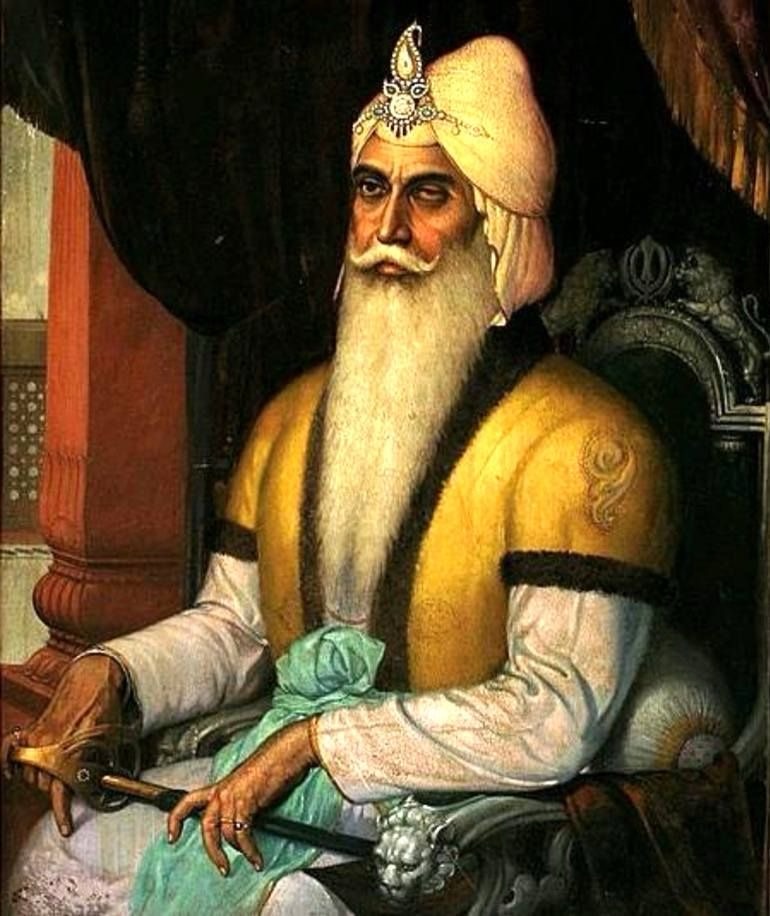
Maharaja Ranjit Singh, known as the “Lion of Punjab,” was a legendary ruler whose life was marked by military conquests, strategic governance, and the establishment of a powerful Sikh Empire. Born on November 13, 1780, in Gujranwala (now in Pakistan), Ranjit Singh was the son of Sardar Maha Singh, the leader of the Sukerchakia misl, one of the twelve independent Sikh states in Punjab. Despite being partially blinded by smallpox at a young age, Ranjit Singh rose to become one of India’s most formidable rulers.
Rise to Power.
Ranjit Singh ascended to leadership at the age of 12, following his father’s death in 1792. His early years were marked by a series of strategic alliances, conquests, and the unification of the various Sikh misls, which had previously functioned as independent and often conflicting entities. In 1799, Ranjit Singh captured Lahore, making it the capital of his growing empire. This victory was a significant milestone in his quest to consolidate power in Punjab.
Conquests and Expansion.
Ranjit Singh’s military campaigns were extensive and ambitious. He expanded his empire across Punjab, extending his rule to include regions such as Multan, Peshawar, Kashmir, and parts of modern-day Afghanistan. One of his most significant conquests was the annexation of Jammu and Kashmir in 1819. This victory over the Afghan Durrani Empire marked the first time that a non-Muslim ruler had controlled the region in over 600 years.
However, Ranjit Singh’s rule over Jammu and Kashmir was not without its challenges. The region was difficult to govern due to its rugged terrain and diverse population. Recognizing the need for capable leadership, Ranjit Singh appointed Gulab Singh Dogra, a trusted general, and member of the prominent Dogra family, as the Raja of Jammu in 1822. This appointment eventually led to the Dogra dynasty’s control over Jammu and Kashmir, which lasted until the partition of India in 1947.
In 1841, Ranjit Singh’s forces also launched a campaign into Tibet under the command of his general, Zorawar Singh. The campaign initially succeeded in capturing several Tibetan territories, including Ladakh. However, the harsh climate and challenging terrain eventually led to a Tibetan counterattack, and Zorawar Singh was killed in battle. Despite these setbacks, the campaign demonstrated the far-reaching ambitions of Ranjit Singh’s empire.
Rule and Governance.
Maharaja Ranjit Singh was a secular ruler who believed in the principles of justice and equality. His administration was known for its efficiency and progressive outlook. He promoted religious tolerance, earning the loyalty of not just Sikhs but also Hindus, Muslims, and Christians. His governance was marked by a strong emphasis on infrastructure development, including the construction of roads, canals, and forts, which contributed to the prosperity of his empire.
Ranjit Singh also modernized his army by incorporating European military techniques and technology. He employed European officers, such as Jean-François Allard and Paolo Avitabile, to train his troops, making the Sikh Khalsa Army one of the most formidable military forces in Asia at the time.
Personal Life.
Ranjit Singh’s personal life was as eventful as his military conquests. He was married multiple times, a common practice among rulers of the time for both personal and political reasons. His first wife, Mehtab Kaur, was the daughter of Sada Kaur, a powerful Sikh leader who played a crucial role in his early rise to power. His second wife, Maharani Datar Kaur (also known as Raj Kaur), was the mother of his heir, Kharak Singh.
Ranjit Singh had several children, but his family life was often marked by tragedy and political intrigue. His sons, particularly Kharak Singh, failed to live up to his expectations, and their inability to maintain the unity and strength of the empire after his death contributed to its decline.
Despite his numerous marriages, it was said that Ranjit Singh had a special fondness for his third wife, Maharani Jindan Kaur, who was the mother of his youngest son, Duleep Singh. Jindan Kaur played a significant role in Sikh politics after Ranjit Singh’s death, particularly in the defense of the Sikh Empire during the Anglo-Sikh Wars.
The Golden Age of the Sikh Empire.
The period of Ranjit Singh’s rule is often referred to as the “Golden Age” of the Sikh Empire. It was a time of peace, prosperity, and cultural flourishing. Ranjit Singh’s patronage of the arts, architecture, and education led to significant advancements in these fields. The renovation of the Harmandir Sahib (Golden Temple) in Amritsar, which he adorned with gold and marble, became a symbol of the empire’s wealth and spiritual significance.
Decline and Fall of the Empire.
The decline of the Sikh Empire began with the death of Maharaja Ranjit Singh on June 27, 1839. His passing left a power vacuum, leading to internal conflicts and succession struggles among his heirs. The lack of a strong leader and the growing influence of the British East India Company further weakened the empire.
The Anglo-Sikh Wars, fought between 1845 and 1849, ultimately led to the fall of the Sikh Empire. Despite the bravery of the Sikh soldiers, the empire could not withstand the might of the British forces. The Treaty of Lahore, signed in 1846, marked the beginning of British control over Punjab, and by 1849, the entire region was annexed by the British.
Legacy.
Maharaja Ranjit Singh’s legacy remains a powerful symbol of Sikh pride and Punjab’s rich history. He is remembered as a unifier, a just ruler, and a protector of his people. His contributions to the Sikh faith, particularly the protection and promotion of Sikh institutions, have made him a revered figure in Sikh history.
The empire he built, though eventually absorbed by the British, stands as a testament to his vision, leadership, and the indomitable spirit of the Sikh people. Even today, Maharaja Ranjit Singh is celebrated not just for his conquests, but for his role in shaping the cultural and political landscape of northern India. His life is a reminder that leadership is not just about power, but about the ability to inspire, unite, and uplift those who follow.
( Compiled from historical records and web resources)
Guchi.
 Improve Your Life