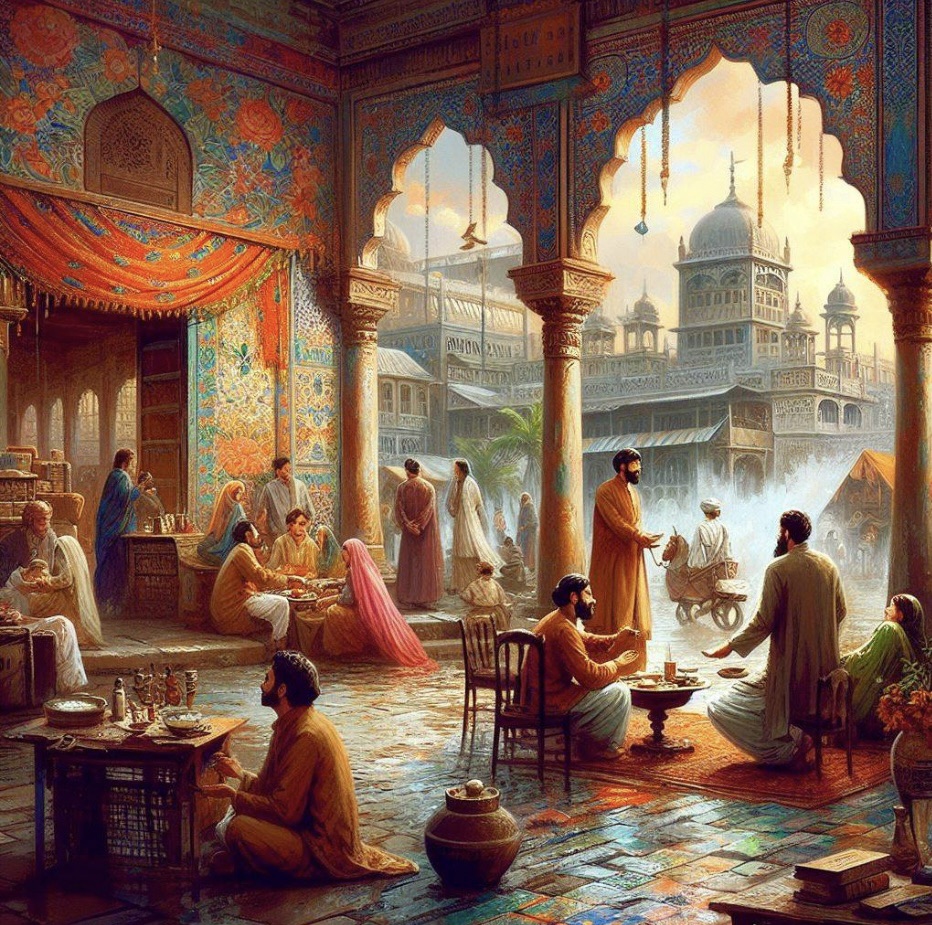
Those of us from old generation who have seen this movie still remember the grandeur of a bygone era in India with Mehfils (gatherings) reverberating with songs like, साकीआ आज मुझे नींद नहीं आएगी, सूना है तेरी महफ़िल में रत जगा है. Saaqiya aaj mujhe. Nind nahi aayegi. Suna hai teri mehfil mein rata jagaa hai.(Meaning that How can I sleep as the celebrations in your gatherings are still strong)!
“Sahib, Bibi aur Gulam” is a classic Indian film directed by Abrar Alvi, released in 1962 starring Guru Dutt, Meena Kumari and Rehman. Set in 19th-century Bengal during the British Raj, the movie explores the complex dynamics of feudalism and the decline of the feudal structure in India.
At its core, the central theme of “Sahib, Bibi aur Gulam” revolves around the struggle for power, identity, and social status within the feudal system. The story follows the lives of three main characters: Bhootnath, Jaba, and Chhote Sarkar, who represent different facets of this feudal society.
Bhootnath, a young and idealistic man from a humble background, arrives in Calcutta seeking employment. He finds work as a servant in the grand mansion of Chhote Sarkar, a wealthy landlord, and becomes fascinated by the opulent lifestyle of the feudal elite. However, as he becomes more entangled in the affairs of the household, Bhootnath begins to witness the dark underbelly of feudalism, including exploitation, decadence, and moral decay.
Jaba, Chhote Sarkar’s neglected wife, serves as a tragic figure trapped within the confines of patriarchal society. She longs for love and attention but is ignored and marginalized by her husband, who is more interested in drinking and socializing with his peers. Jaba’s desperation for affection leads her to seek solace in the company of Bhootnath, further complicating the power dynamics within the household.
Chhote Sarkar, the epitome of feudal authority, represents the entrenched feudal structure that is resistant to change. He embodies the decadence and corruption of the feudal elite, clinging to outdated traditions and social hierarchies despite the changing times. His refusal to adapt ultimately leads to his downfall, as his obsession with status and prestige blinds him to the crumbling foundation of his power.
Through the characters of Bhootnath, Jaba, and Chhote Sarkar, “Sahib, Bibi aur Gulam” explores the tensions between tradition and modernity, feudalism and democracy, and the individual’s quest for freedom and identity within a rigid social structure. The film serves as a poignant commentary on the decline of feudalism in India and the emergence of a new era marked by social upheaval and political change.
Though the feudal system has almost finished in India but its hangover can still be experienced in many parts of the country.
Guchi.
 Improve Your Life