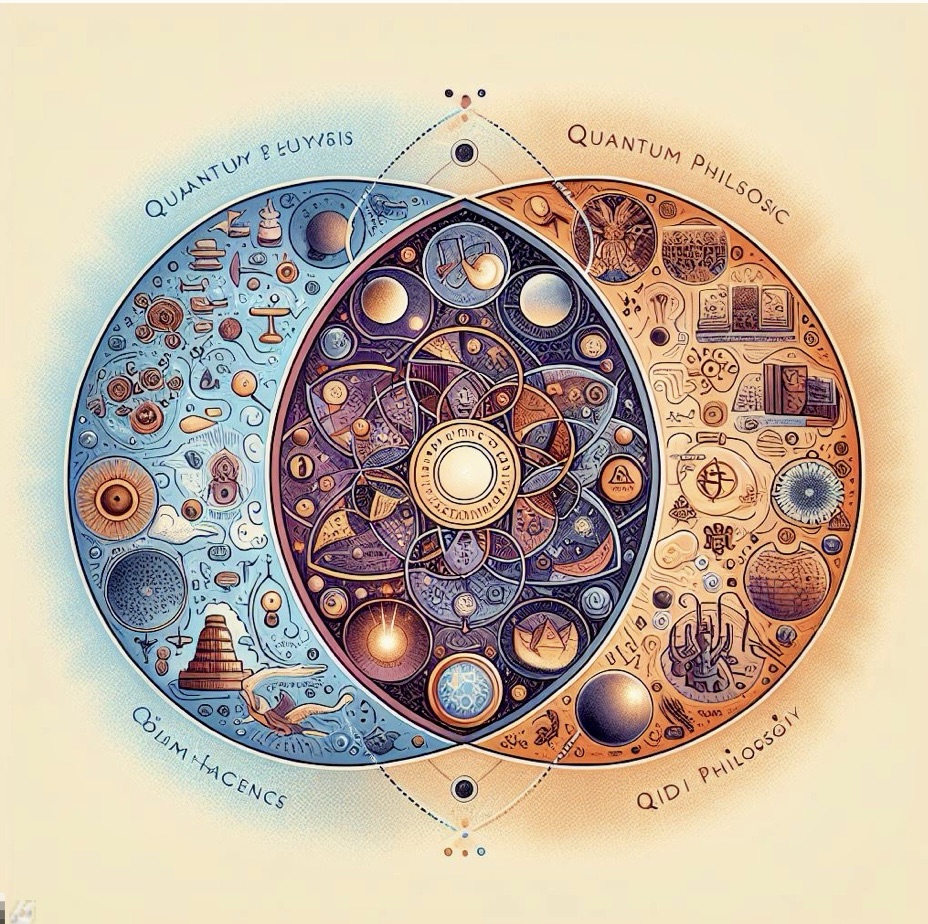
Drawing parallels between the teachings of the Vedas and quantum physics is an interesting exercise that has been explored by many scholars. Both realms delve into the nature of reality, albeit from different cultural and historical perspectives. Here are some parallels and examples:
1. Atom: In the Vedas, the concept of the atom (paramanu) is described as the smallest indivisible particle. Similarly, quantum physics explores the subatomic realm, where particles such as electrons, protons, and neutrons behave in ways that challenge classical notions of solidity and predictability.
2. Mass and Energy: The Vedas emphasize the interconnectedness of all things, stating that matter and energy are interchangeable (prana, the vital life force). This resonates with Einstein’s famous equation, E=mc², which demonstrates the equivalence of mass and energy.
3. Time: Vedantic philosophy discusses the concept of cyclical time (kala), where creation and destruction are part of an eternal cosmic rhythm. Quantum physics, particularly in theories like loop quantum gravity, suggests that time may not be linear but rather a product of complex interactions between matter and spacetime.
4. Soul: The Vedas explore the idea of the soul (atman) as an eternal, immutable essence that transcends individual existence. Similarly, some interpretations of quantum physics propose the existence of a universal consciousness or interconnectedness that underlies reality.
5. Maya (Illusion): In Vedic philosophy, Maya refers to the illusion of separateness and the transient nature of reality. Quantum physics challenges our conventional understanding of reality, suggesting that particles can exist in multiple states simultaneously (superposition) until observed, leading to the idea that our perception of reality may be illusory.
6. Attachment: Both Vedas and quantum physics emphasize the importance of detachment from worldly attachments. In Vedantic philosophy, attachment (raga) leads to suffering, while in quantum physics, attachment to specific outcomes can disrupt the probabilistic nature of quantum systems.
7. Creation and Destruction: The Vedas describe cycles of creation and destruction (srishti and pralaya) as fundamental aspects of existence. Similarly, quantum physics acknowledges the constant flux of particles and fields, where creation and annihilation processes occur continuously at the quantum level.
The influence of Vedic scriptures on modern quantum physics is primarily philosophical rather than direct. Some scholars argue that the conceptual frameworks found in Vedic texts, such as interconnectedness, complementarity, and the role of consciousness in shaping reality, resonate with certain interpretations of quantum mechanics. However, it’s essential to note that while there may be parallels and similarities, the two systems of thought arise from vastly different cultural, historical, and scientific contexts.
( Researched from web resources)
Guchi.
 Improve Your Life