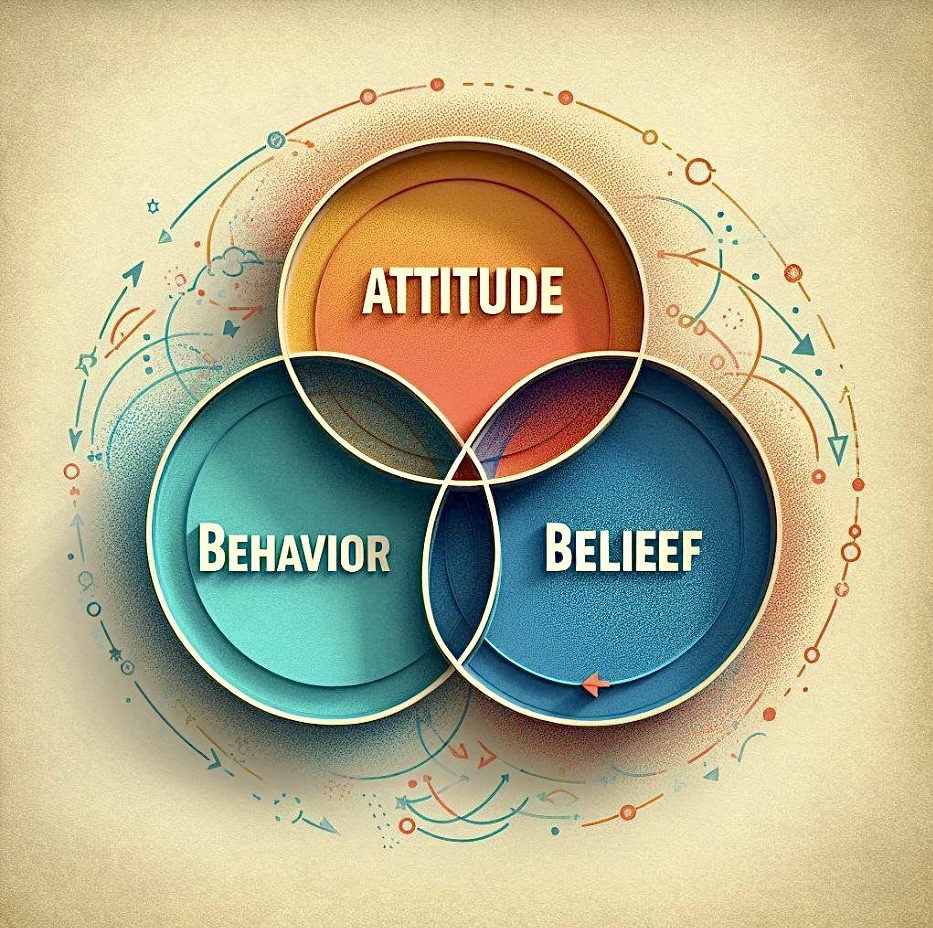
Attitude, behaviour, and belief—three fundamental aspects of human psychology that dictate how we perceive the world and interact with others. Yet, amidst the diversity of human personalities, we observe a striking contrast in individuals’ demeanor and disposition. Some radiate positivity, spreading joy and contentment wherever they go, while others exude negativity, selfishness, and irritability, leaving a trail of discord in their wake. What accounts for this stark divergence in behaviour? Is it a product of upbringing, belief systems, or inherent disposition? Let’s delve into this intriguing phenomenon and unravel its underlying dynamics.
Attitude:
Attitude serves as the cornerstone of our outlook on life, shaping our perceptions, responses, and interactions. A positive attitude infuses resilience, optimism, and a solution-oriented approach, enabling individuals to navigate challenges with grace and determination. Conversely, a negative attitude breeds pessimism, defeatism, and a victim mentality, impeding personal growth and hindering success.
Consider two individuals confronted with adversity in the workplace. The first, with a positive attitude, views setbacks as temporary hurdles to overcome, leveraging optimism and resourcefulness to chart a path forward. In contrast, the second individual, shackled by negativity, succumbs to despair and apathy, relinquishing agency and succumbing to defeat. Their attitudes color their responses, shaping the outcomes they manifest.
Behaviour.
Behaviour serves as the tangible manifestation of our attitudes and beliefs, dictating how we interact with others and navigate life’s complexities. Influenced by upbringing, culture, and personal experiences, our behavior reflects a complex interplay of internal and external factors.
Consider two friends attending a social gathering. The first, buoyed by an outgoing nature and a genuine interest in others, embraces social interactions with enthusiasm and warmth, fostering connections and forging bonds. In contrast, the second friend, burdened by social anxiety or introversion, retreats into the shadows, hesitant to engage and reluctant to partake in communal revelry. Their behaviours, shaped by temperament and disposition, dictate their social interactions and experiences.
Belief:
Belief constitutes the bedrock of our value systems, guiding our moral compass and informing our decisions and actions. Rooted in religious, cultural, or personal convictions, our beliefs shape our ethical framework and imbue life with meaning and purpose.
Consider two individuals faced with a moral dilemma. The first, guided by principles of integrity and honesty, upholds truthfulness as a non-negotiable virtue, even in the face of adversity. In contrast, the second individual, driven by self-interest and expediency, prioritizes personal gain over ethical considerations, compromising integrity for short-term benefits. Their beliefs, entrenched in their moral fiber, dictate the choices they make and the paths they traverse.
In conclusion, the interplay of attitude, behaviour, and belief constitutes the intricate tapestry of human psychology, weaving together to shape our perceptions, actions, and interactions. While upbringing, environment, and inherent disposition may influence our predispositions, we retain agency in cultivating a positive mindset, exhibiting constructive behavior, and nurturing empowering beliefs. By fostering self-awareness and embracing personal growth, we can harness the power of attitude, behavior, and belief to navigate life’s complexities with resilience, integrity, and purpose.
Guchi.
 Improve Your Life